[Asia Economy Reporter Yoo In-ho] On the 18th, Foreign Minister Park Jin will meet with Japanese Foreign Minister Hayashi Yoshimasa in Tokyo, Japan, to hold a Korea-Japan Foreign Ministers' Meeting and discuss bilateral issues including compensation for forced labor victims.
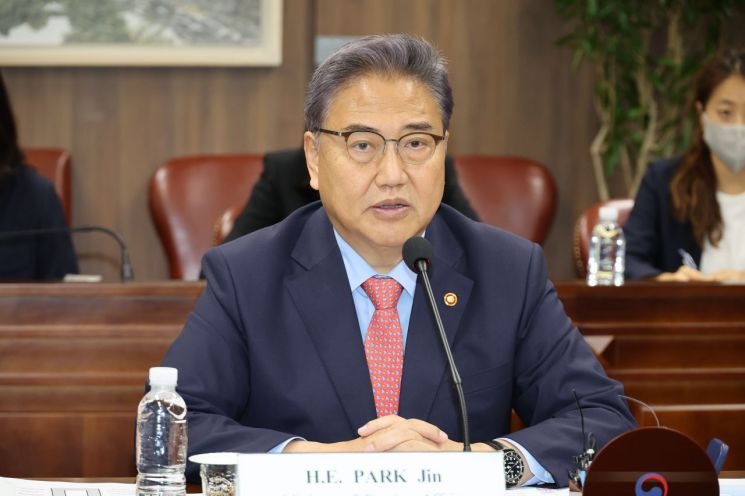
In this meeting, it is expected that the two ministers will only listen to each other's positions on the issue of compensation for forced labor victims, making it difficult to reach a related agreement.
According to the Ministry of Foreign Affairs on the 18th, Minister Park plans to visit Japan in the afternoon and hold the first Korea-Japan Foreign Ministers' Meeting since the launch of the Yoon Seok-yeol administration in Tokyo.
The core agenda of this meeting is expected to be the issue of compensation for forced labor victims during the Japanese colonial period.
The process of forcibly selling Japanese companies' assets in South Korea to pay compensation is being gradually promoted, and the Japanese government has opposed this series of measures, claiming they violate the 1965 Korea-Japan Claims Agreement. The Japanese government views the forced sale of its companies' assets as a red line for the restoration of Korea-Japan relations.
Japanese Prime Minister Kishida Fumio mentioned last month regarding Korea-Japan relations, "Promises between countries must be kept. This is fundamental. Without this, it is difficult to discuss anything further," and added, "It is important to seek progress on issues such as the former Korean laborers' problem (lawsuits by forced labor victims)."
Accordingly, Minister Park is expected to explain the government's efforts to find a solution to the compensation issue for forced labor victims and the victims' positions, and listen to the Japanese government's opinions during the meeting with Foreign Minister Hayashi.
The Ministry of Foreign Affairs has formed a public-private consultative body consisting of representatives of victim lawsuits, support groups, experts from academia, legal and economic sectors, and former diplomats, and has held two meetings.
However, no consensus has yet been reached in the public-private consultative body. The victims' side insists that the so-called 'subrogation' plan, where a fund is created by third parties such as companies from both Korea and Japan to pay compensation on behalf of the defendant companies, must include the participation and apology of the defendant companies.
Moreover, the Ilje Gangje Dongwon Citizen Group supporting plaintiffs such as Yang Geum-deok and Kim Seong-ju, who filed lawsuits against Mitsubishi Heavy Industries, and the lawsuit representatives do not participate in the public-private consultative body, making it difficult to have discussions encompassing all victims.
The Japanese government's basic stance is that this issue should be resolved by the Korean government, so it seems difficult for both sides to find common ground.
Meanwhile, the meeting is expected to discuss ways to expand bilateral private exchanges. Earlier this month, President Yoon met with a delegation from Japan's Keidanren in Seoul and emphasized the need to expand exchanges, stating, "Economic actors from both countries have cooperated as trusted partners, which has been a strong pillar supporting Korea-Japan relations."
There may be discussions on increasing the number of flights on the Gimpo-Haneda route, which resumed at the end of last month, or on resuming visa-free entry for citizens of both Korea and Japan for stays within 90 days.
However, due to the recent rapid spread of COVID-19 in both Korea and Japan, it seems difficult to immediately decide on resuming visa-free entry.
Additionally, discussions are expected on ways to strengthen trilateral cooperation among Korea, the U.S., and Japan on North Korea.
Attention is also focused on whether discussions on a Korea-Japan summit will take place. The Korea-Japan summit has not been held for over two and a half years since December 2019, when then-President Moon Jae-in and then-Prime Minister Abe Shinzo held a bilateral meeting on the sidelines of the China Chengdu trilateral summit.
Minister Park plans to stay in Japan for three days and two nights until the 20th and is coordinating to pay a courtesy call on Prime Minister Kishida. Considering the schedule, the meeting with Prime Minister Kishida is expected to take place on the 19th.
© The Asia Business Daily(www.asiae.co.kr). All rights reserved.

















