Impact of COFIX Increase... Expected to Rise Further Next Month
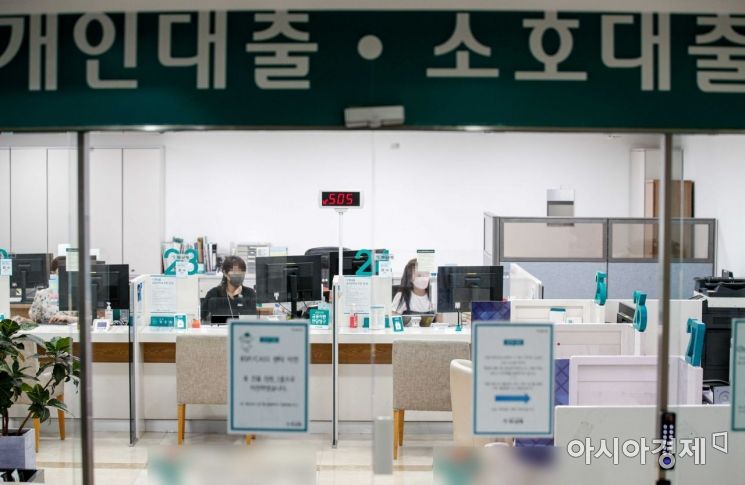 On the 7th, a scene at a bank counter in Seoul as major commercial banks continue to lower loan interest rates and raise interest rates on regular savings and installment savings products. Photo by Kang Jin-hyung aymsdream@
[Asia Economy Reporter Sim Nayoung] The upper limit of jeonse loan interest rates at major commercial banks has exceeded 6% for the first time in about 12 years. This is due to the recent rise in the base rate and market interest rates. According to the financial sector on the 17th, the jeonse loan interest rates (guaranteed by Korea Housing Finance Corporation, 2-year maturity) at KB Kookmin, Shinhan, Hana, and Woori Banks stood at 4.010?6.208% per annum as of the 16th.
Compared to last month on the 24th (3.950?5.771%), the lower limit rose by 0.420 percentage points (p) and the upper limit by 0.437 p within just 20 days. Compared to the end of last year (3.390?4.799%), the upper and lower limits increased by 0.620 p and 1.481 p respectively. The sharp rise in jeonse loan interest rates is due to the increase in COFIX.
The June COFIX announced on the 16th jumped by 0.40 p at once. Banks generally handle jeonse loans with variable interest rates, and the benchmark interest rate for these loans is COFIX. As a result, the rise in June COFIX was directly absorbed by the jeonse loan interest rates.
Next month poses an even bigger problem. The July COFIX, which will be applied from mid-next month, is expected to reflect the shock of the Bank of Korea’s big step (a 0.50 percentage point hike in the base rate at once) on the 13th. A commercial bank official said, "The 6% level of jeonse loan interest rates seems to be the first time since around 2010 when rates were at 5?6%. With COFIX suddenly rising sharply, the 3% level jeonse loan interest rates have almost disappeared."
Jeonse loans are generally executed based on guarantees from institutions such as Korea Housing Finance Corporation (HF), Housing and Urban Guarantee Corporation (HUG), and Seoul Guarantee Insurance (SGI), so their interest rates are usually about 0.5 percentage points lower than general mortgage loans. However, they have now become higher than mortgage loans. Currently, the upper limit of jeonse loan interest rates at the four major banks (6.208%) has surpassed the upper limit of fixed-rate mortgage loans (6.123%). It is only 0.01 percentage points lower than the upper limit of variable-rate mortgage loans (6.218%).
Another commercial bank official explained, "Overall, bank household loans are sluggish, but only jeonse loans are steadily increasing. Therefore, from the banks’ perspective, preferential measures such as interest rate cuts to stimulate demand are likely to focus more on general mortgage loans than on jeonse loans. Hence, it is estimated that the interest rate gap between mortgage loans and jeonse loans is narrowing."
Meanwhile, according to Bank of Korea statistics, as of the end of June this year, other loans (such as unsecured loans) at deposit banks decreased by 1.2 trillion won, while jeonse loans increased by 900 billion won.
© The Asia Business Daily(www.asiae.co.kr). All rights reserved.
![Clutching a Stolen Dior Bag, Saying "I Hate Being Poor but Real"... The Grotesque Con of a "Human Knockoff" [Slate]](https://cwcontent.asiae.co.kr/asiaresize/183/2026021902243444107_1771435474.jpg)















