Centaurus Confirmed Without Overseas Travel
Concerns Over Community Transmission
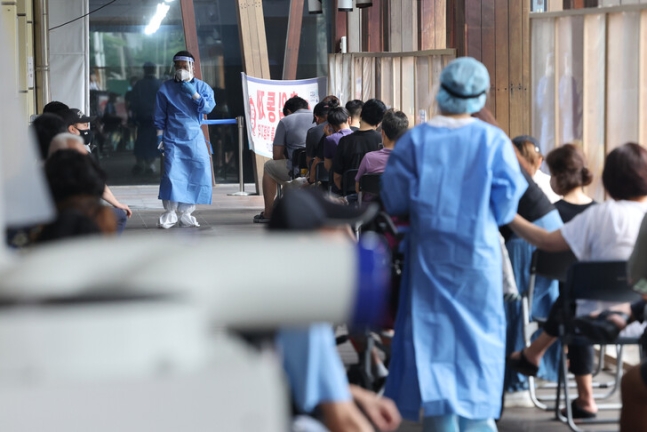 On the morning of the 14th, when the number of new COVID-19 cases reached 39,196, the screening clinic at Songpa-gu Public Health Center in Seoul was crowded with citizens seeking testing. [Image source=Yonhap News]
[Asia Economy Reporter Han Seung-gon] "I’m definitely very anxious.", "If COVID spreads again this time, is it really the end?"
Concerns are rising that the scale of the COVID-19 resurgence could grow larger as the first domestic case of the 'BA.2.75' (Centaurus) variant has been confirmed in South Korea. Centaurus is known to be the most transmissible among the COVID-19 virus variants identified so far.
The Korea Disease Control and Prevention Agency (KDCA) Central Disease Control Headquarters announced on the 14th that the BA.2.75 variant was confirmed for the first time in the country. The confirmed case is a person in their 60s residing in Incheon. Symptoms appeared on the 8th, and the individual tested positive for COVID-19 on the 11th.
Since there was no history of overseas travel during the infectious period, the possibility that the virus has already spread within the local community cannot be ruled out. The confirmed case is currently experiencing mild symptoms and is undergoing home treatment. So far, no additional confirmed cases have been identified among one cohabitant and three community contacts.
Centaurus, another subvariant of BA.2, was first discovered in India on May 26. Since then, 119 cases have been reported across 10 countries including India (90 cases), the United Kingdom (11 cases), the United States (5 cases), Canada (4 cases), Indonesia (3 cases), New Zealand (2 cases), Australia (1 case), Japan (1 case), Nepal (1 case), and Turkey (1 case). Experts named this variant 'Centaurus' after the half-human, half-beast creature from Greek mythology, indicating that this variant is different from previous ones.
As a result, voices mixed with anxiety are emerging, fearing a major resurgence of COVID-19. Kim, a company employee in his 40s who has experienced COVID-19 infection, said, "Having caught it once, it was tough for me, but I feel like I caused a lot of harm to my family and those around me." He added, "If it spreads again, it will be really difficult this time. Is this really the end?"
Concerns are also voiced among self-employed individuals. Choi, a small business owner in his 30s, said, "Business was very difficult due to COVID, and I barely managed to recover sales and get back on my feet, but if COVID spreads again this time, I’m just going to close the business." Kim, a self-employed restaurant owner in his 50s in Euljiro, Jung-gu, Seoul, sighed, saying, "With rising ingredient costs and inflation, if COVID overlaps again, I simply won’t have the strength to endure."
 An analysis suggests that the Kentauros variant appears to spread faster than other variants.
 [Image source=Yonhap News]
The main reason for the public’s anxiety is Centaurus’s transmissibility. Lipi Tukral, a scientist at the Council of Scientific and Industrial Research - Institute of Genomics and Integrative Biology (CSIR-IGIB) in India, analyzed that this variant has been confirmed in several regions far apart within India and appears to spread faster than other variants.
According to research from the University of Arkansas in the United States, the spread rate of Centaurus in India over the past three months is 3.24 times that of BA.5. Matthew Vinniker, head of clinical virology at the Mayo Clinic, a U.S. medical center, expressed concern, saying, "It is still too early to draw conclusions," but added, "The transmission rate in India seems to be increasing exponentially."
Eric Topol, director of the Scripps Research Institute in the U.S., analyzed BA.2.75, stating, "It has eight more mutations than BA.5, many of which are located on the N-terminal of the spike protein, which could mean it has greater immune evasion than what we are currently seeing."
Due to these characteristics, on the 7th (local time), the World Health Organization (WHO) classified BA.2.75 as a 'variant of concern lineage.' This means it is a variant with strong transmissibility or high fatality rate that could impact public health.
Meanwhile, the KDCA explained, "We are conducting follow-up testing for 14 days from the last exposure of contacts and are conducting an in-depth investigation into the infection route." They added, "Given the predicted increase in transmissibility and immune evasion potential of the BA.2.75 variant, we will strengthen surveillance of domestic cases and imported cases and continue close monitoring of domestic occurrence trends."
© The Asia Business Daily(www.asiae.co.kr). All rights reserved.
![Clutching a Stolen Dior Bag, Saying "I Hate Being Poor but Real"... The Grotesque Con of a "Human Knockoff" [Slate]](https://cwcontent.asiae.co.kr/asiaresize/183/2026021902243444107_1771435474.jpg)
















