Road Alignment Change Project from Traditional T-Intersection to Curved T-Intersection at Gwanghwamun Intersection
Road Alignment Changed Only without Lane Number and Signal System Changes from Government Seoul Office to Dongsipjagak
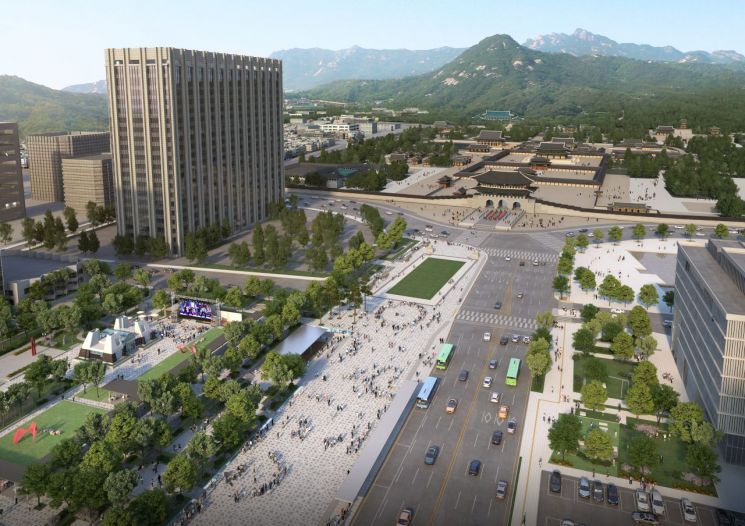
[Asia Economy Reporter Lim Cheol-young] Following the opening of Gwanghwamun Square, the Seoul Metropolitan Government is collaborating with the Cultural Heritage Administration to restore the Gwanghwamun Woldae. The restoration of the Woldae is planned to begin with an excavation survey in August and be completed by December next year.
On the 17th, Seoul announced that it will officially commence the preliminary work for the Woldae restoration, the Sajik-ro road alignment construction, starting in July. The Sajik-ro road alignment project involves changing the intersection in front of Gwanghwamun from a T-shaped to a curved T-shaped intersection. The project period started in February this year and will continue until October, with road paving work involving traffic control scheduled to begin in July.
This project is a preliminary step for the restoration of the Gwanghwamun Woldae. After this main construction, Seoul and the Cultural Heritage Administration plan to restore the Gwanghwamun Woldae, which measures 50 meters in length and 30 meters in width. The Woldae is a wide platform placed in front of palaces or buildings, serving as a space where kings and the people communicated during the Joseon Dynasty. Currently, part of the Gwanghwamun Woldae is buried beneath the road in front of Gwanghwamun, and road diversion work must precede excavation.
The Sajik-ro alignment change project is planned to minimize driver confusion by changing only the alignment without altering the existing number of lanes or traffic signal systems. However, considering the safety of vehicles navigating the curved section of the Woldae area, the speed limit will be lowered from 50 km/h to 40 km/h. The Sajik-ro alignment change project began construction on the plaza section (north side) in February this year, and currently, road repaving and sidewalk construction are about to commence.
Accordingly, Seoul urged drivers using Sajik-ro to use alternative roads instead of the Gwanghwamun intersection during the construction period and to reduce speed and drive safely. Yeo Jang-kwon, Director of the Seoul Metropolitan Government’s Balanced Development Headquarters, said, “The road diversion work for the complete restoration of the Gyeongbokgung Gwanghwamun Woldae has officially begun. Through the full recovery of the Gwanghwamun area, which was distorted and altered during the Japanese colonial period and the economic development era, we aim to enhance its identity as a communication space connecting the past and the future and establish it as a representative space of the Republic of Korea.”
© The Asia Business Daily(www.asiae.co.kr). All rights reserved.
![Clutching a Stolen Dior Bag, Saying "I Hate Being Poor but Real"... The Grotesque Con of a "Human Knockoff" [Slate]](https://cwcontent.asiae.co.kr/asiaresize/183/2026021902243444107_1771435474.jpg)















