During Sequential BA.5-BA.2.75 Waves, Two Recurrent Surges Expected
Simultaneous Waves Could Exceed Record 620,000 Cases

[Asia Economy Reporter Jo In-kyung] The so-called 'Centaurus (BA.2.75),' known to be more transmissible than previous COVID-19 variants, has been confirmed for the first time in South Korea. Experts warn that its presence alongside the rapidly spreading BA.5 variant could further worsen the current epidemic situation.
Experts predict that if both variants spread simultaneously, the daily number of confirmed cases could surpass the record high of 620,000 cases recorded on March 17. However, health authorities maintain that since BA.2.75 has not yet shown a clear trend of rapid spread, no immediate additional measures are necessary.
According to the Korea Disease Control and Prevention Agency on the 16th, patient A, who developed suspected COVID-19 symptoms on the 8th and was confirmed positive on the 11th, was found to be infected with BA.2.75 and is currently undergoing home treatment without any unusual symptoms. Among A’s cohabitants and three individuals who had contact before symptom onset, no additional confirmed cases have been reported.
Experts consider the fact that patient A has no history of overseas travel and an unclear infection route as a strong indication that BA.2.75 may already be spreading within the local community. Recently, the detection rate of the Omicron subvariant BA.5 in South Korea has risen to 35%, with projections that it will soon become the dominant strain. The emergence of another potent variant, BA.2.75, adds a new variable. Consequently, concerns are growing that the two variants could cause two separate waves of outbreaks with a time lag or simultaneously spread, thereby increasing the overall scale of the epidemic.
BA.2.75 is reported to be 3 to 9 times more transmissible than BA.5, although this figure is not yet fully reliable. Currently, reputable international organizations such as the World Health Organization (WHO) are analyzing the characteristics of BA.2.75, including its fatality rate and virulence. The European Centre for Disease Prevention and Control (ECDC) has also begun detailed monitoring of this variant.
Professor Eom Jung-sik of the Department of Infectious Diseases at Gachon University Gil Medical Center said, "The fact that the first confirmed BA.2.75 case in South Korea has no overseas travel history means that this variant has already entered the country. It is highly likely that the variant with stronger transmissibility, whether BA.5 or BA.2.75, will become the dominant strain."
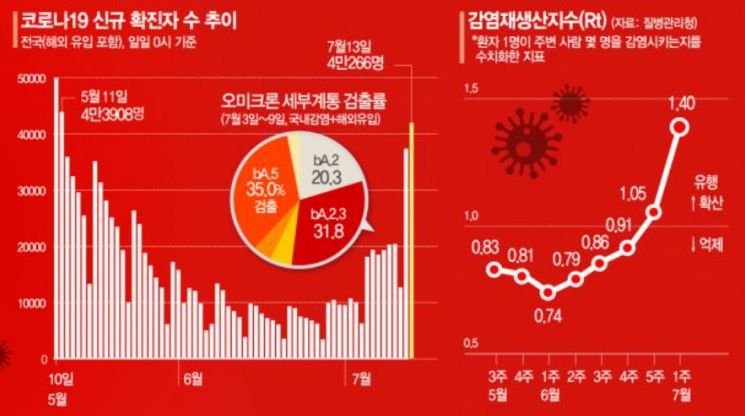
Experts, including those at the National Institute for Mathematical Sciences, initially predicted that with BA.5 becoming the dominant strain exceeding a 50% detection rate, the daily maximum number of confirmed cases in mid-August could reach between 250,000 and 290,000. With the addition of BA.2.75, the theoretical number of cases could more than double, surpassing the previous record high.
Jung Ki-seok, Chair of the National Infectious Disease Crisis Response Advisory Committee and Professor of Respiratory Medicine at Hallym University Sacred Heart Hospital, stated, "If BA.2.75 shows high transmissibility following BA.5, it is possible to exceed the previous domestic record of 620,000 new daily cases."
However, health authorities have stated that they are not currently considering additional quarantine measures related to the BA.2.75 variant.
Son Young-rae, Head of the Social Strategy Division at the Central Disaster and Safety Countermeasures Headquarters, said at a briefing on the 15th, "There is a possibility that the BA.2.75 variant will spread mainly within local communities. We will monitor whether this variant gains a dominant position in terms of prevalence, but we do not see an immediate need to change our response measures."
He added, "If the prevalence expands, we will comprehensively assess the situation by evaluating not only transmissibility but also fatality and severity rates observed abroad. If a variant with significantly increased fatality or severity rates becomes dominant, we will actively consider strengthening entry restrictions."
© The Asia Business Daily(www.asiae.co.kr). All rights reserved.
![Clutching a Stolen Dior Bag, Saying "I Hate Being Poor but Real"... The Grotesque Con of a "Human Knockoff" [Slate]](https://cwcontent.asiae.co.kr/asiaresize/183/2026021902243444107_1771435474.jpg)

















