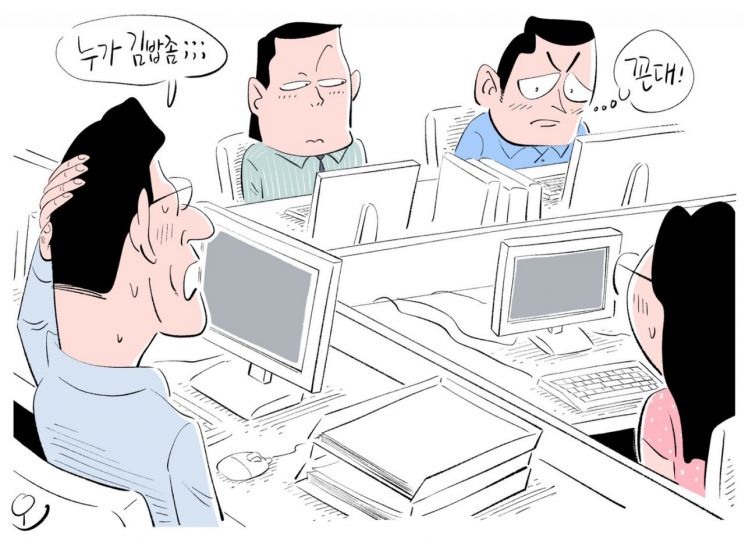
[Asia Economy Reporter Kim Jong-hwa] On Monday morning during the commute, a brief moment of laughter blooms inside Company A's elevator. This happened because a middle-aged man greeted Public Relations Manager B with "Gimbap Chaseok, are you coming to work?" Everyone laughed, but Manager B himself could not hide his bitterness. While the colleague's greeting was close to a form of consolation, most of those laughing might not understand the full context and could mock him as a 'kkondae' (old-fashioned authoritarian).
Manager B's nickname became 'Gimbap Chaseok' after a junior employee from the PR department appeared on a recently aired TV program and referred to him as the 'Chaseok who was sent on a gimbap errand.'
The junior employees, Mr. C (born in 1993) and Assistant Manager D (born in 1987), both from the MZ generation (Millennials + Generation Z), appeared on a program hosted by psychiatrist Dr. Oh Eun-young. They represented the perspectives of MZ generation workers and those caught between the old and new generations in the workplace, respectively.
On the show, Mr. C mentioned an incident from a few months ago when Assistant Manager D took 40 minutes to buy gimbap, saying, "If the person below is asked, they have to do it again," expressing a negative view of the gimbap errand. In response, Assistant Manager D explained, "Chaseok sent me a personal KakaoTalk message asking, and if I didn't go, the youngest employee would have to, so I went." However, other participants joked that he was a 'deputy who does unpleasant tasks to flatter his boss.' D protested again, saying, "What's wrong with doing a gimbap errand?" but Mr. C maintained his negative stance, saying, "If you do it once, you have to do it two or three more times."
The broadcast candidly expressed some aspects of workplace life as seen by the MZ generation. Mr. C said, "I don't check KakaoTalk chat rooms on holidays," and another participant argued, "The start of work hours is not when you arrive at the office but from the time you prepare to leave home."
Although Mr. C, a PR department employee, was criticized within the company for not reporting to Manager B or the team leader while appearing on the show, he stated, "The recording was done on a holiday, and since it was a holiday activity, I had no obligation to report to the company." After the broadcast aired, Manager B told Mr. C, "Not reporting was clearly a mistake," but confessed, "I'm not sure if he sincerely acknowledges that it was wrong."
The reporter asked Manager B why he sent Mr. C on the gimbap errand. Manager B reflected, "That day, the team leader was busier than usual, so I asked if he had eaten breakfast, and he said he didn't even have time to eat. It was a mistake to hastily send someone on a gimbap errand." Normally, he would have gone himself, but due to work with the team leader, he asked Assistant Manager D, which appeared 'kkondae-like' to other employees.
In the end, Manager B was publicly labeled a 'kkondae' through the broadcast, and the department atmosphere worsened compared to before. Manager B said, "When giving instructions to employees, I now pay more attention to the relevance of the tasks. I try to handle things myself whenever possible," but also confessed, "Even if I get called a kkondae, I have to assign work. I hope employees focus more on their essential duties."
In your workplace, what level would Manager B be? Unlike the broadcast, in some companies, he might be considered 'excellent,' while in others, he could be the 'worst' person to avoid.
On that day's broadcast, Dr. Oh Eun-young advised, "A company is a place to work, not to socialize. However, cooperation and collaboration are very important to perform well. We need to take time and gradually make changes."
Professor Lee Byung-hoon of Chung-Ang University's Department of Sociology emphasized, "As generational change is rapidly occurring in the workplace, communication between the older and newer generations is a very important issue. More opportunities for dialogue and communication are needed, but these should not be resolved through traditional hierarchical methods like company dinners. Detailed communication programs by rank and position should be developed and implemented."
© The Asia Business Daily(www.asiae.co.kr). All rights reserved.
![Clutching a Stolen Dior Bag, Saying "I Hate Being Poor but Real"... The Grotesque Con of a "Human Knockoff" [Slate]](https://cwcontent.asiae.co.kr/asiaresize/183/2026021902243444107_1771435474.jpg)















