Writer and Lawyer Jeong Ji-woo
Decided to Become a Writer in 8th Grade
Debuted in 2012 but Income Fluctuated
New Challenge: Balancing Law School Studies and Parenting
Lawyer Career Provides Great Inspiration for Writing
Wife and Son's 'Current Memories' Most Important
New Book "To the World That Says I'm Living Wrong" Offers Attitude to Endure Reality
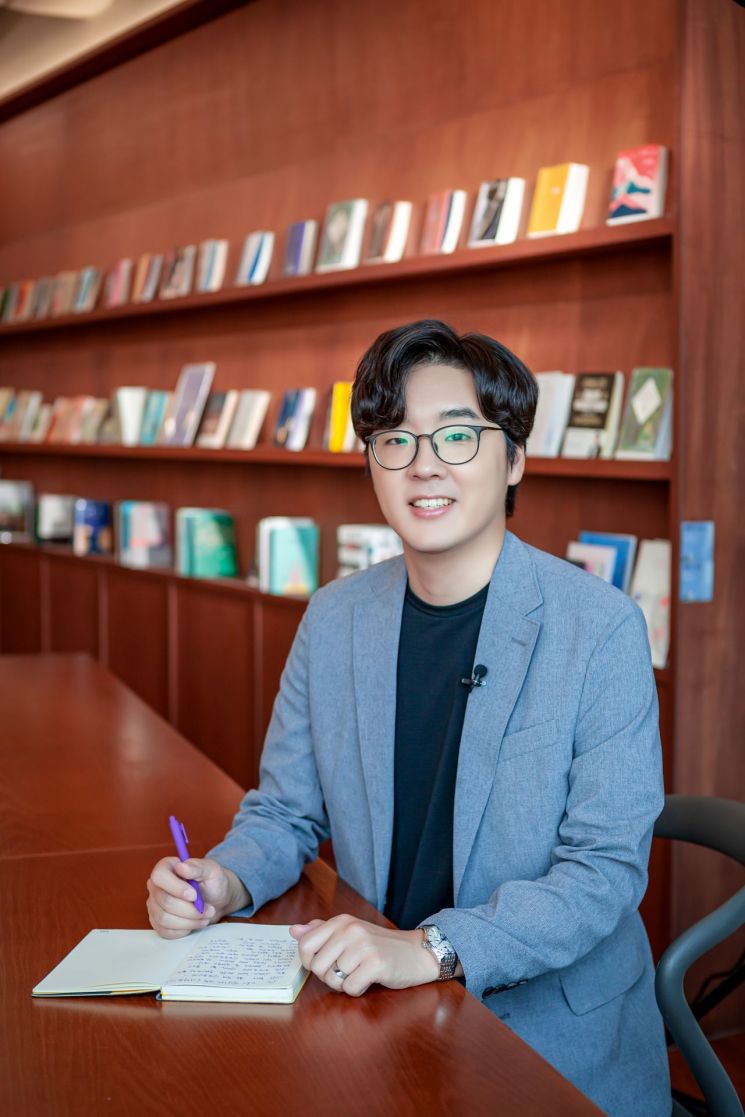
[Asia Economy Reporter Seo Mideum] "As far as I know, there are hardly any full-time writers."
This is what lawyer Jeong Ji-woo (36, photo), author of To the World That Says I’m Living Wrong (Hankyoreh Publishing), said. He dreamed of becoming a writer since he was young. His exact memory is the day after the final exam of the second year of middle school. "I started writing a novel because the story of the game ‘Farland Tactics 2’ lingered in my mind."
He realized his dream of debuting as a writer in 2012, but becoming a full-time writer who could live off royalties was like a dream. He tried to support his family through lectures and contributions, but there were limits.
In the process of finding a stable way to live with his wife and son, his choice was to become a legal professional. Of course, it was not an easy choice and was a continuous tough challenge.
However, he succeeded in entering law school and became a lawyer last year. Based on that experience, he published his sixteenth book, To the World That Says I’m Living Wrong. We asked lawyer Jeong about his thoughts on publishing the book and his views as a writer. The following is a Q&A.
- You must have had many options, so why did you choose to become a lawyer?
▲ As a writer, my income was very irregular, so life was very unstable. I considered various options. I thought about working for a publishing company and becoming a professional lecturer. But none of those really appealed to me. At that time, my younger sister, who was attending law school, recommended it. She said there was a lot of writing involved and thought it would suit me well. I thought it would be fortunate if I didn’t run out of the money I had saved, but thanks to scholarships and such, the financial burden was reduced, and I was able to finish well.
- Still, it must have been a difficult challenge.
▲ I had a child right after getting married. I studied while holding my newborn. I read books in between making baby food and giving baths. Not because I was especially family-oriented, but because I had to do it that way to protect my family (laughs).
- I heard you achieved good grades while balancing study and childcare.
▲ In the first year of law school, I was almost at the bottom of the class. It was natural since I was studying for exams again after 10 years. Actually, writing humanities books requires critical reading and derivative thinking, but you can’t creatively interpret legal provisions (laughs). So I thought of writing and organizing notes for each subject. I made notes for all subjects. But I lacked the physical time to memorize them. So I chose to record them. I listened to the recordings during childcare and while commuting. Later, I could even listen at several times the speed. By the third year, I rose to the top ranks.
- You are a lawyer who is also a writer. Life must have changed significantly from when you were a full-time writer.
▲ I struggled to adapt to commuting. Before, I lived freely without being bound by time, so it was inevitable. Weekends felt new. The transition from weekend to early week felt like dimensional travel. Weekends became incredibly precious. With time constraints, writing also changed. Before, I planned and wrote entire books over several months. But since becoming a lawyer, I haven’t written a single book that way. I gathered writings done during breaks, after work, on the subway, and while making baby food, and published them as books. All books since Happiness Is There. Without a Doubt (2019) have been like that.
- There must be pros and cons to holding dual roles.
▲ I have studied humanities and written since I was twenty, but at some point, I felt frustrated. It seemed like I was covering the same content repeatedly and couldn’t break out of a certain framework. After publishing Time Leaning on Classics (2017), I really had nothing more to write. I needed an escape. But after becoming a lawyer, I learned many unknown aspects. I started to see a world I hadn’t seen before by acquiring knowledge about dynamic social issues like cryptocurrency-related fraud cases, entertainment copyright cases, and non-fungible tokens (NFTs). As a writer, I am receiving a lot of inspiration.
- Come to think of it, these days, books written by people with jobs about their own fields are gaining much attention.
▲ Writing is no longer a privilege. In the past, only certain people could write publicly, but now anyone can be a writer. Many people have their own interesting stories. The writing of someone who only studied books in a closed room can actually be less interesting.
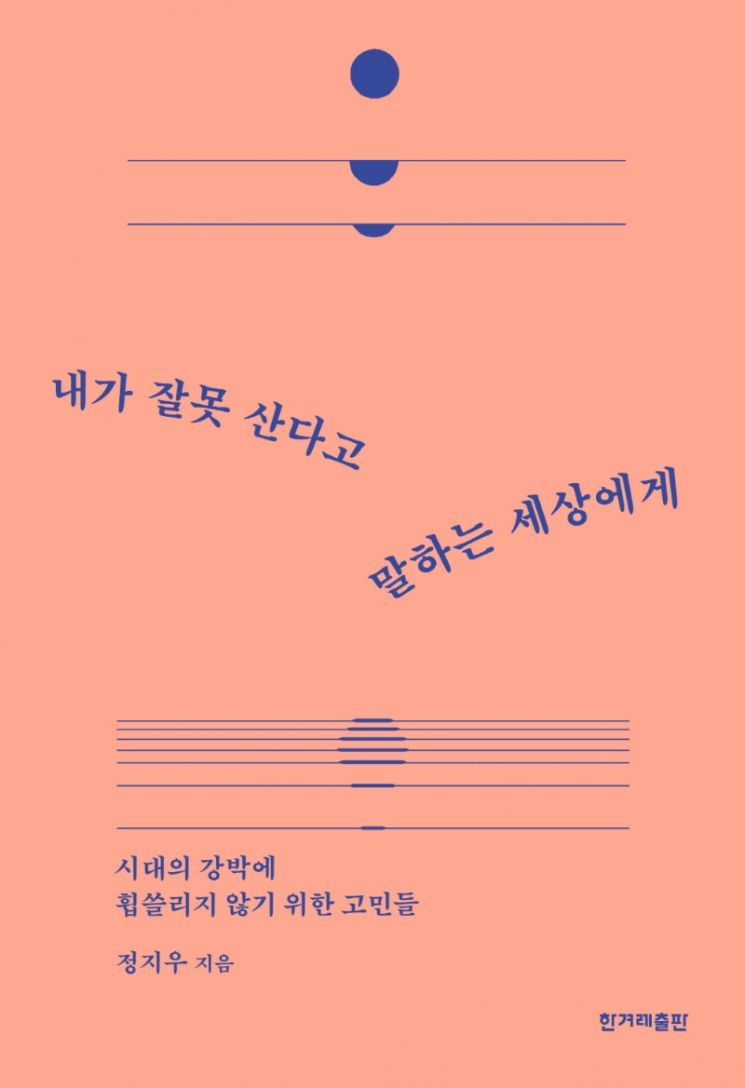
- What was the motivation and environment behind the publication of To the World That Says I’m Living Wrong?
▲ I tend to write on various topics. Parenting, married life, literary and cultural criticism, youth issues?I write about whatever I want at the time. But if I write daily for about a year, the writings accumulate by category. Among them, the social critical perspective was covered in There Is No Despair on Instagram (2020), and this book can be seen as its sequel. I tried to include an attitude that allows one to live well and endure in such situations while being critical. I thought it was time for an essay collection that contains the attitude needed to navigate today’s problematic society.
- I heard you came up with the title yourself.
▲ One night, it suddenly came to me. The more I pondered it, the more it seemed to penetrate the content. Thinking back, I always felt pressured. The feeling that I was living wrong. That’s why I published my first book under a pen name. Even those around me didn’t really know I had published a book, and I didn’t do lectures or interviews. If a person in their twenties wrote a book like Angry Society (2014), they might have been criticized. I wanted to hide anonymously and be regarded like a professor in their thirties or forties. I didn’t even tell people around me about entering law school. I was also worried about others’ views if I failed the bar exam.
- Maybe that’s why you expressed concerns about the culture of harsh criticism in the book.
▲ In the self-development market, harsh criticism emphasizing choice and will, saying "You shouldn’t live like that," is trending. There are many YouTube contents that categorically say things like "Don’t get married," "Don’t have children," "That job is doomed." Such clarity can be attractive, but I think there is no easy answer in life. What is the worst for someone can be the best for another. The temptation of "If you do only this, your life can change" is ruining our society and life. Harsh criticism has become a kind of faith.
- I was impressed by your emphasis on the ‘compatibility of sensitivity’ in human relationships.
▲ The tolerance for preferences has increased considerably. It means recognizing what others like. Conversely, people have become strict about things that make them uncomfortable, to the point of labeling them as evil. Some treat bosses who suggest company dinners as old-fashioned and evil. Conversely, bosses label those who avoid dinners as evil for lacking community spirit. If someone makes me uncomfortable, they are the devil. I think it is important not to hastily label others as evil. Humans are imperfect beings. If you expect others to be perfect, relationships cannot be maintained. That’s why the compatibility of sensitivity is important.
- In the book, you focused on the importance of ‘the now’ through your child. Are you satisfied with your current life?
▲ Becoming a salaried employee with a fixed income definitely has meaning. But the more important influence, ‘the now,’ has continued since marriage and the birth of my child. Honestly, I didn’t know what I wanted in the past. Whether I wanted freedom, recognition, money, or to write a masterpiece. But since having a child, my standards have become clear. Maintaining the family well. Everything else is secondary. Above all, the ‘memories of the now’ that the three of us build are important.
- Can we expect works based on your experiences as a lawyer in the future?
▲ I think so. I want to write books about the experiences I have as a lawyer. Another thing is that I want to play a meaningful role for people who crave writing. Now, I don’t have much desire to publish books myself. Rather, I want to help others publish books. Recently, I supervised and published a report interview collection of people who took my writing classes. Discovering writers feels meaningful.
© The Asia Business Daily(www.asiae.co.kr). All rights reserved.


















