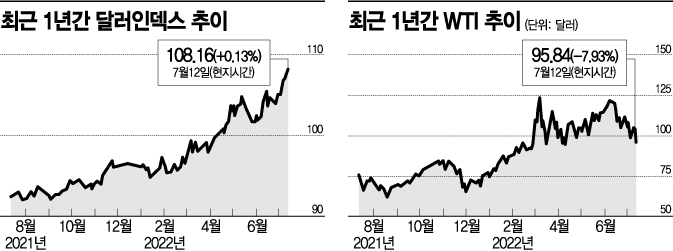
[Asia Economy New York=Special Correspondent Joselgina] The so-called ‘R (recession) fear’ is once again shaking the global financial markets. International oil prices have fallen below $100 per barrel, and as investors flock to safe-haven assets, the value of the US dollar has soared to its highest level since 2002. Considering that central banks around the world, including the Federal Reserve (Fed), have entered the early stages of a tightening cycle, concerns are pouring in that the depth of the recession could be deeper than expected.
◇Sharp Drop in Oil Prices, Strong Dollar, Inversion of Long- and Short-term Interest Rates
On the 12th (local time) at the New York Mercantile Exchange (NYMEX), August delivery West Texas Intermediate (WTI) crude oil closed at $95.84 per barrel, down 7.93%. This is the lowest closing price since April. The September Brent crude oil contract on the London ICE Futures Exchange also closed at $99.49 per barrel, the lowest in the past three months.
Despite Russia’s ongoing invasion of Ukraine, the sharp drop in oil prices indicates the magnitude of recession fears. The US New York stock market also closed lower across the board as concerns over slowing corporate earnings and recession grew ahead of the June Consumer Price Index (CPI) announcement.
The Dollar Index, which measures the value of the US dollar against the currencies of six major countries, recorded 108.16. It briefly surged to 108.56 during the session, marking the highest level since October 2002. As money flowed into the safe-haven dollar, the Dollar Index has risen about 13% so far this year. Due to the strong dollar, the euro’s value plummeted. On this day, the dollar and euro entered parity for the first time in 20 years, with ‘1 dollar = 1 euro’.
Peter Cardillo, Chief Economist at Spartan Capital, analyzed, “The dollar is strong due to recession fears,” adding, “The appearance of a ‘super dollar’ despite falling US Treasury yields indicates that the global economy is heading toward a recession.”
The ongoing inversion of long- and short-term interest rates, considered a precursor to recession, is also fueling market concerns. In the New York bond market, the yield on the US 10-year Treasury note fell to around 2.97%. This decline indicates increased demand for safe-haven government bonds, pushing bond prices higher. However, the 2-year Treasury yield remained at around 3.04%, widening the spread between long- and short-term Treasury yields. The phenomenon where long-term yields, which carry greater uncertainty due to longer maturities, fall below short-term yields is interpreted as a strong signal that economic activity is likely to slow down.
◇Fed’s Tightening Forecast, Focus on Inflation Indicators
The market continues to be cautious about the possibility of a recession resulting from the Fed’s aggressive tightening.
According to a survey released by Magnify Money on the same day, 7 out of 10 Americans already believe a recession is approaching. Additionally, 88% of respondents cited high inflation as the biggest warning sign of a recession.
Thomas Barkin, President of the Richmond Federal Reserve Bank, also diagnosed, “Consumption is being affected by inflation,” and “Signs of economic slowdown are also appearing.” John Madziyal of Vanguard warned, “Although the recession probabilities presented vary, it is clear that consumer and business sentiment are deteriorating.”
The key is the US CPI to be announced on the 13th. The market currently expects the June CPI to rise 8.8% year-over-year, surpassing the 8.6% increase in May. European investment banks UBS and Deutsche Bank have even suggested the possibility of a 9% increase. In that case, the Fed’s aggressive tightening stance is expected to gain further momentum. Experts also see a high likelihood that the long- and short-term Treasury yield inversion, regarded as a precursor to recession, will deepen in conjunction with the Fed’s tightening.
With the corporate earnings season starting this week, market uncertainty appears to be intensifying. If the cost burden from inflation and consumption slowdown become visible in corporate earnings, concerns about recession will inevitably grow stronger. The National Federation of Independent Business (NFIB) small business optimism index for June fell to 89.5, marking the lowest level since January 2013. The proportion of small business owners expecting better economic conditions in the next six months also hit the lowest point in 48 years.
© The Asia Business Daily(www.asiae.co.kr). All rights reserved.
![Clutching a Stolen Dior Bag, Saying "I Hate Being Poor but Real"... The Grotesque Con of a "Human Knockoff" [Slate]](https://cwcontent.asiae.co.kr/asiaresize/183/2026021902243444107_1771435474.jpg)















