"The Biggest Advantage is Convenience... Collaboration with Famous Restaurants Too"
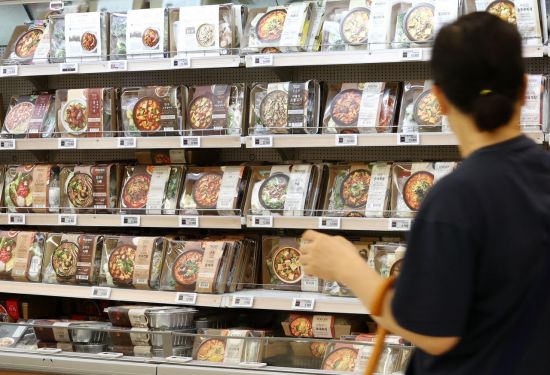 Demand for meal kits is increasing due to rising dining-out prices. The photo shows a meal kit display at a large supermarket in Seoul on the 15th of last month.
 [Image source=Yonhap News]
[Asia Economy Reporter Park Hyun-joo] The popularity of meal kits continues unabated. Due to soaring dining-out prices, consumers feeling the financial burden are favoring more affordable meal kits.
The biggest advantage of meal kits is convenience. They consist of pre-prepared ingredients and seasonings, allowing consumers to cook specific dishes immediately. Even those inexperienced in cooking or busy consumers can easily prepare a meal, leading to high demand especially among single- and two-person households. Meal kits gained particular attention as an alternative to dining out during social distancing measures.
A, a single-person household, recently stopped ordering delivery food and now often relies on meal kits for meals. He said, "Every time I paid delivery fees, I thought 'the tail is bigger than the belly.' Nowadays, delivery fees start at around 3,000 won. Usually, meal kits come in two servings, but if I portion the ingredients properly, I can cook one serving at a time, and I like that I can add or remove ingredients depending on my preferences."
Collaborations with famous local restaurants and dining brands are also a key to meal kits' popularity. B, an office worker, said, "You can try noodles featured in the Michelin Guide or pasta from restaurants run by famous chefs as meal kits. Those places are expensive and hard to book, and while the taste may not be exactly the same as eating there, it's nice to enjoy them comfortably at home." The Michelin Guide is a gourmet guidebook selected through strict evaluations and is also called the bible of gastronomy.
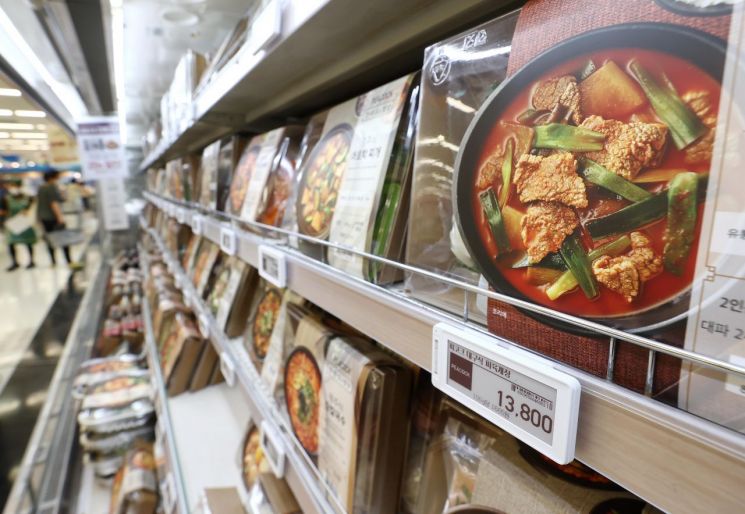 The domestic meal kit market continues to experience rapid growth. The photo shows a meal kit display at a large supermarket in Seoul. [Image source=Yonhap News]
Despite expectations that meal kit sales would sharply decline after social distancing measures were lifted, their popularity continues. Fresh Easy's meal kit sales from January to May increased by 20% compared to the same period last year, and HY (formerly Korea Yakult) recorded about 50,000 meal kit sales in May, an 18.6% increase from the previous month.
The industry expects the growth trend of meal kits to continue for the time being. As dining-out prices soar, more consumers are expected to purchase cost-effective meal kits. According to market research firm Euromonitor's data on the 6th, the domestic meal kit market size was estimated at 101.7 billion won in 2019 before the COVID-19 outbreak, growing to 188.2 billion won in 2020 and 258.7 billion won last year. It is expected to continue growing at an average annual rate of 31% until 2025, reaching 725.3 billion won.
Meanwhile, the consumer price inflation rate surged to the 6% range for the first time in about 24 years since the foreign exchange crisis, and dining-out prices rose by 8.0%. As a result, food expenses have also increased. According to an analysis of microdata from Statistics Korea, the average monthly food expenditure (groceries + dining out) for a four-person household in the first quarter of this year was 1,066,902 won, a 9.7% increase from 972,286 won a year earlier.
© The Asia Business Daily(www.asiae.co.kr). All rights reserved.


















