If Pedestrians Are Seen, 'Stop First' Enforcement Starts from the 12th
'Pedestrians Trying to Cross?' "Standards Are Ambiguous," Complaints Arise
"The Key to 'Right Turn Method' Is Pedestrian Confirmation"
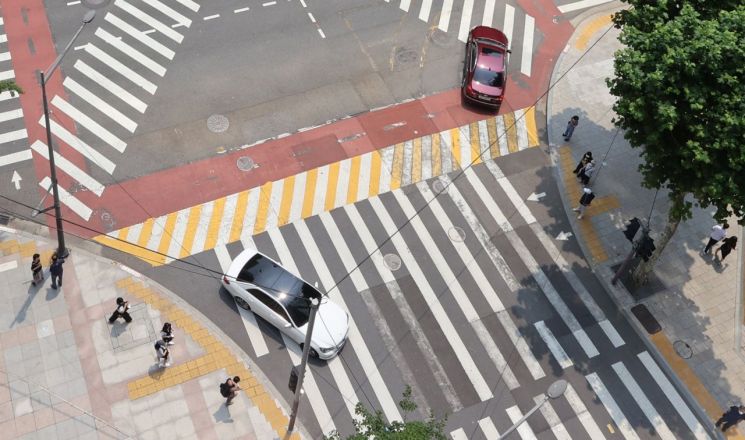 Vehicles are making right turns at an intersection in Jongno-gu, Seoul, two days before the enforcement of the Road Traffic Act amendment on the 10th.
 [Image source=Yonhap News]
[Asia Economy Reporter Kang Joo-hee] Starting from the 12th, an amendment to the Road Traffic Act expanding the obligation to stop temporarily before crosswalks will be enforced. However, there is considerable confusion among drivers regarding the 'right-turn method.' Critics point out that the standard requiring drivers to watch not only pedestrians crossing but also those 'intending to cross' the crosswalk is ambiguous.
The amendment to the Road Traffic Act, effective from the 12th, notably strengthens the obligation to protect pedestrians. The requirement to stop temporarily before a crosswalk now applies not only when pedestrians are 'crossing' but also when they are 'about to cross.' Accordingly, drivers must stop when making a right turn if pedestrians are crossing the crosswalk or if there are pedestrians intending to cross, even if no one is currently on the crosswalk.
When making a right turn, if the traffic signal ahead is green and there are no pedestrians, drivers may proceed slowly and stop if necessary. If the traffic signal ahead is red, drivers must stop unconditionally, and if no pedestrians are present at that time, they may turn right slowly. However, if an accident occurs during this process, the right-turning vehicle will be held responsible for violating the signal.
Additionally, in school zones where crosswalks do not have traffic signals installed, drivers must stop temporarily regardless of the presence of pedestrians. Violating this rule results in a fine of 60,000 KRW (for passenger cars) and 10 penalty points.
Nevertheless, many drivers remain confused about the strengthened Road Traffic Act. The standard to watch for pedestrians 'intending to cross' the crosswalk is unclear. Lee (29), an office worker who commutes by private car, said, "Sometimes people just stand near the crosswalk without crossing. It's not clear whether I should stop or go in such cases. Even if I stop first, the cars behind me might honk, thinking 'I could go.'
Another citizen in their 30s, Seo, said, "There are many crosswalks near large marts and shopping malls without pedestrian signals. Pedestrians constantly pass through these areas, but cars cannot wait forever. I understand the law's intention to protect pedestrians, but it seems to overlook the various situations that occur on the road while driving, which is unfortunate."
However, many drivers sympathize with the need to strengthen the temporary stop regulation despite the inconvenience. A citizen with four years of driving experience said, "The degree of inconvenience varies depending on driving style, but stopping when there are pedestrians at a crosswalk is natural. Right-turn accidents happen too frequently and are dangerous, so even before the law was enforced, I avoided turning right when people were on the crosswalk. I believe that if you drive with the mindset of 'I could also be a pedestrian,' you will gradually get used to it."
Professor Yoo Jung-hoon of Ajou University's Department of Traffic Systems Engineering said, "In principle, the signal system is a simple rule: you should not go when the pedestrian signal is green, and you can proceed when it is red. This amendment to the Road Traffic Act moves slightly further in adhering to that principle." However, he added, "In Korea, as the number of cars rapidly increased in the past, the signal system has been perceived differently from global standards. There are too many unnecessary traffic lights, such as having to stop at a red light even when no pedestrians are present. Because of this, there is little awareness about ignoring traffic lights. If unnecessary traffic lights are reduced and a traffic culture where drivers must stop unconditionally at stop signs, like in other countries, is established, confusion can be reduced."
© The Asia Business Daily(www.asiae.co.kr). All rights reserved.
![Clutching a Stolen Dior Bag, Saying "I Hate Being Poor but Real"... The Grotesque Con of a "Human Knockoff" [Slate]](https://cwcontent.asiae.co.kr/asiaresize/183/2026021902243444107_1771435474.jpg)















