Court: "There must be a claim for money to punish for the crime of evading compulsory execution"
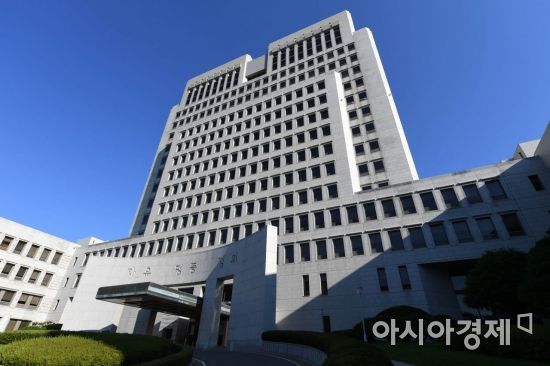
[Asia Economy Reporter Heo Kyung-jun] The Supreme Court has ruled that the crime of "obstruction of compulsory execution" cannot be applied to a union chairman who withdrew union funds under provisional seizure in cash. The court emphasized that in order to recognize the charge of embezzling money to avoid compulsory execution, it must first be examined whether there is a claim to demand that money.
The Supreme Court's 2nd Division (Presiding Justice Min Yoo-sook) announced on the 11th that it overturned the original verdict sentencing Mr. A (85), the chairman of the housing redevelopment maintenance project union, to imprisonment on charges of obstruction of compulsory execution, and remanded the case to the Busan District Court.
Since around 2013, Mr. A had ignored demands from the construction company for an additional construction cost of over 6.1 billion won, and in June 2014, the construction company filed a lawsuit for payment of construction costs and applied for provisional seizure on the union's bank deposits. Mr. A was prosecuted on charges of withdrawing the entire 3.4 billion won of union funds from the bank in cash to avoid compulsory execution of the deposits.
The first trial court stated, "Since the lawsuit between the union and the construction company regarding this construction is ongoing, it is unclear whether the construction company has actually suffered economic losses. There is no evidence to consider that Mr. A privately misappropriated the withdrawn funds," and sentenced him to 10 months in prison with a 2-year probation.
The second trial court upheld the first trial's judgment, stating, "Mr. A's act of withdrawing union funds constitutes concealment as described in the crime of obstruction of compulsory execution, regardless of whether the construction company suffered damages as a result."
However, the Supreme Court's judgment differed. It held that there must be a claim for money that the developer demands from the union in order to punish for obstruction of compulsory execution. The Criminal Act stipulates that a person who conceals, damages, falsely transfers property, or incurs false debts to harm creditors for the purpose of avoiding compulsory execution shall be punished by imprisonment of up to three years or a fine of up to 10 million won.
The Supreme Court stated that the crime of obstruction of compulsory execution is intended to protect the rights of creditors, so a claim must exist, but the court did not examine whether the construction company had a claim.
In the first trial of the civil lawsuit filed by the construction company against the union in 2014, most of the additional construction cost claims were recognized, and the construction company won. However, the second trial ruled against the construction company, citing reasons such as the absence of an agreement between the construction company and the union regarding additional construction costs. The construction company appealed but withdrew the lawsuit in May.
The Supreme Court concluded that since the construction company currently lost the civil lawsuit and no claim exists, it is difficult to hold the obstruction of compulsory execution charge.
© The Asia Business Daily(www.asiae.co.kr). All rights reserved.
![Clutching a Stolen Dior Bag, Saying "I Hate Being Poor but Real"... The Grotesque Con of a "Human Knockoff" [Slate]](https://cwcontent.asiae.co.kr/asiaresize/183/2026021902243444107_1771435474.jpg)
















