Up to 20cm long... Devouring plants indiscriminately
Reappearing in the main area less than a year after a 10-year eradication effort
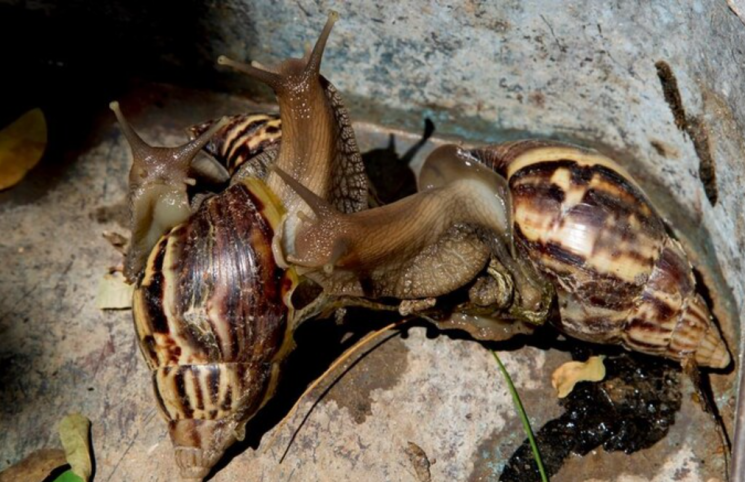 African Giant Snail. Florida authorities have urged people to report immediately upon discovering the snail. [Image source=Yonhap News]
[Asia Economy Intern Reporter Kim Nayeon] In the state of Florida, USA, the invasive African giant snail has invaded the area again less than a year after being eradicated.
These snails are known to consume over 500 species of plants and even chew on houses.
According to media outlets including CBS in the US on the 7th (local time), Nikki Fried, Florida's Agriculture Commissioner, announced that over 1,000 snails have been captured from the 29th of last month until this day as part of the eradication efforts.
Florida agricultural authorities received a report from a gardener on the 23rd of last month about sightings of the snails in Pasco County, after which they issued a quarantine order in the area and began snail control measures.
Under the quarantine order, moving plants, soil, debris, or construction materials outside the designated area is prohibited unless carried by a person.
This snail belongs to the Achatinidae family and can grow up to 25 cm in shell length and 38 cm in body length. Its average lifespan is 5 to 6 years, but it can survive up to 9 to 10 years.
According to the Florida Department of Agriculture's website, this snail species can consume at least 500 types of plants, classifying it as a harmful animal that damages agriculture and natural reserves.
Moreover, a single snail can lay thousands of eggs at once when it reaches four months old, making its reproductive capacity high. Although it moves slowly, it can quickly infiltrate areas by attaching itself to vehicles or machinery.
Besides plants, it also consumes building finishing materials such as plaster and paint to supplement calcium. It can also transmit parasites that cause meningitis in humans.
Florida has a history of eradicating this snail twice before. It was first discovered in 1969 and eradicated by 1975, but reappeared in 2011, with eradication efforts completed last year. The second eradication took 10 years and cost $23 million (approximately 30 billion KRW), capturing 170,000 snails.
Since it takes several years to completely eradicate the snails once they reproduce and spread, this time is also expected to take a considerable amount of time.
Florida authorities have urged residents to report any sightings of the snails.
© The Asia Business Daily(www.asiae.co.kr). All rights reserved.
![Clutching a Stolen Dior Bag, Saying "I Hate Being Poor but Real"... The Grotesque Con of a "Human Knockoff" [Slate]](https://cwcontent.asiae.co.kr/asiaresize/183/2026021902243444107_1771435474.jpg)















