'50,000 Electronics' Urged to Strengthen Shareholder Return Policy
Limits of Memory Business Sensitive to Market Conditions Highlighted
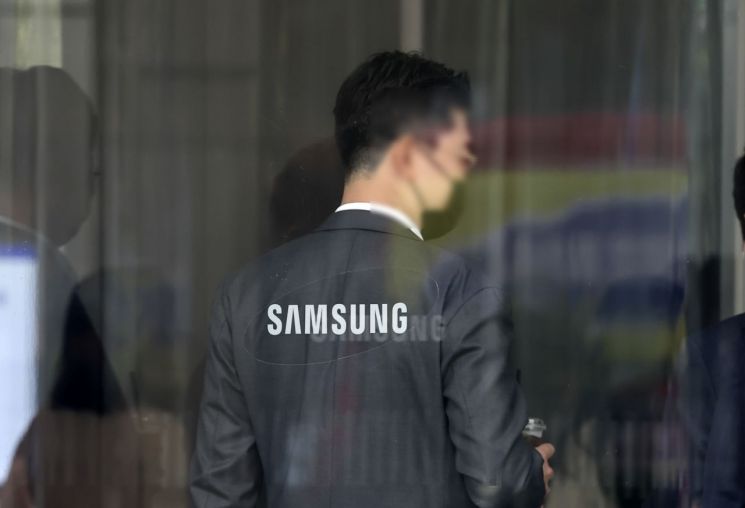
[Asia Economy Reporter Moon Chaeseok] Samsung Electronics posted sales of 77 trillion KRW in the second quarter, the second highest ever. Despite adverse factors such as the Russia-Ukraine conflict and inflation (rising prices), the company performed well, but there are somewhat painful calls to accelerate the restructuring of its business focused on memory semiconductors, which are sensitive to market changes.
On the 7th, Samsung Electronics announced its preliminary consolidated results for the second quarter, recording sales of 77 trillion KRW and operating profit of 14 trillion KRW. Compared to the same period last year, sales increased by 20.94% and operating profit by 11.38%. Sales were the highest for a second quarter but were 1% lower than the record high of 77.78 trillion KRW in the first quarter. Operating profit was the third highest for a second quarter and decreased by 0.85% compared to 14.12 trillion KRW in the first quarter.
Although only preliminary figures were released and detailed results by division were not disclosed, securities firms estimated that the DS (semiconductor) division earned about 10 trillion KRW in operating profit. Due to the economic recession leading to reduced consumer demand and China’s city lockdown policies, demand for PCs and mobile devices weakened, but demand for servers, including data center investments, remained solid.
In the second half of the year, as prices for memory semiconductors such as DRAM and NAND flash decline, Samsung Electronics’ performance outlook is not very optimistic. Taiwanese market research firm TrendForce predicted that DRAM prices could fall by up to 10% in the third quarter compared to the second quarter. NAND prices are also on a downward trend.
Given this situation, there are calls to speed up business restructuring such as foundry (semiconductor contract manufacturing). Analyst Kim Sun-woo of Meritz Securities wrote in a report immediately after Samsung Electronics’ earnings announcement on the 7th, titled “Profit Stabilization, Then What,” that the market will closely watch production and investment policies from a mid-term perspective.
Analyst Kim said, “The yield of Samsung Electronics’ foundry advanced processes is still undergoing stabilization work, and considering that this is directly linked to the future competitiveness of MX, continuous observation is necessary,” adding, “The current memory market is at a point where it reacts sensitively to strategic changes in supply.”
There was also harsh criticism that Samsung Electronics, often called the “50,000 Electronics” (referring to its stock price), needs to make efforts to manage its stock price. Analyst Kim said, “From a mid-term perspective, semiconductor production and investment policies are very important factors,” and added, “There will be a need to compensate for the retreat in shareholder returns related to the trend of reduced facility investment reflecting economic slowdown, memory inventory carryover strategies, and increased unit costs of facility investment.” He suggested that as free cash flow decreases, the level of shareholder returns may also decline.
A report was also published raising the possibility of a decline in Samsung Electronics’ performance next year and SK Hynix’s in 2024. Both are not unrelated to the structural problem of operating mainly in the memory semiconductor industry. Hwang Min-sung, head of the Tech team at Samsung Securities, stated that it is well known that the supply chain itself is broken due to a shortage of people to build factories, rising labor and material costs, and delays in equipment delivery.
Kim said, “Our company may revise downward its forecast that Samsung Electronics’ DRAM production will grow in the high single digits to low double digits next year, and this is not only Samsung Electronics’ problem but an issue for the DRAM industry, the memory industry, and the semiconductor industry as a whole,” adding, “In 2024, problems such as the lack of extreme ultraviolet (EUV) equipment supply to SK Hynix’s Wuxi (China) plant and limited cleanroom issues will arise, potentially reproducing next year’s Samsung Electronics’ problems at SK Hynix in 2024.”
© The Asia Business Daily(www.asiae.co.kr). All rights reserved.

















