Confirmed Status as Korea's Largest Structural Elucidation Infrastructure through International Symposium
Global Industry-Academia-Research Collaboration, Network Strengthening... Leap to New Drug Development Hub
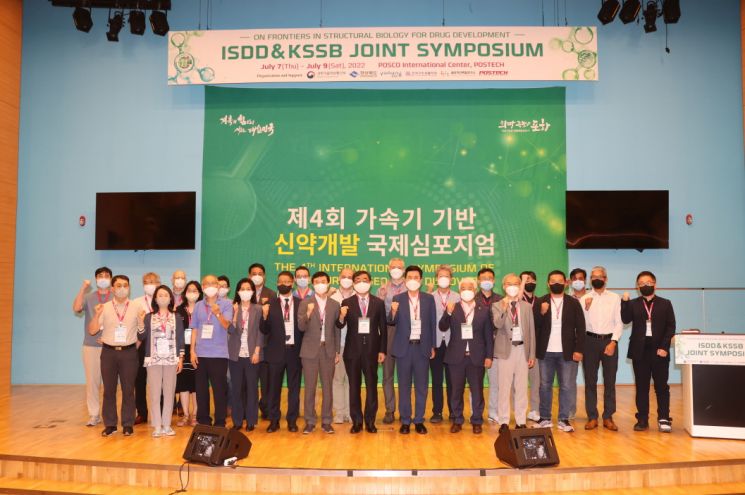
[Asia Economy Yeongnam Reporting Headquarters Reporter Dongguk Lee] Pohang City, Gyeongbuk Province, in collaboration with the Ministry of Science and ICT, Gyeongbuk Province, the Korea Structural Biology Society (KSSB), and POSTECH, held the ‘4th Accelerator-Based New Drug Development International Symposium’ from July 7 to 9 at the POSCO International Hall International Conference Room.
The symposium, themed ‘Structure-Based New Drug Development,’ was attended by over 400 participants including domestic and international experts in structure-based new drug and vaccine development and members of the Korea Structural Biology Society.
Pohang City and Gyeongbuk Province are promoting joint cooperation and network strengthening projects with global industry-academia-research institutions for structure-based new drug development by utilizing world-class 3rd and 4th generation synchrotron accelerators and Cryo-Electron Microscopy (Cryo-EM). Since 2017, Pohang City has proactively hosted international symposiums to enhance structural determination research capabilities and industrialize structure-based new drug development technologies.
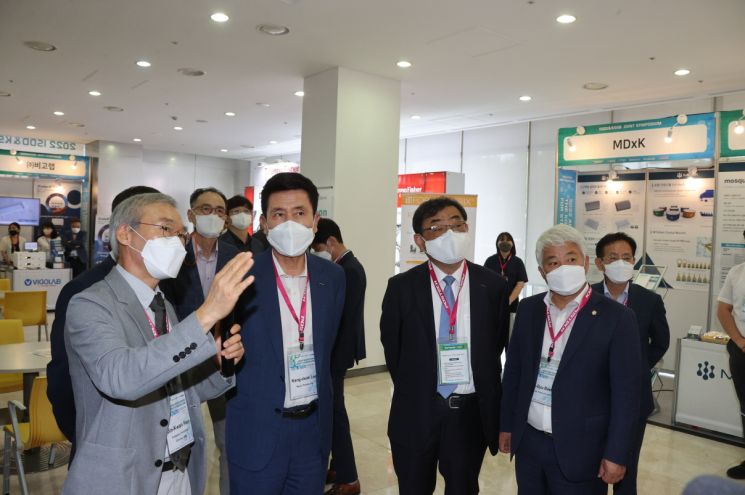
At this symposium, 13 international experts including Professor Ian Wilson, a world-renowned authority in structure-based vaccine and new drug development, and 8 experts from domestic universities and companies participated, presenting in-depth discussions on four cutting-edge topics: ▲ Structural studies on viruses and their pathogenesis ▲ New discoveries using enzymes structurally ▲ GPCR structure and function ▲ Membrane transporters, channels, and enzymes.
GPCR stands for G protein-coupled receptor, a receptor type widely used in intracellular signal transduction, with about half of currently known pharmaceuticals related to GPCRs.
Professor Ian Wilson from the Scripps Research Institute in the U.S., who delivered the keynote lecture, emphasized the necessity and importance of developing universal antibodies and therapeutics that can rapidly respond to pandemics using viral protein structures. He stated that structure-based universal antibody design research is expected to act as a catalyst for vaccine and therapeutic development against future infectious diseases.
Invited speakers Professor Elizabeth Campbell and Professor Seth Darst from Rockefeller University in the U.S. introduced research on the RNA genome replication and transcription process of the COVID-19 virus, mechanisms occurring inside the body after viral invasion, and antiviral therapeutic research, receiving great acclaim from the audience.
Regarding membrane protein research, Professor Seon Choi from Ewha Womans University, Professor Hideaki Kato from the University of Tokyo, and Professor Volodymyr Korkhov from ETH Zurich in Switzerland presented research achievements using Cryo-Electron Microscopy.
In the structure-based new drug development session, Professor Kojiro Kojima from Yokohama University and Dr. Robert Fenwick from the Computational Science Research Center at San Diego State University proposed directions for precision medicine research using computer-based structural analysis and calculations, suggesting the direction for structure-based new drug development.
The Korea Structural Biology Society (KSSB), Korea Cryo-EM Users Association (KOCUA), Osong Advanced Medical Industry Promotion Foundation New Drug Development Support Center, and Gyeongbuk Bio Industry Research Institute Vaccine Commercialization Technology Support Center also participated, presenting various research contents. Additionally, suppliers of cutting-edge research equipment for structure-based new drug development introduced the latest equipment, adding luster to the event.
Mayor Kang-deok Lee of Pohang said, “By utilizing core bio-infrastructure such as synchrotron accelerators, the Membrane Protein Research Institute, Pohang Knowledge Industry Center, and the Green Vaccine Demonstration Support Center, Pohang is poised to leap forward as a global hub for new drug development, leading startups and job creation in the biopharmaceutical sector. We will also do our best to realize bio-national security by fostering future-oriented physician-scientists through the establishment of research-centered medical schools and smart hospitals.”
To foster the bio new industry, Pohang City is building the Membrane Protein Research Institute and Green Vaccine Demonstration Support Center in the Pohang Convergence Technology Industrial Complex and is accelerating efforts to establish a sustainable bio-ecosystem with centers such as the Bioprinting Artificial Organ Application Technology Center and the Microbiome Core Research Support Center.
© The Asia Business Daily(www.asiae.co.kr). All rights reserved.
![Clutching a Stolen Dior Bag, Saying "I Hate Being Poor but Real"... The Grotesque Con of a "Human Knockoff" [Slate]](https://cwcontent.asiae.co.kr/asiaresize/183/2026021902243444107_1771435474.jpg)
















