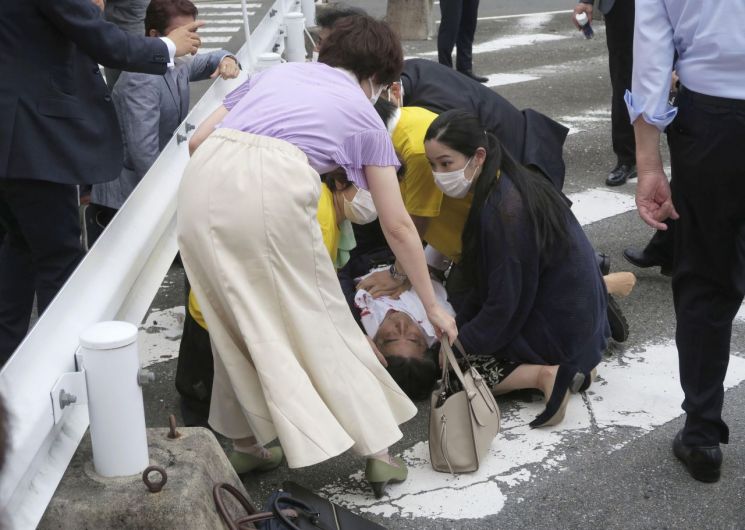
[Asia Economy Reporter Jeong Hyunjin] Former Japanese Prime Minister Shinzo Abe was shot with a shotgun during a campaign rally for the House of Councillors election on the 8th and was transported to the hospital in cardiopulmonary arrest. In response, the Japanese government immediately held a meeting of relevant ministries and agencies. Prime Minister Fumio Kishida, who was also campaigning for the election, canceled his other schedules and returned immediately, while Abe’s wife, Akie, headed to the hospital.
According to NHK and Asahi Shimbun, the Japanese government established a crisis management office at the Prime Minister’s Official Residence Crisis Management Center around 11:45 a.m., just 15 minutes after news broke that former Prime Minister Abe had been shot, and held a meeting of related ministries.
Chief Cabinet Secretary Hirokazu Matsuno stated regarding the incident, “Such an atrocity cannot be tolerated. We strongly condemn it,” adding, “The government is making every effort to respond appropriately.” Regarding Abe’s condition, he only said, “It is currently unclear. We are continuing to confirm.”
Prime Minister Fumio Kishida, who was campaigning for the House of Councillors election as scheduled that day, canceled his subsequent plans and returned to the official residence upon hearing the news. According to Asahi, Kishida had conducted about 10 minutes of the scheduled rally around noon but made no specific remarks about the incident. Matsuno said, “I instructed all ministers who were scattered across various locations due to election campaigns to return to Tokyo immediately.”
Japan is preparing for the House of Councillors election scheduled for the 10th. Former Prime Minister Abe was shot during his election campaign.
As soon as news of Abe being shot was reported, his wife Akie left their home around 12:25 p.m., according to Asahi Shimbun. At that time, three to four police officers were guarding Abe’s residence.
The Japanese political sphere immediately condemned the incident as a challenge to democracy. Tsuyoshi Takagi, a member of the House of Representatives and the LDP’s Diet Affairs Committee Chairman, told NHK, “It is an unbelievable act of violence to attack using a weapon. It is outrageous,” adding, “The details of his condition are unknown, but I hope he is safe.” Other parties such as Komeito and the Constitutional Democratic Party also condemned the incident as “an absolutely unforgivable act.”
Earlier, around 11:30 a.m., former Prime Minister Abe collapsed bleeding while conducting a street campaign in Nara City, Nara Prefecture, ahead of the House of Councillors election. NHK reported that two gunshot-like sounds were heard, and Abe collapsed bleeding from the chest area.
Police officials stated that Abe appeared to have been shot from behind with a shotgun. He was urgently transported to the hospital, and fire department officials explained that he was in cardiopulmonary arrest. Initially, while being transported by ambulance, Abe was conscious and responded to calls, but later lost consciousness and entered cardiopulmonary arrest.
The police arrested a man at the scene and are investigating him on suspicion of attempted murder. The gun the man possessed was also confiscated.
Former Prime Minister Abe was campaigning to support constitutional revision after the House of Councillors election on the 10th. Abe was Japan’s longest-serving prime minister, serving two terms from September 2006 to September 2007 and from December 2012 to September 2020. As a leading hardliner within the LDP, he persistently advocated for revising the pacifist constitution during his tenure.
In this House of Councillors election, it is expected that the pro-constitutional revision forces, including the LDP, will secure more than two-thirds of the seats, meeting the threshold to propose constitutional amendments.
According to public opinion polls, the ruling coalition of the LDP and Komeito is expected to hold between 133 and 151 seats after the election. Securing a majority is considered likely, with attention focused on whether they will secure enough seats to propose constitutional amendments. Due to increased security threats such as Russia’s invasion of Ukraine, rising tensions between China and Taiwan, and North Korea’s missile launches, constitutional revision has emerged as a key issue in this House of Councillors election.
© The Asia Business Daily(www.asiae.co.kr). All rights reserved.
![Clutching a Stolen Dior Bag, Saying "I Hate Being Poor but Real"... The Grotesque Con of a "Human Knockoff" [Slate]](https://cwcontent.asiae.co.kr/asiaresize/183/2026021902243444107_1771435474.jpg)















