Risk of Hospitalization 3 Times Higher After Second COVID-19 Infection
"Asymptomatic Cases in First Infection May Appear Upon Reinfection"
Confirmed Cases Rise in Europe During Vacation Season... "Europe Has Become a Hotspot for Resurgence"
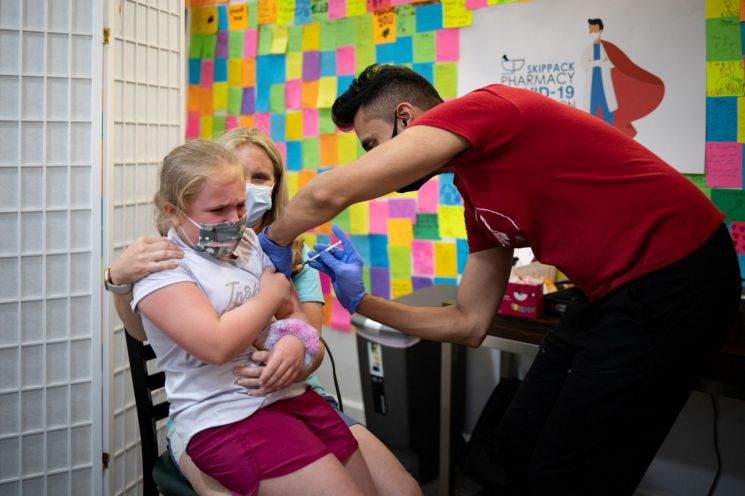 An 8-year-old child is receiving the third COVID-19 vaccine (booster shot) at a pharmacy in Schwenksville, Pennsylvania, USA. [Image source=Yonhap News]
[Asia Economy Reporter Park Hyun-joo] A study has found that the likelihood of experiencing ongoing health problems increases if reinfected with COVID-19. As the summer vacation season approaches, concerns about reinfection are growing, especially with the rise of Omicron subvariant BA.5 cases centered around popular tourist destinations in Europe.
On the 6th, according to CNN and The Wall Street Journal (WSJ), a research team led by Professor Jiyad Al-Aly from Washington University in St. Louis, USA, published these findings on the preprint site Research Square.
This study was based on the health records of more than 5.6 million people registered in the U.S. Veterans Health Administration system. The researchers compared the health records of over 250,000 individuals infected once with COVID-19 and 38,000 individuals infected two or more times. Among the reinfected, 36,000 had been infected twice, 2,200 three times, and 246 four times. The 5.3 million uninfected individuals served as the control group.
According to the study results, those infected two or more times had more than twice the risk of death and more than three times the risk of hospitalization within six months after their last infection compared to those infected only once. Particularly, individuals infected two or more times showed higher risks of lung and heart problems, fatigue, digestive and kidney diseases, diabetes, and neurological disorders. The researchers noted that after reinfection, diseases such as chest pain, abnormal heart rhythms, heart attacks, heart failure, and blood clots were newly diagnosed.
Furthermore, the risk of new health problems was highest shortly after COVID-19 reinfection but persisted for at least six months. The increased health risk from reinfection was independent of COVID-19 vaccination status and increased with each infection.
Professor Al-Aly stated, "If you have been infected with COVID-19 before, you might think your immune system is trained to recognize and fight it, but reinfection may not trigger that response." He added, "This study shows that each COVID-19 infection brings new risks that accumulate over time." He also mentioned that symptoms not manifested during the first infection could appear as diseases during reinfection.
Dr. Daniel Griffin, a U.S. infectious disease expert, told CNN, "Many people think that if they survive the first infection, they will be fine with reinfection. Symptoms may be mild during reinfection, but this is not proven." He explained that because the COVID-19 virus continues to mutate and evade existing immunity, it is difficult to assume reinfection symptoms will be mild.
However, WSJ pointed out that the study mainly involved older age groups. Amesh Adalja from the Johns Hopkins Center for Health Security said, "For example, a healthy 18-year-old is unlikely to experience a significant increase in health risks from reinfection in the same way as an elderly person with health issues." The media also noted that immunity gained from recovery after previous infection or vaccination might still reduce the severity of reinfection.
 A woman is cooling off near the Trocadero Fountain close to the Eiffel Tower in Paris, France.
 [Image source=Yonhap News]
Meanwhile, as the summer vacation season arrives, COVID-19 cases are rising again in popular European tourist destinations crowded with visitors. According to the British daily The Guardian on the same day, Spain's COVID-19 cases recently increased by 60% compared to last month, with about 80% of these cases being BA.5 infections. The spread was particularly notable in famous tourist spots such as Ibiza and Mallorca.
In Greece, the number of new daily cases last weekend reached approximately 11,700, tripling compared to the previous week. According to Greek authorities, the age group of confirmed cases was mainly 18 to 24 years old, occurring primarily in popular tourist destinations like Corfu and Kefalonia. In Germany, the BA.5 variant has spread, with 500 COVID-19 deaths reported in the past week, and France saw about an 80% increase in cases over the past two weeks.
In response, the World Health Organization (WHO) pointed out that "Europe has become a hotbed of COVID-19 resurgence," noting that increased person-to-person contact through concerts and travel is driving the rise in cases in the region. Michael Ryan, head of the WHO Emergency Response Team, said at a press conference that day, "We are witnessing a serious spread of the disease in Europe," adding, "This will soon happen in other regions as well."
However, the WHO forecasted that "the recent surge will not cause a 'catastrophe' like the early days of COVID-19." This is because understanding of COVID-19 has improved, and vaccines and treatments are now available, unlike during the initial virus spread. WHO Director-General Tedros Adhanom Ghebreyesus said at a briefing that while the COVID-19 resurgence should be taken seriously, "We will not be held hostage by the virus as we were in 2020."
© The Asia Business Daily(www.asiae.co.kr). All rights reserved.
![Clutching a Stolen Dior Bag, Saying "I Hate Being Poor but Real"... The Grotesque Con of a "Human Knockoff" [Slate]](https://cwcontent.asiae.co.kr/asiaresize/183/2026021902243444107_1771435474.jpg)
















