Samsung and LG Show Resilient Performance Amid Adverse Conditions
Samsung Highlights 'Semiconductors', LG Emphasizes 'Automotive Components'
[Asia Economy Reporters Sunmi Park and Chaeseok Moon] Despite global adverse conditions such as inflation and economic growth slowdown, Samsung Electronics and LG Electronics recorded their highest-ever sales for the second quarter. Although their performance retreated compared to the first quarter, it is considered a solid achievement. However, with global economic instability expected to persist for the time being, uncertainty over second-half performance has increased.
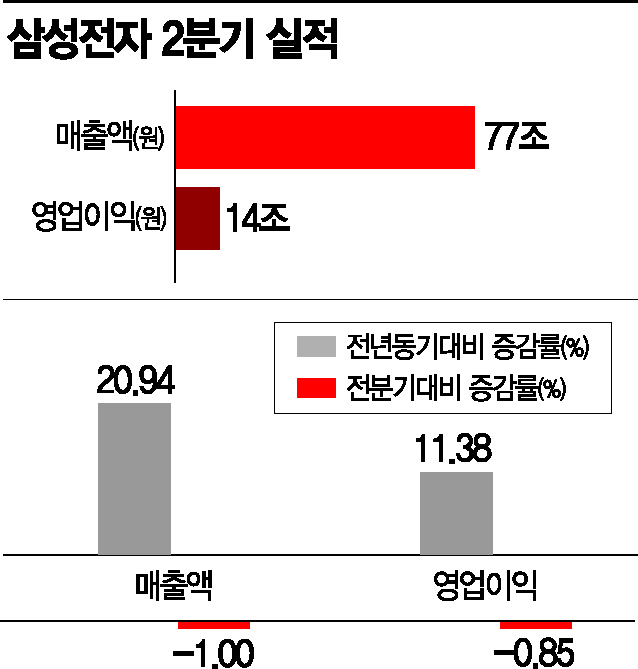
On the 7th, Samsung Electronics announced its preliminary results for the second quarter of this year, reporting consolidated sales of 77 trillion KRW and operating profit of 14 trillion KRW. Compared to the same period last year, sales and operating profit increased by 20.94% and 11.38%, respectively. LG Electronics reported second-quarter sales of 19.472 trillion KRW, up 15.0%, while operating profit decreased by 12.0% to 791.7 billion KRW.
Both Samsung Electronics and LG Electronics set record-high sales for the second quarter. Although their results declined compared to the first quarter, which had set the 'highest' record across all quarters, they are evaluated as having held up well despite adverse conditions.
In Samsung Electronics' case, the set business, including smartphones and home appliances, which are highly affected by economic conditions, showed poor performance, but the semiconductor division defended well and led the overall results. Although memory prices declined in the second quarter, semiconductor purchases by customers proceeded normally, and shipment volume increased. Due to the nature of transactions being based on the dollar, the exchange rate effect from the strong dollar is also considered, with an estimated 10 trillion KRW of the total 14 trillion KRW operating profit coming from semiconductors.
 On the 7th, LG Twin Tower in Yeouido, Seoul, ahead of LG Electronics' preliminary announcement of its fourth-quarter earnings for last year. According to the securities industry, LG Electronics is expected to record sales in the 20 trillion won range and operating profit in the 800 billion won range in the fourth quarter, driven by strong sales of home appliances and TVs. Photo by Kang Jin-hyung aymsdream@
LG Electronics faced burdens on its performance as TV sales slumped due to the disappearance of the COVID-19 special demand and the contraction of consumer sentiment caused by inflation and high interest rates, along with significant increases in raw material and logistics costs. However, its automotive components business performed well. LG Electronics had previously announced that it secured new projects worth a total of 8 trillion KRW in the automotive (electric and electronic equipment) sector in the first half of this year.
The VS Business Division, which handles automotive components, is showing promising sales growth as the vehicle semiconductor supply issue eases and production by automakers and parts suppliers gradually expands. Accordingly, the industry expects the VS Business Division to record quarterly sales of 2 trillion KRW for the first time and to have achieved its first profit turnaround in nine years, supported by continuous cost structure improvements. Furthermore, if this pace continues, the total order backlog could surpass 65 trillion KRW by the end of the year.
However, the industry also expresses concerns that global adverse factors such as ▲the Russia-Ukraine war ▲COVID-19 lockdowns in China ▲inflation ▲economic growth slowdown are likely to continue into the second half, posing risks to the performance of Samsung Electronics and LG Electronics.
Samsung Electronics was expected to achieve an operating profit in the 60 trillion KRW range for the first time this year, but recent forecasts have been revised downward by 6.83% compared to a month ago (63.3102 trillion KRW). Reflecting recent inventory reduction moves in distribution channels and conservatively estimating the set business performance, some opinions suggest that operating profit could shrink to the 51 trillion KRW level this year, potentially failing to set a new record.
Yangjae Kim of Dior Investment Securities said, "The trend of declining quarterly earnings is expected to continue until the first half of next year," adding, "Due to weakening front-end demand, smartphone and TV sales are expected to decline, and with increasing inventory, the semiconductor sector is also expected to see a wider price drop in DRAM and NAND in the second half."
LG Electronics is also facing a challenging management environment due to global economic instability this year. Above all, the global home appliance market is expected to show a clear slowdown in growth compared to the previous year. Accordingly, LG Electronics is expected to focus its capabilities on achieving sales growth and profitability through premium strategies and thorough global supply chain management.
The key will be how much premium home appliances, including the LG Objet Collection, can drive performance. Considering the TV market is also expected to face consumption contraction due to inflation and interest rate hikes leading to economic recession, LG Electronics must focus on increasing the sales proportion of premium products such as OLED TVs and large-sized TVs, improving the product mix to achieve sales growth and profitability.
© The Asia Business Daily(www.asiae.co.kr). All rights reserved.
![Clutching a Stolen Dior Bag, Saying "I Hate Being Poor but Real"... The Grotesque Con of a "Human Knockoff" [Slate]](https://cwcontent.asiae.co.kr/asiaresize/183/2026021902243444107_1771435474.jpg)
















