COVID-19 Spread in South Korea Following Overseas Surge... 'Doubling' Phenomenon
Exchange Rate Soars Amid Economic Recession Concerns... Increased Travel Costs
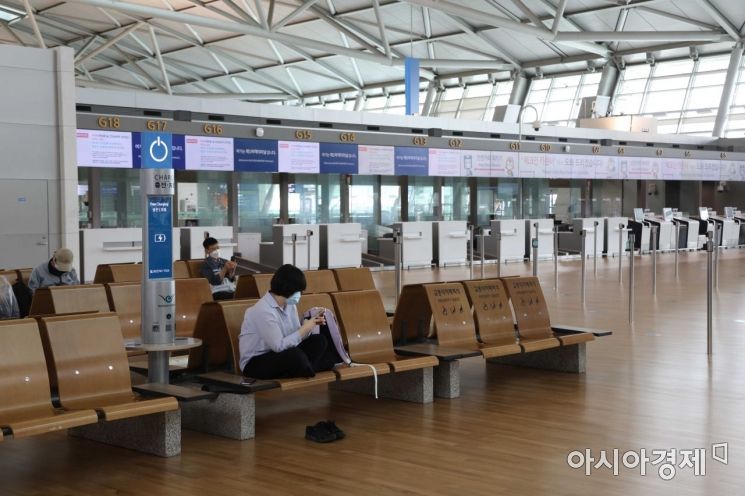 The departure hall of Terminal 1 at Incheon International Airport on the 22nd of last month, as demand for overseas travel during the summer vacation season increases. Photo by Mun Ho-nam munonam@
[Asia Economy Reporter Yoon Seul-gi] As the first vacation season since the recovery from COVID-19 begins, an increase in overseas travel demand is expected, but it faces adverse factors such as the resurgence of COVID-19 and soaring exchange rates. However, experts predict that due to the deepening polarization of consumption and income, and the relatively low fear of COVID-19 infection, the trend of "those who want to travel will continue to travel" will persist.
New COVID-19 cases are nearing 20,000, showing signs of resurgence. According to the Central Disease Control Headquarters, as of midnight on the 7th, there were 18,511 new confirmed cases. This is nearly double the 9,591 cases reported on the same day last week (June 27), showing a so-called "doubling" phenomenon where cases double every week.
The fact that the reproduction number (an indicator showing how many people one infected person infects) has exceeded 1 adds to the concern. Last week, the reproduction number was 1.05, surpassing 1 for the first time in 14 weeks.
The quarantine authorities also forecast that the spread will continue for the time being. Lee Sang-min, the 2nd Deputy Director of the Central Disaster and Safety Countermeasures Headquarters (CDSCH) and Minister of the Ministry of the Interior and Safety, stated at the CDSCH meeting on the morning of the 6th, "The average daily number of confirmed cases last week was 8,549, marking a shift from a 14-week decline to an upward trend, and the reproduction number exceeded 1 for the first time since the fourth week of March."
The overseas situation is similar. According to the World Health Organization (WHO), during the week of June 20-26, there were 4.28 million new COVID-19 cases worldwide, showing an increase for three consecutive weeks. This is due to the spread of the Omicron subvariant named BA.5, which transmits 35.1% faster than BA.2 (Stealth Omicron).
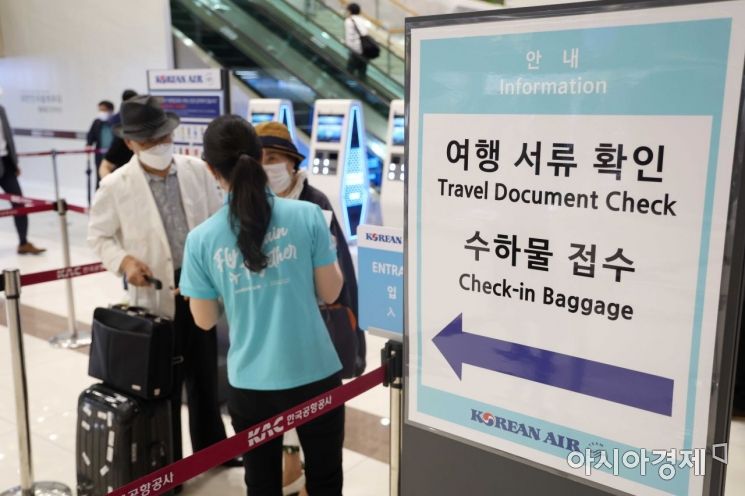 On the 29th of last month, when the Gimpo-Haneda flight route resumed operations, passengers were checking in at the international terminal of Gimpo Airport in Gangseo-gu, Seoul. Photo by Moon Honam munonam@
◆ First peak season since recovery... Will travel sentiment shrink?
Given this situation, dark clouds have gathered over the travel industry, which is experiencing a boom. Although travel demand, suppressed during the COVID-19 period, has surged with the recovery trend, concerns are rising that consumer sentiment may shrink as the possibility of COVID-19 spreading again becomes prominent.
Additionally, the sharp rise in exchange rates is problematic. On the 5th, an inversion of long- and short-term interest rates, interpreted as a precursor to a recession, occurred for the third time this year. With gloomy forecasts emerging, preference for the Korean won weakened, and the won-dollar exchange rate surpassed 1,310 won on the 6th, the highest level in 13 years. The won-dollar exchange rate has exceeded 1,300 won only three times before: during the 1997 foreign exchange crisis, the 2001 U.S. dot-com bubble, and the 2008 global financial crisis?all times of economic crisis.
However, experts diagnose that due to the polarization of consumption and income, consumers with the means are likely to travel despite the burden. Professor Lee Eun-hee of Inha University's Department of Consumer Studies explained, "With the exchange rate and airfare prices rising significantly, the travel expenses consumers must bear have increased. However, as consumption and income polarization is progressing, even if travel expenses increase due to higher exchange rates or inflation, 'those who want to travel will travel.'" She added, "Moreover, pent-up consumer sentiment from two years of COVID-19 restrictions is being released, so planned trips are expected to proceed as scheduled."
Regarding the signs of COVID-19 resurgence, Professor Lee said, "If countries impose lockdowns or strengthen entry quarantine measures due to COVID-19, travel sentiment could shrink, but such measures are not being implemented. Also, the perception that COVID-19 is not as dangerous as before has developed, so it is unlikely to have a significant impact."
© The Asia Business Daily(www.asiae.co.kr). All rights reserved.
![Clutching a Stolen Dior Bag, Saying "I Hate Being Poor but Real"... The Grotesque Con of a "Human Knockoff" [Slate]](https://cwcontent.asiae.co.kr/asiaresize/183/2026021902243444107_1771435474.jpg)
















