Surplus Turnaround to $3.86 Billion in May from April Deficit
BOK Forecasts Current Account Surplus in June
However, Goods Account Surplus Expected to Continue Declining
H2 Current Account Target Achievement... "Needs Monitoring"
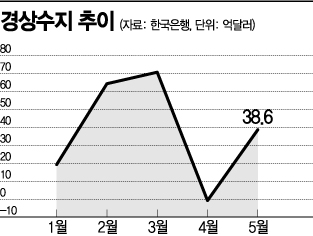
In May, South Korea's current account recorded a surplus of $3.86 billion, recovering from a deficit in the previous month. However, the surplus shrank by more than $6.5 billion compared to a year ago due to rising import prices of raw materials such as oil. With growing concerns about economic recessions in major countries including the United States and an upward trend in exchange rates, the current account surplus is expected to remain unstable for the time being.
According to the preliminary balance of payments statistics released by the Bank of Korea on the 7th, the current account surplus in May was $3.86 billion. In April, it recorded a deficit of $80 million, marking the first negative balance in two years since April 2020, but it returned to a surplus within a month. However, the surplus amount sharply decreased by $6.55 billion compared to $10.41 billion in the same month last year.
This is largely due to the reduction in the goods account surplus, which accounts for the largest portion of the current account, shrinking from $6.65 billion to $2.74 billion over the past year. The decrease in the goods account surplus was caused by imports increasing more than exports. Exports ($61.7 billion) showed a solid performance led by petroleum products and semiconductors, increasing by $10.5 billion, but imports ($58.96 billion) rose by $14.41 billion due to a sharp surge in raw material prices.
The services account also turned to a deficit of $20 million, marking the first deficit in four months since January this year (-$490 million). The surplus in transportation services expanded by $410 million due to high export freight rates, but surpluses in processing services, travel, and other business services declined. The primary income account, which reflects inflows and outflows such as wages, dividends, and interest, recorded a surplus of $1.45 billion, down by $3.58 billion compared to last year.
The net financial account, which is assets minus liabilities, increased by $3.03 billion in May. In direct investment, overseas investment by domestic investors rose by $5.47 billion, and foreign investment in South Korea increased by $1.37 billion. In securities investment, domestic investors' overseas investment grew by $7.13 billion, and foreign investors' domestic securities investment increased by $2.46 billion.
The Bank of Korea expects the current account surplus to continue in June, but the goods account surplus is likely to keep shrinking. Earlier, the Bank projected the current account surplus for this year to be $21 billion in the first half and $29 billion in the second half, totaling a $50 billion surplus for the year. If the June current account surplus exceeds $1.83 billion, the first-half target can be achieved.
However, due to supply chain instability caused by the Ukraine crisis and growing recession concerns, there is a possibility that the current account surplus will significantly decrease in the second half. Kim Young-hwan, head of the Bank of Korea’s Financial Statistics Department, said, "The reduction in the goods account surplus due to the surge in imports is expected to continue for the time being," adding, "Results consistent with the forecast are likely until the first half, but we need to observe the second half more closely."
© The Asia Business Daily(www.asiae.co.kr). All rights reserved.
![Clutching a Stolen Dior Bag, Saying "I Hate Being Poor but Real"... The Grotesque Con of a "Human Knockoff" [Slate]](https://cwcontent.asiae.co.kr/asiaresize/183/2026021902243444107_1771435474.jpg)















