National Research Institute of Cultural Heritage Conservation Science Center Completes Preservation Treatment
Foreign Substance Removed and Damaged Parts Reinforced "Exhibition Scheduled for Next Year"
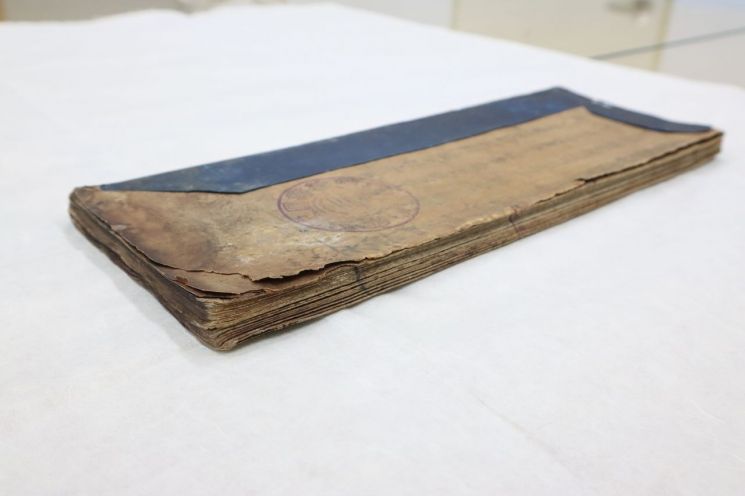
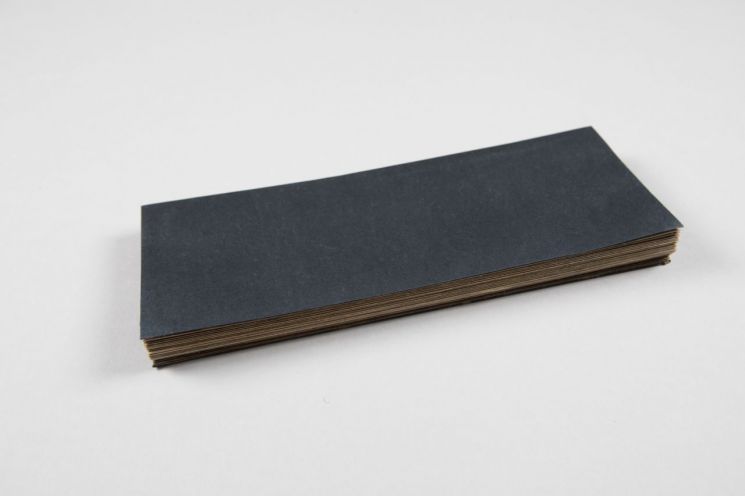
The Cultural Heritage Conservation Science Center of the National Research Institute of Cultural Heritage announced on the 7th that it has completed the conservation treatment of the treasure "Baekji Eun-ni Daebuljeong Yeorae Milinsu Jeungyo-ui Je Bosal Manhaeng Sungeomeong Volume 10 (Baekji Eun-ni Sungeomeong)." Baekji Eun-ni Sungeomeong is a Buddhist scripture, the last volume of the ten volumes of the Surangama Sutra (楞嚴經), handwritten in silver ink. Baekji Eun-ni (白紙銀泥) refers to text written with a silver-containing pigment on white paper. Currently, volumes 1 to 9 are not extant.
The Baekji Eun-ni Sungeomeong was produced in the 5th year of King Gongmin of Goryeo (1356). The back of the scripture contains a publication record stating that I Banghan (李邦翰) wrote it for his deceased mother. Its dimensions are 11.2 cm in width and 30.5 cm in height. It is in the form of a booklet folded fifty-seven times, and when fully unfolded, its width reaches 6.3 meters.
During the conservation process, the Cultural Heritage Conservation Science Center analyzed the paper fibers and confirmed that the white paper used was hanji made from mulberry bark. It was verified that silver was used in the text as known, and it was also found that some parts had darkened due to the combination of silver and sulfur.
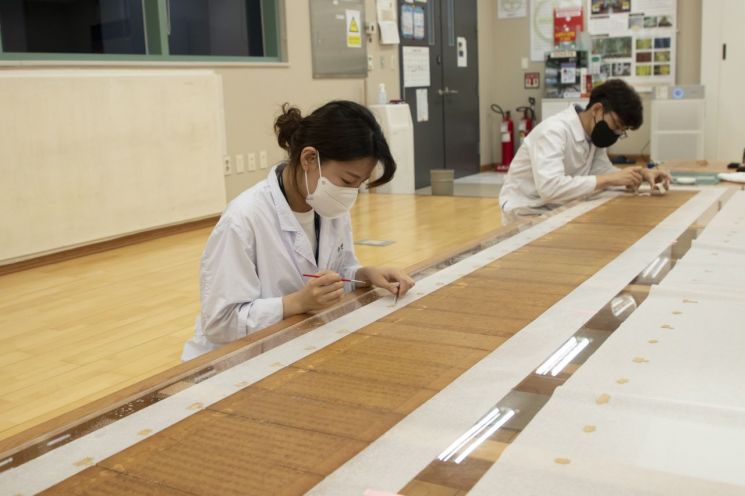
The damaged parts were restored as closely as possible to their original form. A center official explained, "The main text paper, which had yellowing, tears, and losses, was washed using dry and wet methods, and the torn and missing parts were reinforced. The front cover, which was mostly missing, was restored using indigo-dyed paper." He added, "The back cover with silver ink treasure flower patterns (寶相華文) had silver lines worn off due to abrasion, foreign substances adhered, and partial losses; these missing parts were reinforced with indigo-dyed paper and foreign substances were removed." Treasure flower patterns refer to imaginary flowers that do not actually exist.
A low concentration of animal glue was applied to the silver ink used on both the main text and covers. Surface contaminants on the paper were removed using tang ion water (water purified to remove dissolved anions and cations). The center official said, "The thickness of the torn or missing main text paper varied from 0.1 mm to 0.15 mm, making conservation treatment challenging. We completed the restoration by pounding traditional hanji to match thickness and color, then overlaying it on the damaged areas." He also mentioned, "The artifact is scheduled to be exhibited to the public next year at the Kyungpook National University Museum, where it is housed."
© The Asia Business Daily(www.asiae.co.kr). All rights reserved.
![Clutching a Stolen Dior Bag, Saying "I Hate Being Poor but Real"... The Grotesque Con of a "Human Knockoff" [Slate]](https://cwcontent.asiae.co.kr/asiaresize/183/2026021902243444107_1771435474.jpg)

















