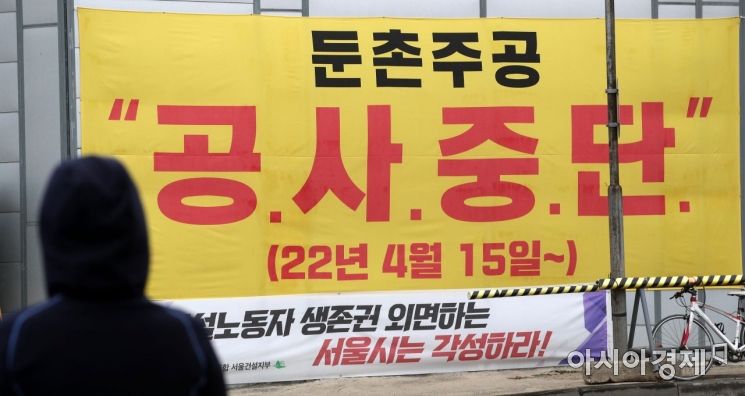
 The Dunchon Jugong Reconstruction Complex in Gangdong-gu, Seoul, the largest reconstruction project in history, is facing a construction halt crisis. As conflicts over project costs between the association and the construction companies reach a peak, the Dunchon Jugong Construction Consortium (including Hyundai Engineering & Construction and three other companies) has announced a construction stoppage starting on the 15th. The photo shows a banner announcing the construction halt at the reconstruction site on the 14th. Photo by Kim Hyun-min kimhyun81@
[Asia Economy Reporters Kim Hyemin and Hwang Seoyul] The Dunchon Jugong Reconstruction Association in Gangdong-gu, Seoul, and the construction consortium (Hyundai Engineering & Construction, HDC Hyundai Development Company, Daewoo Engineering & Construction, Lotte Engineering & Construction) have agreed on 8 clauses including an increase in construction costs. The last remaining clause concerns disputes over commercial properties, and the association and the construction consortium are conducting final negotiations under Seoul City's mediation.
On the morning of the 7th, Seoul City held a briefing at Seoul City Hall to provide an interim update on the progress of these negotiations.
Seoul City stated that after presenting the first mediation proposal at the end of May and meeting with the association and the construction consortium about 10 times each to coordinate opinions, 8 out of 9 contentious issues have been agreed upon. The agreed clauses include ▲re-verification of the existing construction cost increase (558.4 billion KRW) ▲review of sale prices ▲progress of association sales and general sales ▲design changes such as finishing materials ▲reflection of verification results from the Korea Real Estate Board ▲approval by general assembly ▲resumption of construction ▲effectiveness of the agreement and responsibilities in case of violation.
The cause of conflict, the increase in construction costs, will be verified by the Korea Real Estate Board for appropriateness, and the results will be reflected as is. Regarding the finishing material dispute that arose later, the existing contract terms will be followed, but changes to elevators, electric vehicle chargers, and balcony expansions for general sales approved at the general assembly in July last year will be maintained. The association will bear the cost increase due to design changes.
Agreements were also reached on the ratification of the agreement and the timing of construction resumption. The association will withdraw lawsuits against the construction consortium within 15 days of the agreement and ratify the agreement within 60 days. They also agreed to apply for sale price review within 60 days, and within two months from the notification of the review results, apply for approval of the resident recruitment announcement and proceed with general sales. The construction consortium will prepare to resume construction immediately after the lawsuit withdrawal and will resume construction promptly once the general assembly approval is completed.
Although most issues have been agreed upon, the difference in positions between the association and the construction consortium regarding the commercial property dispute remains the final obstacle. The construction consortium insists that disputes between the association, the commercial property representative organization, and the PM (Project Management) company must also be resolved and approved by the general assembly before construction can resume, whereas the association maintains that "there is no reason to involve the commercial property issue."
Kim Jang-su, head of the Multi-family Housing Support Division, said, "The clauses already agreed upon can be agreed to by the association president representing the association, but the commercial property dispute involves individual interests of association members," adding, "The dispute points must be shared and agreed upon within the association." This implies that Seoul City acknowledges its limitations in mediating the commercial property dispute. He added, "If the agreement had been properly reached, general sales were expected in January next year."
Seoul City announced that if the final agreement continues to be delayed, it will designate the Seoul Housing and Communities Corporation (SH) as the project agent after collecting opinions from association members to mediate the conflict. This is pursuant to Article 28, Paragraph 1 of the Urban and Residential Environment Improvement Act, interpreted as a form of pressure indicating that the city will intervene if the agreement is further delayed.
© The Asia Business Daily(www.asiae.co.kr). All rights reserved.

















