4th Dose Vaccination Rate for 60+ at 31%
Effective in Preventing Severe Cases and Deaths
Relatively Low Infection Prevention Rate
Existing Vaccines Offer One-Third Protection Against BA.5 Variant
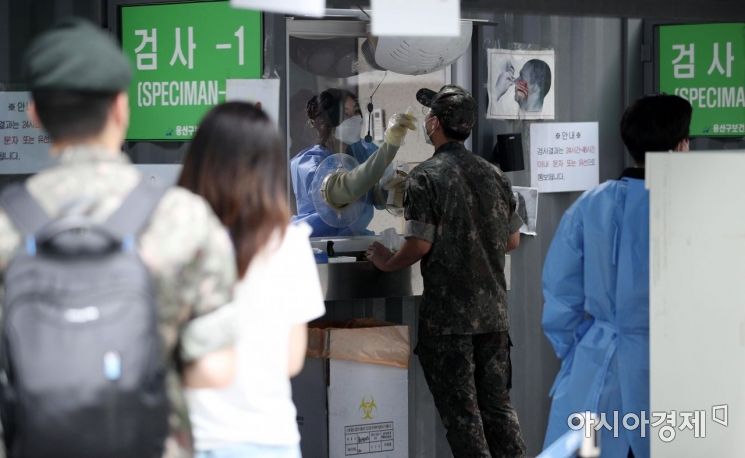 On the 7th, medical staff are collecting samples from citizens at the screening clinic of Yongsan-gu Public Health Center in Seoul. The Central Disease Control Headquarters announced that as of midnight on the same day, 18,511 new confirmed cases were reported, bringing the total to 18,451,862. This is approximately 8,900 more than the previous week. Photo by Hyunmin Kim kimhyun81@
As the daily new COVID-19 cases approach 20,000, signaling a resurgence of the virus, the government is considering expanding the fourth dose of vaccinations but has yet to reach a definitive conclusion. This hesitation stems from the fact that the currently available vaccines are not highly effective against the recently prevalent Omicron BA.5 variant, and even if additional vaccinations are administered now, the emergence and spread of another variant this fall could undermine the expected infection prevention benefits.
Despite Vaccine Stockpiles, Only 31% of Elderly Have Received the Fourth Dose
According to the Central Disease Control Headquarters of the Korea Disease Control and Prevention Agency on the 7th, as of the previous day, 33,379,346 people, or 65.0% of the total population, have received the third dose of the COVID-19 vaccine. However, only 4,464,087 people, or 8.7%, have received the fourth dose. Among those aged 60 and older, 89.8% have completed the third dose, while the fourth dose coverage is 31.3%. More than 87% of the population has completed the basic first and second doses.
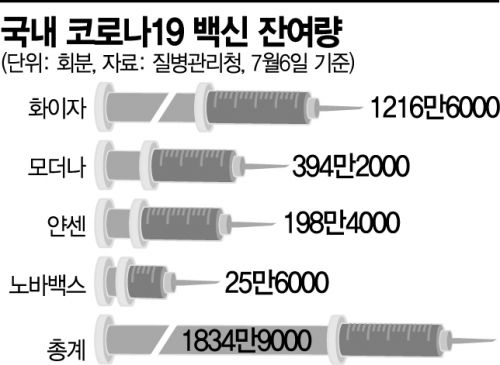
Since the Omicron surge in March, the domestic government has discontinued the vaccine pass, and breakthrough infections have increased even among vaccinated individuals, leading to a growing reluctance to get vaccinated. Consequently, approximately 18.35 million doses of vaccines remain unused, including 12.16 million doses of Pfizer and 3.94 million doses of Moderna.
Experts estimate that immunity gained from vaccination or natural infection typically lasts about three months, up to a maximum of six months. Considering that the Omicron surge peaked in March, it is expected that the number of people maintaining immunity will sharply decline by September. Those who received the third dose since November last year have already experienced a significant drop in vaccine-induced immunity.
The health authorities currently recommend the fourth dose only for people aged 60 and above, immunocompromised individuals, and facility workers. An analysis of 1.51 million people who received the third and fourth doses last month showed that the fourth dose group had a 20.3% higher infection prevention effect compared to the third dose group. The prevention effect against severe illness was 50.6% higher, and the prevention effect against death was 53.3% higher. While the fourth dose has been confirmed to reduce severe illness and death, its infection prevention rate is relatively low.
Low Expected Effectiveness of Fourth Dose for the Entire Population
A major obstacle is that existing COVID-19 vaccines have limited effectiveness in preventing infections caused by BA.5, which is currently driving the spread. Many global pharmaceutical companies plan to release updated vaccines targeting the Omicron variant (BA.1) within this year, but these vaccines also show a sharp decline in prevention effectiveness against BA.5, down to about one-third. Moreover, since BA.5 is known to have high transmissibility but low fatality, some question the necessity of vaccination itself.
Professor Jeong Jae-hoon of the Department of Preventive Medicine at Gachon University College of Medicine said, "It is difficult to expect existing COVID-19 vaccines to prevent variants effectively, but they do reduce the rate of severe illness in high-risk groups, so their use is necessary. However, much depends on the vaccination plans for the updated vaccines."
Professor Eom Jung-sik of the Department of Infectious Diseases at Gachon University Gil Medical Center stated, "Currently, there is insufficient evidence to enforce a fourth dose for the entire population, and considering the challenges in securing medical personnel and the cost burden of large-scale vaccinations, the expected benefits are not significant. By the time vaccines capable of responding to some variants arrive domestically, it is highly likely that another variant will emerge."
The health authorities are continuously monitoring the development of updated vaccines effective against BA.5 and other variants and are in discussions with pharmaceutical companies to ensure rapid procurement once development is complete.
Professor Jeong Ki-seok, chair of the National Infectious Disease Crisis Response Advisory Committee and a respiratory medicine specialist at Hallym University Sacred Heart Hospital, said, "Given the insufficient vaccine effectiveness against BA.5, mandatory fourth doses for the general population beyond the elderly and immunocompromised are unnecessary. However, since new updated vaccines are expected to be supplied soon, if we can secure the maximum supply by around October and vaccinate the entire population simultaneously to build immunity, we could have a relatively safe winter."
© The Asia Business Daily(www.asiae.co.kr). All rights reserved.
![Clutching a Stolen Dior Bag, Saying "I Hate Being Poor but Real"... The Grotesque Con of a "Human Knockoff" [Slate]](https://cwcontent.asiae.co.kr/asiaresize/183/2026021902243444107_1771435474.jpg)
















