High Inflation Era... 8 Major Dining Items Rise
"Let's Save on Lunch" Outsiders Visit Company Cafeterias
Increase in 'Pyeondo-jok' Eating 'Convenience Store Lunchboxes'
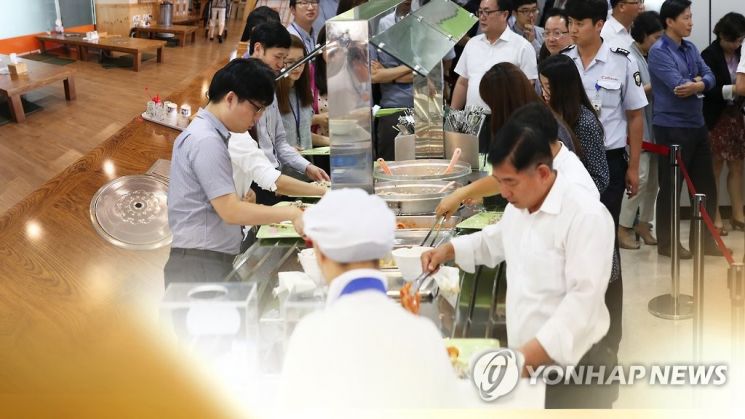 Due to the impact of rising prices, more office workers are visiting company cafeterias open to outsiders rather than regular restaurants.
[Asia Economy Reporter Han Seung-gon] "Lunch? I usually get it at the company cafeteria or convenience store."
Mr. Kim, a man in his 30s, is a member of the so-called 'Company Cafeteria Group Chat.' He said, "The economy is tough, and the company cafeteria is cheaper than regular restaurants, so I look for cafeterias near the office to have lunch or dinner." He added, "We also share information about the cafeterias in the group chat. Since the menus are managed by nutritionists and offer a variety of meals depending on the day, it's even better."
Due to the worst-ever triple high phenomenon of high inflation, high interest rates, and high exchange rates, office workers' lunch culture is also changing. According to the Korea Consumer Agency's price information portal 'Chamgagaek' on the 7th, the average price of eight representative dining-out items in Seoul rose by more than 8% in June compared to January.
The price increase rate was highest for Jjajangmyeon (black bean noodles). The average price rose 8.5% from 5,769 won at the beginning of the year to 6,262 won. Compared to a year ago, it jumped 16.2%. Additionally, Kalguksu (hand-cut noodle soup) increased 6.4% from 7,769 won to 8,269 won. Gimbap also rose 6.3% to 2,946 won.
Meanwhile, Naengmyeon (cold noodles) exceeded 10,000 won per bowl. Naengmyeon, which was 9,808 won in January, rose 4.7% to 10,269 won, and the price of Samgyeopsal (pork belly, 200g) also increased by 4.7%. Kimchi jjigae set meals rose 4.4%, Samgyetang (ginseng chicken soup) 4.0%, and Bibimbap 3.8%, respectively.
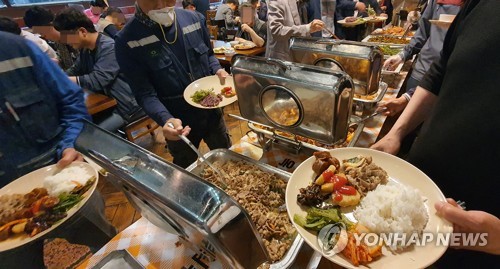 A lunch buffet restaurant in downtown Seoul is bustling with office workers. The price at this restaurant is 7,000 won. Photo by Yonhap News.
As a result, among office workers, there is even talk that "lunch hour is scary." Mr. Park, a man in his 40s, said, "Isn't lunch time supposed to be a time to eat and rest a bit?" but added, "However, meal prices have risen so much that I feel stressed about which restaurant to go to."
Mr. Choi, a self-employed man in his late 30s, said, "I mainly do sales, and I can immediately feel the rise in meal costs." He added, "Although the company provides meal support, considering the inflation rate, the range of menu choices has inevitably narrowed."
Mr. Kim, a member of the 'Company Cafeteria Group Chat,' said, "I search for cafeterias that outsiders can also enter, get information from the group chat, and finally decide which cafeteria to go to." He added, "Looking at one cafeteria's menu for today's lunch, it is 'Bulmat Jeyuk Bokkeum' (spicy stir-fried pork with smoky flavor). The price is in the 5,000 won range."
The so-called 'Convenience Store Lunch Pack Tribe' who save on meal expenses is also increasing. According to the convenience store industry, lunch box sales from the 1st to the 21st of last month rose compared to the same period last year by △GS25 49.1% △7-Eleven 35% △CU 30.1%. Since people can have lunch with a 5,000 won convenience store lunch box while maintaining nutrition with various menus, the convenience store lunch pack tribe is expected to grow further amid the recession.
Meanwhile, the government is making every effort to control prices. Kim Hee-jae, Director of the Price Policy Division at the Ministry of Economy and Finance, said, "Due to the prolonged Russia-Ukraine conflict and disruptions in the global supply chain causing international energy and grain price increases, difficult price conditions may continue for some time," adding, "We will continue to seek additional measures to minimize the burden on people's livelihoods."
© The Asia Business Daily(www.asiae.co.kr). All rights reserved.
![Clutching a Stolen Dior Bag, Saying "I Hate Being Poor but Real"... The Grotesque Con of a "Human Knockoff" [Slate]](https://cwcontent.asiae.co.kr/asiaresize/183/2026021902243444107_1771435474.jpg)
















