Power Shortage Amid Economic Crisis... Situation Worsens Due to Russian Economic Retaliation
[Asia Economy Reporter Kang Woo-seok] Amid the recent surge in global energy prices due to Russia's invasion of Ukraine, countries such as Germany and Japan are facing severe energy and economic crises. Additionally, the looming 'Russia risk' of economic retaliation in response to Western sanctions is exacerbating the situation.
According to reports citing a study by the German Economic Institute (IW) from German public broadcaster Deutsche Welle, in May, 25% of households in Germany spent more than 10% of their income on living energy costs such as heating, hot water, and electricity. This represents a 10.5% increase compared to the same period last year (14.5%).
Energy price comparison site 'Verivox' forecasts that this year, heating and electricity costs for a family of four in Germany will increase by 1,881 euros (approximately 2.55 million KRW) and 235 euros (approximately 320,000 KRW), respectively, compared to the previous year. IW has expressed concern that the situation is more severe than during the oil shocks of the 1970s.
The trade situation is also unfavorable. Germany recorded a trade deficit of 1 billion euros (approximately 1.35 trillion KRW) in May due to a decline in exports amid soaring energy prices. This is the first time Germany has posted a trade deficit since 1991.
Japan is also facing its worst power shortage recently. Despite increased electricity demand due to an early heatwave, supply difficulties have arisen due to soaring energy prices, a reduction in nuclear power generation since the 2011 Fukushima Daiichi nuclear disaster, and operational disruptions at hydroelectric and thermal power plants.
The weak yen is also dealing a significant blow to Japan. According to Bloomberg on the 4th (local time), the yen was trading at 135.93 yen per dollar, a 21.61% decline in value compared to the previous year. The global benchmark Brent crude oil price has risen 40% this year due to Russia's invasion of Ukraine and demand recovery; when adjusted for the yen's value, prices in Japan have surged nearly 70%. According to local trade data, the cost of importing one ton of liquefied natural gas (LNG) in yen rose 120% year-on-year in May.
Jane Nakano, a senior researcher at the U.S. think tank Center for Strategic and International Studies, stated, "Several factors, including high fuel prices and a plummeting currency since the war, are putting significant pressure on Japan's energy security," adding, "This is becoming one of the most severe energy crises Japan has faced."
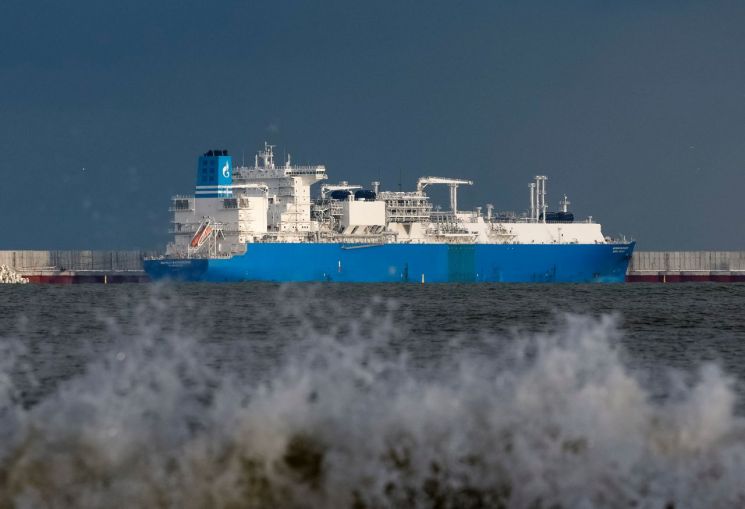 On February 3rd (local time), the Marshal Vasilevskiy, a floating liquefied natural gas (LNG) storage and regasification unit (FSRU) vessel belonging to the state-owned natural gas company Gazprom, was anchored off the coast near Kaliningrad, a city on the Baltic Sea in Russia. Europe depends on Russia for 40% of its annual natural gas demand. [Image source=Yonhap News]
Moreover, Russia's retaliatory moves against Western sanctions are further worsening the situation. According to Interfax News Agency on the 1st, the Russian government plans to establish a new Russian corporation to acquire all rights and assets of 'Sakhalin Energy,' which operates the 'Sakhalin-2' project.
'Sakhalin-2' is an energy development project led by Russia in the East Asia region, which exported 10.41 million tons of liquefied natural gas (LNG) and 4.16 million tons of oil last year alone.
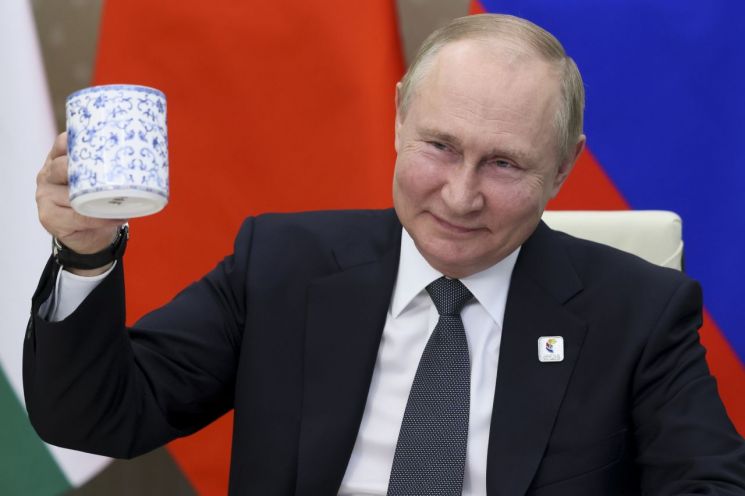
Russian President Vladimir Putin recently signed the 'Law on Special Economic Measures in the Fuel and Energy Sector Regarding Unfriendly Actions by Certain Foreign and International Entities.' According to this law, half of the shares of the newly established corporation will be held by Gazprom Sakhalin Holdings LLC and others participating in joint operations.
The remaining shares will be distributed proportionally to the stakes held by foreign investors previously involved in Sakhalin Energy's operations, including the British oil company Shell (27.5%), Japan's Mitsui & Co. (12.5%), and Mitsubishi Corporation (10%).
However, foreign investors must separately request to acquire shares in the new Russian corporation within one month, and the Russian government will decide whether to approve these requests.
If investors' requests are denied, the Russian government will sell the shares to Russian companies and deposit the proceeds into a special account under the foreign investors' names. Subsequently, after reviewing activities related to finance, environment, and other areas to assess damages, the government will refund only the remaining amount after deducting the calculated damages from the special account.
Pavel Zavalny, chairman of the Energy Committee of the Russian State Duma, expressed retaliatory intentions, stating, "Japan, along with the U.S. and other Western countries, imposed economic sanctions on Russia, causing us losses. However, Japan is simultaneously participating in the Sakhalin-2 project and securing production resources," adding, "We do not rule out imposing sanctions not only on Shell but also on Japanese companies."
Previously, Japan joined Western sanctions against Russia by freezing assets of key Russian figures, including President Putin, and banning exports and imports of certain Russian goods.
Japan has so far expressed no intention to withdraw from 'Sakhalin-2.' Takeshi Hashimoto, president and CEO of Mitsui OSK Lines, Japan's largest shipping company, argued that with soaring energy prices and limited prospects for restarting nuclear power plants in Japan, Russian LNG is necessary for Japan. He said, "Since Japanese companies want LNG from Sakhalin-2, Mitsui OSK will do its best to supply gas regardless of Russia's national policies."
Russia also announced a temporary shutdown of the Nord Stream gas pipeline connecting to Germany for about ten days. According to Russian Interfax News Agency on the 1st (local time), Nord Stream AG, the pipeline operator, stated in a press release that both lines of the Nord Stream pipeline would be temporarily suspended from July 11 to 21 for regular maintenance, including mechanical and automation system inspections.
Gazprom, the Russian state-owned gas company and the largest shareholder of Nord Stream AG, had already reduced natural gas supplies to Germany via Nord Stream by 60% since June 16, citing delays in pipeline equipment repairs.
Former U.S. President Donald Trump warned during a NATO summit visit to Europe that Germany's increasing dependence on Russian gas was problematic, stating, "Germany is a hostage to Russia because it imports 60-70% of its energy from Russia."
Germany, which has relied on Russia for 55% of its natural gas and 34% of its oil, has raised its gas emergency supply plan alert from level 1 'early warning' to level 2 'emergency warning' in response to Russia's energy retaliation and is taking measures accordingly.
German Chancellor Olaf Scholz admitted in an interview with U.S. CBS released last month, "We should have invested in infrastructure that allows us to switch supplies at any time," acknowledging that Europe's heavy dependence on Russian energy was a mistake.
© The Asia Business Daily(www.asiae.co.kr). All rights reserved.
![Clutching a Stolen Dior Bag, Saying "I Hate Being Poor but Real"... The Grotesque Con of a "Human Knockoff" [Slate]](https://cwcontent.asiae.co.kr/asiaresize/183/2026021902243444107_1771435474.jpg)
















