People Power Party's First Argument in 'Jurisdictional Dispute Trial'... Ministry of Justice and Prosecution Hold Separate Public Hearing
Five Judges Express 'Abolition of Death Penalty' Opinion... Legal Community Expects Progressive Decision After Arguments
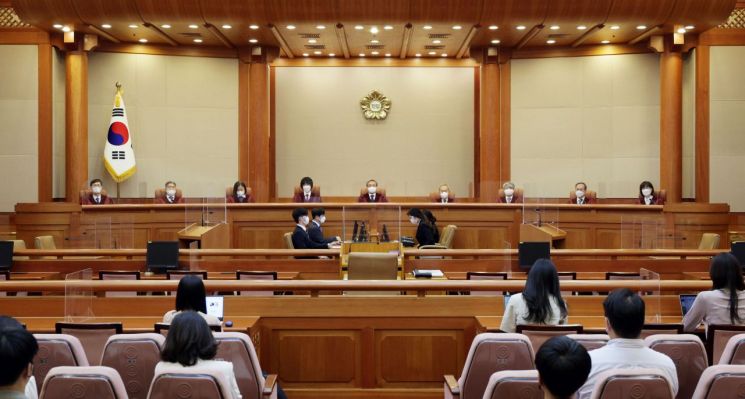
[Asia Economy Reporter Heo Kyung-jun] The Constitutional Court will hold public hearings next week on the authority dispute trial regarding the Complete Prosecution Reform Act (Geomsu Wanbak Law) and the death penalty system. Since the court's decision will determine the constitutionality of the Geomsu Wanbak Law and the death penalty system, interest in the public hearings is higher than ever.
On the 6th, legal circles analyzed that the Geomsu Wanbak Law, which amends the Prosecutors' Office Act and the Criminal Procedure Act, mainly restricts the prosecution's investigation powers and significantly expands the police's authority. If implemented in September, it is expected to bring about a major transformation in the criminal justice system. For this reason, it is widely anticipated that the Constitutional Court will decide on the constitutionality of the law before its enforcement.
The Constitutional Court will conduct the first public hearing on the 12th regarding the authority dispute trial filed by the People Power Party, which claimed that "their rights to review and vote on the bill were infringed," against the Speaker of the National Assembly and the Chairperson of the Legislation and Judiciary Committee concerning the Geomsu Wanbak Law.
Earlier, the People Power Party filed the authority dispute trial, stating that "the agenda adjustment committee chairperson passed the adjustment plan without substantive review, and the Democratic Party appointed Min Hyung-bae, who disguised his party resignation, as an agenda adjustment committee member, which clearly infringed on the petitioners' rights to review and vote on the bill."
Subsequently, the Ministry of Justice and the prosecution also filed an authority dispute trial on the 27th of last month, arguing that "the unconstitutionality of the legislative amendment process is serious and clear, and the content of the amendment causes a severe infringement of the fundamental rights of the sovereign people, thus judging it unconstitutional."
If the Constitutional Court merges the authority dispute cases filed separately by the People Power Party and the Ministry of Justice and prosecution before the hearing date, the Ministry of Justice and prosecution may attend the public hearing. However, since the cases have not yet been merged, it seems unlikely that the Ministry of Justice and prosecution will attend this public hearing.
Ultimately, a separate public hearing will be held for the authority dispute trial filed by the Ministry of Justice and prosecution. Authority dispute trials require mandatory oral arguments. Article 30 of the Constitutional Court Act stipulates that "trials on impeachment, dissolution of political parties, and authority disputes shall be conducted by oral argument."
The Ministry of Justice and prosecution plan to closely monitor this public hearing and prepare future response measures. A prosecution official said, "We are seriously responding to the Geomsu Wanbak Law, which clearly harms the people," and added, "We are reviewing effective measures from various angles."
Additionally, the Constitutional Court plans to hold a public hearing on the death penalty system on the 14th, the first in 13 years. In 1996, the court ruled with a 7 (constitutional) to 2 (unconstitutional) vote, and in 2010, with a 5 (constitutional) to 4 (unconstitutional) vote, upholding the constitutionality of Article 41(1) of the Criminal Act, which defines the death penalty as a type of punishment, and Article 250 of the Criminal Act (murder), which includes the death penalty as a statutory punishment.
The Ministry of Justice recently submitted a brief through its representative, the Korea Legal Aid Corporation, stating that there is no reason to change the existing constitutional judgment on the death penalty.
For the Constitutional Court to declare a law unconstitutional, at least six of the nine justices must agree. Among the current justices, five?including Chief Justice Yoon Nam-seok, and Justices Lee Seok-tae, Lee Eun-ae, Moon Hyung-bae, and Lee Mi-seon?have expressed positions favoring the abolition of the death penalty or are actively considering it.
Therefore, legal circles are giving weight to the expectation that the Constitutional Court will make a progressive decision on the death penalty system following the public hearing.
© The Asia Business Daily(www.asiae.co.kr). All rights reserved.
![Clutching a Stolen Dior Bag, Saying "I Hate Being Poor but Real"... The Grotesque Con of a "Human Knockoff" [Slate]](https://cwcontent.asiae.co.kr/asiaresize/183/2026021902243444107_1771435474.jpg)















