While Market Cap Decreases by 18.12%
Top 10 Stocks Fall 20.25%
Yet, Based on Foreign Investor Demand
Brokerage Firms Recommend Increasing Large-Cap Holdings
[Asia Economy Reporter Myung-Hwan Lee] As the domestic stock market faced a downturn in the first half of this year, resulting in a shrinking market capitalization, it was found that the decrease in market capitalization was more significant among large-cap stocks, which hold a substantial portion of the KOSPI market. Related indices of the KOSPI also showed a larger decline in indices composed mainly of large-cap stocks. However, the securities industry recommended increasing the proportion of large-cap stocks based on the recovery of foreign investor demand.
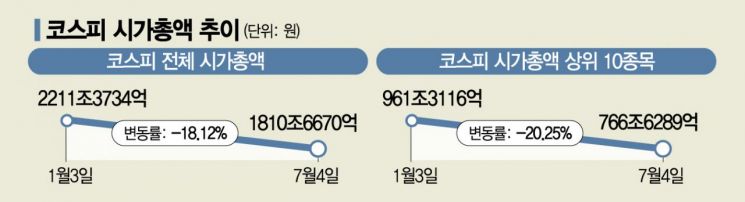
On the 6th, Asia Economy analyzed the market capitalization trends of the KOSPI market as of January 3, the first trading day of this year, and July 4. The KOSPI market capitalization decreased by 18.12% in the first half of the year. The market capitalization, which was 2,211 trillion KRW on January 3, dropped to 1,811 trillion KRW on July 4.
Among the listed stocks in the KOSPI market, the decline was more pronounced in the stocks with the highest market capitalization. The market capitalization of the top 10 stocks, which account for more than 40% of the KOSPI market capitalization, decreased from 961 trillion KRW to 767 trillion KRW during the same period, a 20.25% drop. Even when expanded to the top 20 stocks, the market capitalization decline rate reached 19.37%.
Samsung Electronics, which has held the undisputed number one spot in market capitalization, saw its share of the KOSPI market capitalization noticeably decrease over six months. Samsung Electronics' share of the KOSPI market capitalization, which was 21.22% on January 3, fell to 18.83% on July 4. During this period, Samsung Electronics' market capitalization dropped by 27.35%. The market capitalization shares of other large tech stocks such as SK Hynix (4.23% → 3.58%), Samsung Electronics Preferred (2.66% → 2.36%), and Samsung SDI (2.02% → 1.92%) also declined. Among the top 10 stocks, the market capitalization shares of the two major portal stocks, Kakao (2.31% → 1.67%) and Naver (2.79% → 2.13%), also showed a marked decrease.
The decline centered on large-cap stocks is also confirmed in related indices. The KOSPI50 index, composed of the top 50 stocks by market capitalization, fell by 24.93% during this period, showing a steeper decline than the KOSPI, which dropped 22.75%. Other large-cap focused indices such as KOSPI100 (-23.15%) and KOSPI200 (-22.88%) also experienced relatively larger declines. In contrast, indices composed mainly of small and mid-cap stocks, such as KOSPI Small Cap (-16.62%), KOSPI Mid Cap (-18.30%), and KOSPI200 Small and Mid Cap (-19.48%), showed less severe declines.
Nevertheless, the securities industry recommended expanding the proportion of large-cap stocks, citing the recovery of foreign investors' sentiment centered on large-cap stocks. Lee Kyung-min, a researcher at Daishin Securities, said, "Foreign investors have been increasing their shareholding in large-cap stocks since May," adding, "Given the sharp decline due to external uncertainties, it can be seen as an expectation for a relatively stronger rebound in large-cap stocks once investment sentiment stabilizes." Kim Seung-hyun, head of the research center at Yuanta Securities, also said, "Although foreign investors have net sold a staggering 70 trillion KRW since February 2020, considering the reduced burden, their response to exchange rate changes could be stronger than before," and predicted, "If foreign investors return, the second half of the year will favor large-cap stocks in terms of size."
© The Asia Business Daily(www.asiae.co.kr). All rights reserved.
![Clutching a Stolen Dior Bag, Saying "I Hate Being Poor but Real"... The Grotesque Con of a "Human Knockoff" [Slate]](https://cwcontent.asiae.co.kr/asiaresize/183/2026021902243444107_1771435474.jpg)
















