Households of Urban Workers in the 2nd to 4th Income Quintiles Experience Real Income Decline Over One Year
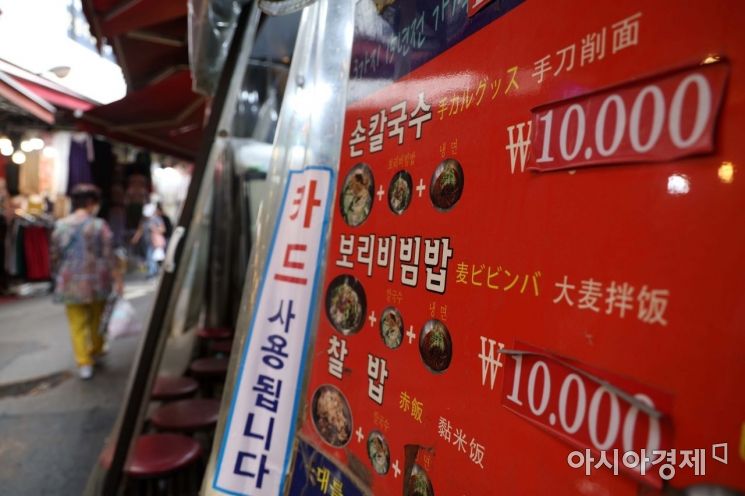 On the 4th, one day before the government's announcement of June consumer price trends, a restaurant in Namdaemun Market, Seoul, is quiet. Photo by Mun Ho-nam munonam@
[Asia Economy Sejong=Reporter Kwon Haeyoung] Amid soaring prices, it has been revealed that the real income of middle-class worker households living in cities decreased in the first quarter of this year.
According to the National Statistical Portal of Statistics Korea on the 6th, the average monthly nominal income of worker households (household head is a worker) living in cities, including special and metropolitan cities, was 5,714,309 KRW in the first quarter of this year, an increase of 6.4% compared to the previous year.
On the other hand, the real income considering inflation (5,424,119 KRW) increased by only 2.5%. Real income is an income indicator calculated by removing the impact of inflation. A decrease in real income means that prices rose more sharply than income, increasing the household burden.
In particular, the real income of middle-class urban worker households, excluding the bottom 20% (1st quintile) and top 20% (5th quintile) income groups, actually decreased compared to a year ago.
Looking at each quintile, the real income of 2nd quintile urban worker households (3,110,107 KRW) decreased by 1.6% compared to the previous year. This is due to a 2.1% decrease in real earned income. The 3rd quintile also saw a 0.5% decrease in real earned income, resulting in a 1% decrease in real income (4,447,991 KRW), and the 4th quintile's real income (6,141,011 KRW) decreased by 2.8%, with earned income down 3.8%. Real disposable income, calculated after deducting essential expenses such as taxes, also decreased across the board for the 2nd (-1.9%), 3rd (-2.4%), and 4th (-3.2%) quintiles.
In contrast, the 1st quintile's real income (1,785,870 KRW) increased by 0.9%, and the 5th quintile's real income (11,626,826 KRW) jumped by 8.6%.
While the 1st quintile, which mainly receives government support, and the 5th quintile, which has a high income level, saw increases in real income, middle-class worker households relying on earned income experienced a decrease in real income, indicating they were directly hit by rising prices. The fact that prices in urban areas are higher than in rural regions likely also had an impact.
With consumer price inflation accelerating more steeply from the second quarter, the blow to middle-class households is expected to grow. Last month, consumer prices rose 6% compared to a year earlier, marking the highest inflation rate in 23 years and 7 months since November 1998 (6.8%) during the foreign exchange crisis.
© The Asia Business Daily(www.asiae.co.kr). All rights reserved.
![Clutching a Stolen Dior Bag, Saying "I Hate Being Poor but Real"... The Grotesque Con of a "Human Knockoff" [Slate]](https://cwcontent.asiae.co.kr/asiaresize/183/2026021902243444107_1771435474.jpg)















