Inflation Rate Hits 6%... First Time in 24 Years Since the Foreign Exchange Crisis
Energy and Raw Material Prices Continue to Rise
'Unmanned Automation' Accelerates to Cut Labor Costs
Increase in Unmanned Convenience Stores, Kiosks, and Serving Robots
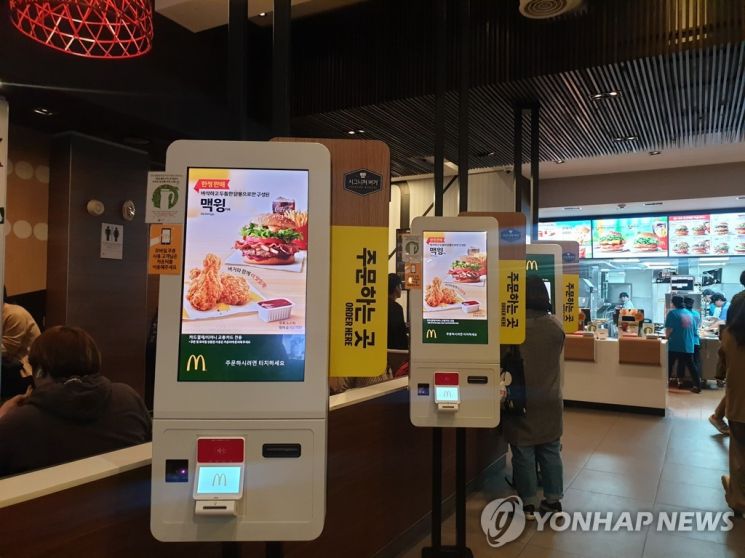 McDonald's kiosk. The photo is not related to any specific expression in the article. [Image source=Yonhap News]
[Asia Economy Reporter Yoon Seul-gi] As the inflation rate in June exceeded 6%, high inflation continues, and the 2023 minimum wage has been raised by 5.0% compared to this year, deepening the worries of self-employed business owners. Since the cause of inflation lies externally, such as the shock from the Ukraine war, it is difficult to expect price stability in the near future. Self-employed individuals are turning to kiosks or serving robots to reduce fixed expenses like labor costs.
According to Statistics Korea on the 7th, the consumer price index in June was 108.22 (2020=100), up 6.0% from the same month last year. This is the first time in about 24 years since the foreign exchange crisis. The consumer price inflation rate was in the 2% range for six months from April to September last year, then rose to 3.2% in October, entering the 3% range. In March (4.1%) and April (4.8%) this year, it was in the 4% range, then 5.4% in May, and rose to the 6% range in June.
By item, prices of industrial products and services rose significantly. Industrial products, including petroleum products (39.6%) and processed foods (7.9%), increased by 9.3% compared to a year ago. Agricultural, livestock, and fishery products rose 4.8%, led by livestock products (10.3%) and vegetables (6.0%), with a larger increase than the previous month (4.2%). Due to the electricity and gas rate hikes in April and May, electricity, gas, and water prices rose 9.6% compared to a year ago. Personal services increased 5.8%, with both dining out (8.0%) and other personal services (4.2%) rising. Public services rose 0.7%, and rent increased by 1.9%.
The rapid inflation trend continues due to the global supply chain disruptions caused by the war, which led to sharp rises in energy and raw material prices, and the recovery of daily life after COVID-19, which pushed up service prices such as dining out. Additionally, the sharp rise in agricultural, livestock, and fishery product prices has increased the inflation rate compared to the previous month (5.4%).
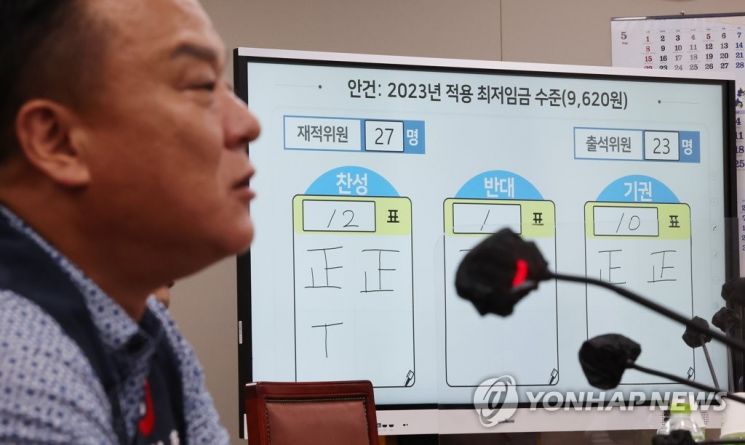 The minimum wage for 2023 has been finalized at 9,620 KRW per hour, a 5.0% increase from this year. [Image source=Yonhap News]
◆ "Payment Capacity Limits" Opposition to Minimum Wage Increase
Earlier, on the 29th of last month, the 2023 minimum wage was finalized at 9,620 won per hour, a 5.0% increase from this year. Compared to this year's minimum hourly wage of 9,160 won, this is a 5.0% (+460 won) increase. The monthly conversion of the minimum wage (based on 209 working hours per month) is 2,010,580 won, which is 96,140 won higher than this year.
With inflation soaring, the increase in minimum wage has intensified the difficulties of self-employed business owners. Particularly, convenience store owners, who mostly employ part-time workers, have expressed dissatisfaction. The Korea Convenience Store Owners Association issued a statement on the 30th of last month, saying, "Convenience stores have long reached the limit of their ability to pay the minimum wage," and criticized the minimum wage increase as "a decision that causes conflicts between parties of equal standing and pushes convenience store owners into lawbreakers."
The association pointed out, "The minimum wage increase causes an additional burden of 300,000 to 450,000 won per store per month," and warned that "an increase without considering the payer's situation will inevitably lead to employment reduction, non-payment of minimum wage, ultra-short-term hiring to avoid weekly holiday pay, and thus worsen social problems."
Mr. Kim, in his 50s, who operates a convenience store in the metropolitan area, also expressed management difficulties. He said, "Sales are similar, but fixed costs like electricity bills and labor costs keep rising. Since the contract period is five years, I can't quit midway even if it's tough. I already work more than eight hours a day, so it's hard to increase working hours further, and I'm considering switching to an unmanned store."
In fact, as labor costs increase, the trend of hybrid convenience stores operating unmanned or unmanned only during certain hours is growing. There are already 120 unmanned stores and 2,603 hybrid stores nationwide.
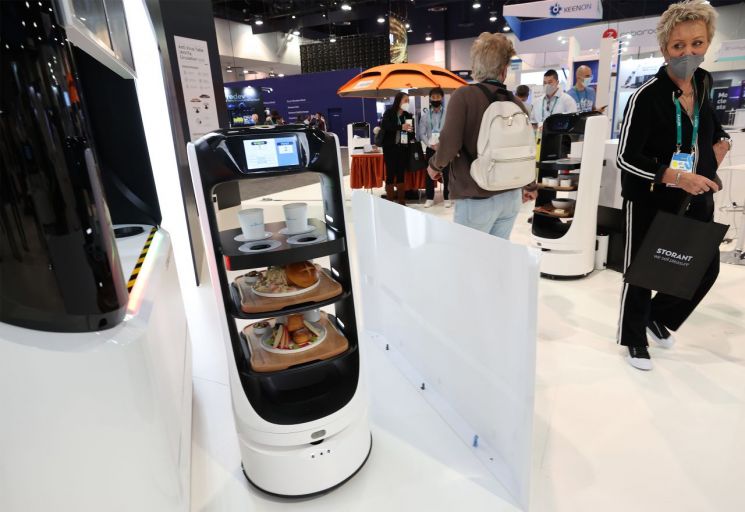 On the second day of CES 2022, the world's largest electronics and IT exhibition, held on the 6th (local time) at the Las Vegas Convention Center in Nevada, USA, visitors are experiencing 'Storant,' a robot cafe that operates ordering, manufacturing, and serving automatically without human intervention, presented by the Korean company 'Vision Semicon.' [Image source=Yonhap News]
In other industries as well, more business owners are using unmanned payment devices (kiosks). According to the finalized '2020 Economic Census Results' by Statistics Korea on the 28th of last month, the number of businesses that introduced kiosks in three sectors?retail, lodging, and food & beverage?was 30,000. Among them, food & beverage accounted for 17,000 (57.1%), the largest share, followed by retail with 10,000 (34.7%) and lodging with 2,000 (8.2%).
In restaurants, serving robots are also being used to replace manpower. Mr. A, who runs a Kalguksu (hand-cut noodle) restaurant in Gyeonggi Province, said, "Kalguksu is heavy, and even with many staff during busy lunch and dinner times, it's tough, so we operate serving robots. They are a bit slow but skillfully avoid obstacles and deliver food to the desired places, which is very convenient. Customers are curious and pleased. Some even ask to have Kalguksu delivered by robot."
An industry insider from the serving robot sector said, "Mainly, self-employed business owners who want to improve service quality are seeking serving robots." He added, "When hiring new part-time workers, you have to train and manage them, but robots don't require that. Robots take over simple labor, allowing staff to provide services that increase customer satisfaction. Rather than completely replacing manpower, robots contribute to enhancing service quality."
© The Asia Business Daily(www.asiae.co.kr). All rights reserved.
![Clutching a Stolen Dior Bag, Saying "I Hate Being Poor but Real"... The Grotesque Con of a "Human Knockoff" [Slate]](https://cwcontent.asiae.co.kr/asiaresize/183/2026021902243444107_1771435474.jpg)


















