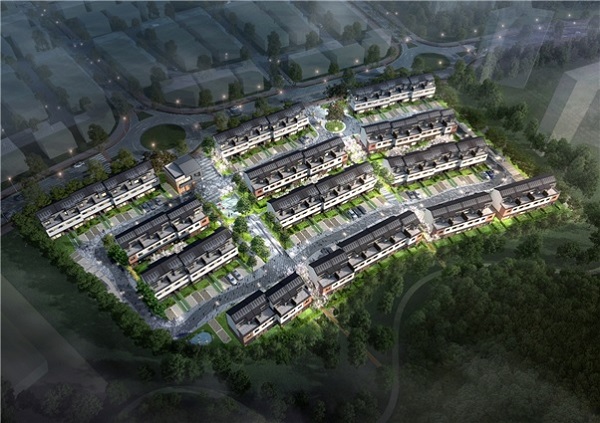
The zero-energy rental detached house 'Loren House' is starting its subscription schedule in Sejong City and Busan. Special and general subscription applications will be accepted from the 6th to the 7th. Winners will be announced on the 13th, followed by document submission from the 18th to the 20th, official contracts from the 22nd to the 24th, and preliminary winner draws and contracts on the 26th and 27th.
LH (Korea Land & Housing Corporation) introduced Loren House, a zero-energy rental detached house, in 2018 in Sejong City, Gimpo Hangang New Town in Gyeonggi, and Osan Segyo District. At that time, 1,598 applicants competed for 219 units, recording an average competition rate of 7.3 to 1, demonstrating its great popularity. Unlike general sales, the lower subscription threshold and the absence of hassles related to detached house construction were cited as reasons for its popularity.
In fact, Loren House attracts high interest from those who want to live in detached houses because it eliminates the hassles of permits and construction that occur when building detached houses. Moreover, as it is supplied as a public-supported private rental housing product, anyone aged 19 or older who is a member of a household without a home can apply regardless of whether they have a subscription savings account or previous winning history.
The affordable market price also receives positive responses from demanders. General supply rents are set at 95% or less of market price, and special supply (for youth, newlyweds, and seniors) rents are 85% or less of market price, with a maximum residence period of 8 years (renewable every 2 years). Rent increases upon contract renewal are limited to within 5%, and there are no tax burdens such as acquisition tax or property tax during the residence period, significantly reducing the burden on residents.
Loren House consists of medium-sized homes with a net floor area of 84㎡, and reduces electricity and heating costs through solar power generation and passive construction methods. It is systematically managed by a professional housing management company, and as rental housing, there are no concerns about financial burden or liquidity issues when disposing of the property.
Especially, Loren House offers the comfort of a detached house and the convenience of an apartment. Each unit has a private yard, making it ideal for children to play freely without worries about noise between floors. In addition to individual parking spaces per unit, facility management, security, and crime prevention services are provided, offering convenience comparable to apartments.
Energy savings are also a strong point of Loren House. By maximizing insulation performance through exterior wall insulation and windows, and utilizing renewable energy such as geothermal and solar power, the indoor temperature is maintained consistently, enabling energy savings of over 65% compared to typical apartments in electricity and heating/cooling costs.
According to LH, it is expected that each household can reduce energy costs by an average of 420,000 KRW annually. Approximately 1,088 tons of carbon dioxide emissions can also be reduced annually, equivalent to the amount absorbed by 165,000 30-year-old pine trees.
LH plans to recruit tenants for seven blocks in three target districts this year: Hwaseong Dongtan Residential Development District, Sejong Administrative City Complex, and Busanjin-Hae Economic Free Zone Myeongji District. Special supply applications will be accepted on the 6th in two locations: Sejong City and Busan.
The zero-energy houses in Sejong City consist of 78 units in 15 buildings, each three stories high, with a net floor area of 84㎡. Private gardens and rooftop terraces are provided as standard, and to protect privacy, maximum distances between buildings and living fences have been designed. The large-scale Gounteul Park is close to the complex, offering an excellent residential environment, and it is an education-specialized complex with kindergartens, elementary, and middle schools within a 500m radius. The government complex and main living areas of Sejong City are nearby, providing access to various living infrastructures. The area is well connected by a wide transportation network and convenient access to major arterial roads in Sejong City.
The zero-energy houses supplied in Busan consist of 64 units in 29 buildings, each three stories high, with a net floor area of 84㎡. It will be developed as a high-quality detached zero-energy residential complex befitting Myeongji International New City. To complete the beautiful natural environment and landscaping, water features will be introduced. A small village rest area with migratory bird-themed sculptures will be created, and a waterside walking path adjacent to the Nakdong River will be designed. The complex boasts a pleasant residential environment adjacent to Ullim Park on the east side, and there are kindergartens, elementary, and middle schools nearby, providing good educational conditions. E-Mart Traders, Busan Museum of Modern Art, neighborhood parks, and Eulsukdo Ecological Park are close by, offering excellent living infrastructure.
The Dongtan zero-energy houses, scheduled for supply in the second half of the year, consist of 332 units in 104 buildings, each three stories high, with a net floor area of 84㎡. They are mainly oriented southward for excellent lighting and ventilation. Close to natural environments such as Hambongsan and Sinrichon Park, it is an urban residential complex where rural life is possible, with a green space ratio exceeding 36%, making it an eco-friendly residential area.
All these complexes provide private gardens and rooftop terraces that residents can use according to their preferences. Residents can grow fruits and vegetables or plant flowers and trees in the gardens, realizing the dream of detached house living. Rooftop terraces allow for home camping and parties, offering a wide-open sense of space. As eco-friendly complexes, two electric vehicle charging stations will be installed in shared parking spaces, and 12 mobile charging stations are planned.
Advanced security systems will also be introduced. Six locations within the complexes will have 2-megapixel high-definition CCTV cameras, and motion detectors will be installed on floors 1 to 3 to detect intrusions by outsiders. Unmanned security systems at unit entrances, unmanned parcel delivery systems, and license plate recognition parking control will be applied. Solar panels converting sunlight into electricity will be installed on roofs, introducing an eco-friendly system that reduces energy costs.
For more details, please visit the official Loren House website. Move-ins for Sejong and Busan Myeongji are scheduled for September, and Dongtan Loren House, scheduled for move-in in April 2023, plans to recruit tenants in the second half of this year.
© The Asia Business Daily(www.asiae.co.kr). All rights reserved.

















