Reusable Amenities Differentiated by Brand and Packaging
Vegan Concept Rooms and Solar Panels on Hotel Exterior
Targeting 'Value Consumption' MZ Generation
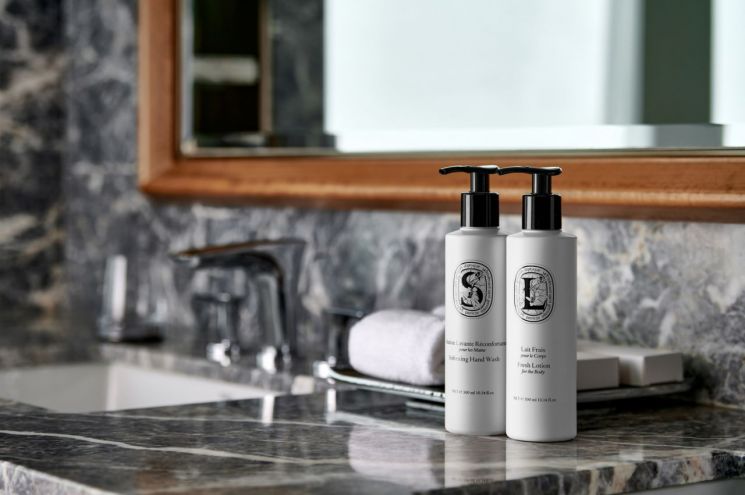
[Asia Economy Reporter Jeon Jinyoung] Luxury hotels have begun actively engaging in ESG (Environmental, Social, and Governance) management by replacing disposable amenities, once a measure of differentiation, with reusable ones and introducing vegan concept rooms. This move aims to align with the value consumption patterns of the MZ generation (Millennials + Generation Z), who have emerged as major consumers in luxury hotels.
According to industry sources on the 5th, Lotte Hotel, Banyan Tree, Sofitel, Walkerhill, Westin Chosun Seoul, Park Hyatt Busan, JW Marriott Dongdaemun, and others are all participating in ESG management with a focus on carbon reduction and eco-friendliness.
Among their ESG efforts, amenities stand out in particular. Disposable amenities have long been regarded as a benchmark of luxury hotel standards, and switching to reusable containers has been a challenge for luxury hotels. Disposable products enhanced hygiene and luxury, and amenity brands were used to differentiate luxury hotels. Moreover, the Ministry of Environment's requirement to ban free provision of small-sized amenities by 2024 has increased the challenge.
In response, luxury hotels have recently been attempting changes that maintain their unique luxury while switching to reusable containers. Lotte Hotel and Signiel devised containers that completely block foreign substances by using tamper-evident packaging. Signiel continues to use the French niche perfume brand Diptyque, while Lotte Hotel switched to the Australian natural skincare brand Grown Alchemist.
Banyan Tree Club & Spa Seoul also strengthened hygiene by placing shampoo, conditioner, and lotion in self-produced reusable ceramic containers and stainless steel pumps in all guest room bathrooms.
Beyond amenities, the hotel industry is participating in ESG in various ways. Walkerhill created the industry's first vegan concept rooms, selecting plant-based leather for cushions and seat pads and using bathroom amenities that have not undergone animal testing. Sofitel installed solar panels on the hotel exterior and water-saving showerheads to contribute to carbon reduction. JW Marriott Dongdaemun Square received eco-friendly building certifications in architectural design and indoor environment, promoting this as a strength.
These changes appear to target the demand of the MZ generation, who have emerged as major consumers in luxury hotels and emphasize value consumption trends. For this reason, luxury hotel vacation packages this summer have shifted from simple pool vacations to "eco-friendly vacations." Park Hyatt Busan offers a "Green Summer" package that provides mineral sunscreen that is harmless to marine ecosystems.
An industry insider said, "When ESG management changes such as introducing large-capacity dispensers first began, some customers felt awkward," but added, "However, as the proportion of MZ guests has increased compared to before, more guests are positively viewing these efforts as participation in eco-friendly activities."
© The Asia Business Daily(www.asiae.co.kr). All rights reserved.
![Clutching a Stolen Dior Bag, Saying "I Hate Being Poor but Real"... The Grotesque Con of a "Human Knockoff" [Slate]](https://cwcontent.asiae.co.kr/asiaresize/183/2026021902243444107_1771435474.jpg)
















