Volatility Swings in War and Ssangyong Motor-Related Stocks
June Shows Highest Fluctuations in First Half of the Year
[Asia Economy Reporter Myunghwan Lee] It has been revealed that June experienced the highest market volatility in the domestic stock market during the first half of this year. This is attributed to the global stock markets entering a downturn in June, causing stock prices of certain stocks to fluctuate wildly. By stock, those related to grains and energy, classified as beneficiaries of the war, and companies participating in the Ssangyong Motor acquisition battle showed the largest price fluctuations.
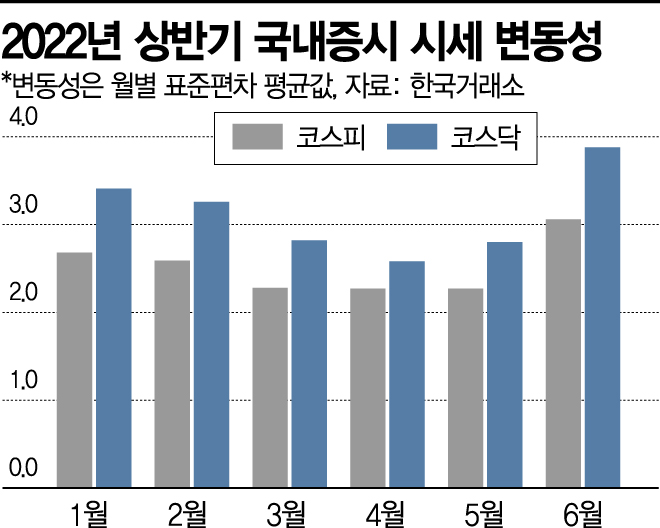
On the 5th, Asia Economy compiled the price trends of listed stocks on the KOSPI and KOSDAQ markets for the first half of this year. The average standard deviation for all KOSPI stocks was 2.53, while for all KOSDAQ stocks it was 3.13. The standard deviation is a figure that indicates the extent to which stock prices fluctuate from their average value, serving as an indicator of price volatility. It appears that the price volatility of KOSDAQ-listed stocks was higher than that of KOSPI-listed stocks in the first half of the year.
Looking at monthly price volatility, both major markets showed the largest price fluctuations in June. The average standard deviation of KOSPI stocks in June was 3.06, the only month in the first half to exceed 3. KOSDAQ also recorded its highest average standard deviation of 3.88 in June. As concerns over a global economic recession grew in June, the domestic stock market showed a continuous downward trend, which seems to have expanded volatility as a result.
January had the second highest price volatility after June. The average standard deviation for KOSPI in January was 2.68, and for KOSDAQ it was 3.41. In January, volatility was high due to the escalating threat of Russia's invasion of Ukraine. February also showed relatively high volatility, with KOSPI and KOSDAQ recording 2.59 and 3.26, respectively.
Examining the stocks with the highest volatility, certain thematic stocks occupied the top ranks. On the KOSPI, Shinwonwoo had the highest volatility in June at 16.76. Shinwonwoo faced delisting as the Financial Services Commission raised the entry conditions for preferred stocks, deciding to remove stocks with fewer than 100,000 listed shares under the strengthened listing requirements. Demand surged for short-term gains ahead of delisting, resulting in high price volatility. KG Steel Preferred also recorded a standard deviation of 16.57 in April for the same reason.
Additionally, on the KOSPI, stocks classified as beneficiaries of the war such as Daesung Energy (13.47 in February), Shinsong Holdings (12.40 in April), and Korea Industries (11.76 in April), as well as stocks related to the Ssangyong Motor acquisition battle like Ssangbangwool (13.36 in April), Vivian (12.23 in April), and Mirae Industry (11.95 in April) showed high volatility.
The KOSDAQ showed a similar trend. Feed stocks such as Hanil Feed (15.83 in April) and Hyundai Feed (14.31 in March), and Ssangbangwool-affiliated stocks like Edison INNO (16.26 in February) and Kwanglim (13.74 in April) exhibited large volatility. The stock with the highest volatility on KOSDAQ was Pobyeipo, which listed in April, with a standard deviation of 30.25, indicating significant price movements mainly among newly listed stocks. Newly listed stocks such as Notus (21.63 in June), K Auction (20.49 in January), and Auto & (18.79 in January) also showed large volatility.
It is expected that volatility in the domestic stock market will continue this month as well. Ji-young Han, a researcher at Kiwoom Securities, commented on the July stock market, saying, "During the process of digesting major events such as macro indicators and earnings announcements, there is a possibility that the KOSPI may temporarily break below the lower bound, making volatility inevitable." She advised, "A strategy to respond by focusing on sectors with favorable earnings outlooks such as automobiles, entertainment, and distribution, or by adopting quality and dividend styles with strong earnings defense capabilities, would be an alternative."
© The Asia Business Daily(www.asiae.co.kr). All rights reserved.
![Clutching a Stolen Dior Bag, Saying "I Hate Being Poor but Real"... The Grotesque Con of a "Human Knockoff" [Slate]](https://cwcontent.asiae.co.kr/asiaresize/183/2026021902243444107_1771435474.jpg)















