Business Community on High Alert Over Chain Strikes
Government Urges Restraint Amid Inflation Pressure
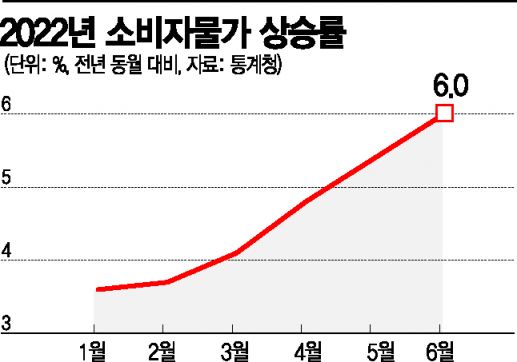
[Asia Economy Reporter Kiho Sung] As consumer prices in June recorded a 6.0% increase for the first time in 24 years, labor unions are gearing up to intensify their wage hike demands and launch a full-scale "Hatu" (夏鬪, summer struggle). Following the Korean Confederation of Trade Unions' largest rally since the inauguration of the Yoon Seok-yeol administration on the 2nd, aimed at "taming" the government, the Hyundai Motor Union is also likely to hold a general strike for the first time in four years. This year, in particular, strong opposition is expected against next year's minimum wage increase rate and the government's pro-business policy direction, signaling a more militant struggle than ever before. Meanwhile, the government, concerned about inflation, is requesting companies to restrain excessive wage increases and has stated it will strictly respond to illegal activities by labor unions, raising concerns that conflicts between the new administration and labor groups could escalate into a "showdown."
According to the Ministry of Employment and Labor and the completed car industry on the 5th, the Central Labor Relations Commission decided yesterday to suspend negotiations between Hyundai Motor's labor and management. This was due to significant differences in opinions over wages and collective bargaining agreement terms. Having passed the strike vote on the 1st, the Hyundai Motor Union has thus obtained the legal right to strike.
The business community fears that if the Hyundai Motor Union enters a strike phase for the first time in four years ahead of the labor sector's Hatu, a chain of strikes could follow. The Hyundai Motor Union is the largest single union in the country and holds significant influence within the Korean Confederation of Trade Unions, making its strike more symbolic than others.
Strikes demanding wage increases are already underway in various places. According to the Ministry of Employment and Labor, as of the 1st, strikes have begun at 42 workplaces nationwide this year. Among them, mediation has been conducted at 16 sites, while 26, including subcontractor unions at Daewoo Shipbuilding & Marine Engineering and the Isu Chemical Union, are continuing strikes demanding wage increases and other issues.
Unions at large corporations are competitively demanding substantial wage hikes and are prepared to strike if necessary. The Hyundai Motor Union has proposed a basic wage increase of 165,200 KRW and a performance bonus amounting to 30% of net profits. The basic wage increase rate reaches 7.3%.
Samsung Electronics, with about 4,500 employees belonging to four unions, accounting for only about 4% of the total 113,000 employees, has become a hot issue. The labor-management council (non-union) agreed on a 9% wage increase, but negotiations with the unions have not even started this year. The unions are demanding a uniform annual salary increase of 10 million KRW and a performance bonus of 25% of operating profit. SK Hynix is conducting separate negotiations with the full-time (production) union and the technical office workers' union. The technical office workers' union has proposed a 12.8% basic wage increase.
A possibility of a chain strike centered on the Korean Confederation of Trade Unions is also being raised. The Korean Metal Workers' Union under the Confederation has announced a large-scale strike involving about 200,000 participants in mid-month, and the Health and Medical Workers' Union has also announced a strike next month. Additionally, the Confederation plans to hold a nationwide workers' rally on the 15th of next month and may push for a general strike in October.
The government is requesting restraint on wage increases considering inflationary pressures. On the 28th of last month, Deputy Prime Minister and Minister of Economy and Finance Choo Kyung-ho said at a policy meeting with the Korea Employers Federation, "Recently, a high wage increase trend has appeared mainly among some IT companies and large corporations, showing signs of spreading to other industries and companies, which is a very worrisome situation." He emphasized, "Excessive wage increases not only exacerbate the high-price situation but also widen the wage gap between large corporations and small and medium-sized enterprises, increasing the relative deprivation of SMEs and vulnerable workers."
Companies are also voicing concerns. An executive from a major corporation pointed out, "The global economy is entering a recession phase, and the economic environment at home and abroad is rapidly changing due to industrial restructuring. Although the labor sector is leading the Hatu by demanding wage increases, such demands lack justification as they could negatively impact the economy during this turbulent period."
© The Asia Business Daily(www.asiae.co.kr). All rights reserved.
![Clutching a Stolen Dior Bag, Saying "I Hate Being Poor but Real"... The Grotesque Con of a "Human Knockoff" [Slate]](https://cwcontent.asiae.co.kr/asiaresize/183/2026021902243444107_1771435474.jpg)















