[Asia Economy Reporter Lee Seon-ae] Amid the visible technical recession in the US economy, there is a forecast that Jerome Powell, Chairman of the Federal Reserve (Fed), will not break the monetary tightening stance.
On the 5th, Korea Investment & Securities predicted that the interest rate hike trend would not be broken by a technical recession.
Yoon So-jung, a researcher at Korea Investment & Securities, said, "Even if the US economy shows a technical recession, the Fed's stance on raising the benchmark interest rate will not be broken," adding, "The condition for the Fed to step back is that inflation declines over several months and the direction becomes clear. However, gasoline prices rose in June, and the year-on-year increase rates of the Cleveland PCE median and the Dallas Fed trimmed mean PCE, which indicate near-term inflation trends, rose further in May. It is difficult to expect any clues in the June CPI release that would break the Fed's tightening stance."
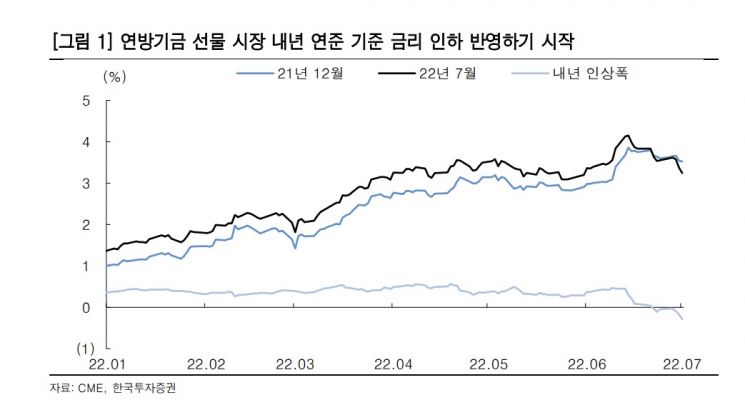
As of the 30th of last month, the Atlanta Federal Reserve Bank's Q2 GDP nowcasting turned negative. This was mainly due to weak private consumption and worsening inventory accumulation outlook caused by the whip effect, which contributed most to the downward revision of the forecast. If GDP records negative growth for two consecutive quarters, it could be considered a technical recession. In fact, in line with these economic concerns, the federal funds futures market has begun to reflect the possibility of the Fed cutting rates next year.
However, the National Bureau of Economic Research (NBER), which officially judges US economic recovery or recession, defines a recession as a state where overall economic activity is significantly contracted for a considerable period. Assuming the June nonfarm payroll consensus is correct, with 2.7 million new jobs created in the first half of the year, it is difficult to define this as a state of significant contraction in economic activity. Researcher Yoon predicted, "Even if a technical recession materializes, the NBER will not define the first half of this year as the start of a recession."
He pointed out, "Despite the increased possibility of a technical recession in the US economy, the tightening stance will not be broken, and quantitative tightening (QT) will not be used as an active monetary policy tool. Accordingly, the narrowing trend of the long- and short-term spread of US Treasury yields continues, increasing the likelihood of an inversion occurring in the third quarter."
© The Asia Business Daily(www.asiae.co.kr). All rights reserved.

















