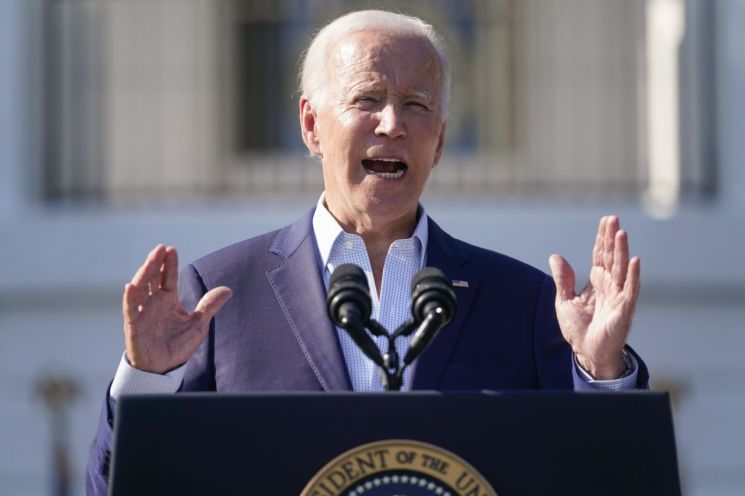
[Asia Economy Reporter Jeong Hyunjin] U.S. President Joe Biden may announce this week a reduction in high tariffs on Chinese consumer goods such as clothing and stationery, Bloomberg News and The Wall Street Journal (WSJ) reported on the 4th (local time). Former President Donald Trump raised tariffs during the U.S.-China trade war, and President Biden has sought to maintain pressure on China, but high inflation has been a hindrance.
Foreign media, citing multiple sources, reported this and said that President Biden has not yet made a final decision and the announcement timing could be delayed. WSJ explained that along with the suspension of tariffs on consumer goods such as clothing and stationery, a broad framework allowing importers to request tariff exemptions is expected to be introduced.
A White House official told Bloomberg that no final decision has been made regarding tariffs yet, but the administration hopes that tariffs align with economic and strategic priorities and do not lead to unnecessary cost increases for Americans.
Foreign media evaluated that if the Biden administration’s tariff reduction on China is confirmed, it would be an important policy move in U.S.-China trade relations. This is interpreted as the Biden administration, which has sought to maintain economic pressure on China, stepping back due to inflationary pressures. In fact, it is reported that the announcement timing of the tariff reduction has been postponed several times due to these concerns. WSJ said, "The repeated delays in the (reduction announcement) show serious divisions within the administration regarding tariffs on China."
In particular, within the administration, Treasury Secretary Janet Yellen showed a positive attitude toward reducing tariffs on China to curb inflation, but U.S. Trade Representative (USTR) Katherine Tai and White House National Security Council (NSC) Advisor Jake Sullivan reportedly held the position that tariffs should be used as leverage to obtain other concessions from China, WSJ reported.
On the 21st of last month, President Biden expressed willingness to speak with Chinese President Xi Jinping regarding tariff reductions on China, suggesting the timing of the reduction was imminent. However, it is known that President Biden has been discussing tariffs imposed during the Trump administration with key economic officials for weeks. Sources told Bloomberg that within the Biden administration, there was a proposal to request reciprocal tariff reductions on U.S. products if a call with President Xi took place, but this plan was scrapped.
Former President Trump imposed high tariffs on Chinese imports four times from July 2018 to September 2019, citing unfair economic practices and trade imbalance issues with China. The two sides reached a Phase One agreement in January 2020, where the U.S. suspended some tariffs and China agreed to purchase an additional $200 billion (about 259 trillion won) worth of U.S. goods and services over two years. Currently, the U.S. maintains a 25% high tariff on $250 billion worth of Chinese goods, and tariffs on $120 billion worth of Chinese goods have been reduced from 15% to 7.5% according to the January 2020 agreement.
© The Asia Business Daily(www.asiae.co.kr). All rights reserved.
![Clutching a Stolen Dior Bag, Saying "I Hate Being Poor but Real"... The Grotesque Con of a "Human Knockoff" [Slate]](https://cwcontent.asiae.co.kr/asiaresize/183/2026021902243444107_1771435474.jpg)















