Russia and Iran Face Narrowed Oil Markets Due to Western Sanctions... Competing to Supply China at 'Low Prices'
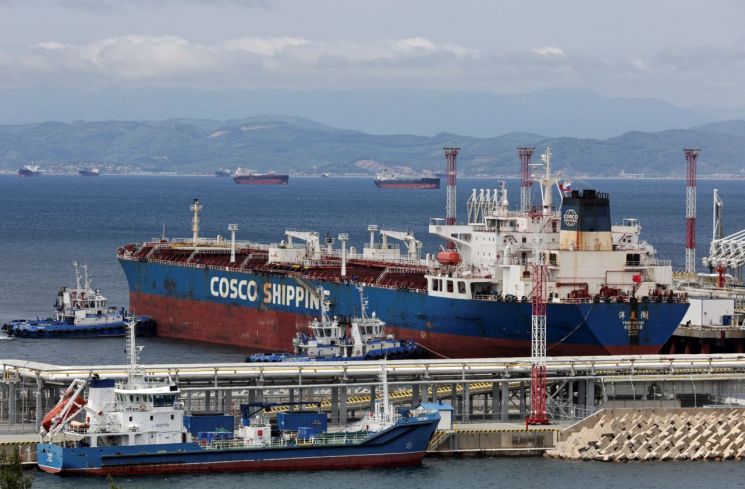 Iran is engaged in a 'bargain competition' with Russia over the oil market of China, the largest crude oil consumer. [Image source=Reuters Yonhap News]
[Asia Economy Reporter Yoon Seul-gi] Russia and Iran, part of the anti-American camp, are engaged in a 'price war' over the Chinese crude oil market. Since the invasion of Ukraine, Russia, blocked from markets by economic sanctions from the West including the United States, has been supplying cheap crude oil to China, forcing Iran to lower its crude oil prices as well.
On the 4th (local time), Bloomberg reported that Russia, whose crude oil export routes have narrowed due to Western sanctions, is launching a 'bargain offensive' to increase its market share in China, causing Iran to struggle to sell its crude oil at fair prices. China is Iran's largest crude oil customer blocked from exports by U.S. sanctions, but since Russia has flooded the Chinese market after the Ukraine invasion, Iran's situation has become difficult.
China has significantly increased imports of Russian crude oil since the Ukraine war. Russia, whose market access has been limited by international sanctions, supplied crude oil cheaply to China. In May alone, China imported 8.42 million tons of Russian crude oil, a 55% increase compared to the same month last year.
Given this situation, Iran has no choice but to lower crude oil prices to maintain competitiveness in the Chinese market. The media reported that currently, Iranian crude oil prices are forming a range similar to Russian Ural crude oil scheduled to arrive in China in August.
This price is $10 per barrel lower than Brent crude, whereas before the war, the price difference between Brent crude and Iranian crude was about $4 to $5 per barrel, effectively doubling the gap. As of the 30th of last month, Brent crude was priced at $114.91 per barrel.
International energy consulting firm Fact Global Energy (FGE) explained that China maintained Iranian crude oil imports at about 700,000 barrels per day in May and June, but Russian Ural crude oil is partially replacing Iranian crude oil in the Chinese market.
Bandana Hari, founder of Singapore-based energy information company Vanda Insights, said, "The competition between Iran and Russia is entirely advantageous to China," adding, "Gulf oil-producing countries, which have to watch their market share being taken by significantly cheaper crude oil, will also become uneasy." China is one of the largest crude oil importers for Gulf oil-producing countries as well.
China's private small refineries, known as 'Tipat' (tea kettle), unlike state-owned refineries, are blocked from exporting to overseas markets and supply fuel only to the domestic market. These companies have recently suffered losses due to reduced domestic demand caused by COVID-19 lockdowns and have become more dependent on cheap Russian and Iranian crude oil.
There are also concerns that some West African countries' crude oil has lost price competitiveness because China buys cheap crude oil without considering its origin. West African oil-producing countries such as Angola, Gabon, and the Democratic Republic of the Congo are relatively far from China, resulting in higher transportation costs.
Energy information provider Kaypler explained that these oil-producing countries are inevitably hit by the 'bargain competition' between Russia and Iran. Mihal Meidan, China energy analyst at the Oxford Institute for Energy Studies (OIES), also said, "Crude oil price is a particularly important consideration for Tipat," adding, "This trend is likely to continue until the economy recovers, activities resume, and crude oil demand increases."
© The Asia Business Daily(www.asiae.co.kr). All rights reserved.
![Clutching a Stolen Dior Bag, Saying "I Hate Being Poor but Real"... The Grotesque Con of a "Human Knockoff" [Slate]](https://cwcontent.asiae.co.kr/asiaresize/183/2026021902243444107_1771435474.jpg)















