Bank of Korea's 'End of June Foreign Exchange Reserves' Statistics
Decreased by $9.43 Billion in One Month
Reserves Used to Defend Won Value
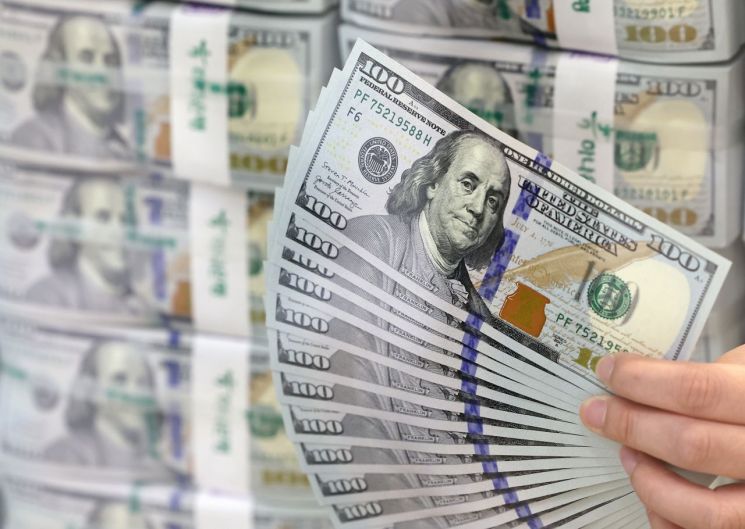
Amid concerns over the depreciation of the Korean won and capital outflows due to the sharp interest rate hikes in the United States, South Korea's foreign exchange reserves decreased by $9.43 billion in one month, marking the fourth consecutive month of decline.
According to the 'End of June Foreign Exchange Reserves' statistics released by the Bank of Korea on the 5th, South Korea's foreign exchange reserves stood at $438.28 billion, down $9.43 billion from the end of the previous month. This is the lowest level in 1 year and 7 months since November 2020 ($436.377 billion).
The foreign exchange reserves have decreased for four consecutive months: $461.766 billion in February, $457.81 billion in March, $449.298 billion in April, and $447.711 billion in May. The decrease this month was significantly larger than the previous month's $1.59 billion decline.
In the recent situation where the won-dollar exchange rate has risen sharply, the foreign exchange authorities appear to have used a large portion of the foreign exchange reserves to defend the value of the won, which expanded the scale of the decrease. Although the won's value is generally determined by the market, when there are extreme fluctuations, the authorities use the foreign exchange reserves, which serve as an emergency fund in foreign currency, to buy or sell dollars to stabilize the market.
The Bank of Korea explained the reasons behind the decrease in foreign exchange reserves, stating, "The decrease was caused by the reduction in the US dollar equivalent of foreign currency assets in other currencies and financial institution deposits, as well as the implementation of measures to ease volatility in the foreign exchange market."
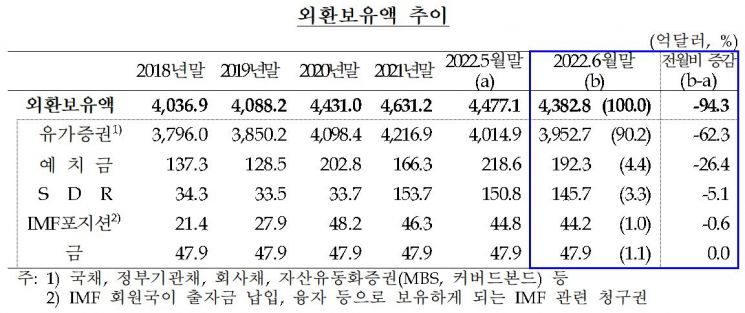
Looking at the assets, securities such as government and corporate bonds ($395.27 billion) sharply decreased by $6.23 billion compared to the previous month, deposits ($19.23 billion) decreased by $2.64 billion, International Monetary Fund (IMF) Special Drawing Rights (SDR, $14.57 billion) decreased by $510 million, and the IMF position ($4.42 billion) decreased by $60 million.
As of the end of May, South Korea ranked 9th in the world in terms of the size of its foreign exchange reserves, the same as the previous month.
China had the largest reserves at $3.1278 trillion, followed by Japan ($1.3297 trillion), Switzerland ($1.0411 trillion), India ($603.2 billion), Russia ($587.4 billion), Taiwan ($548.9 billion), Hong Kong ($465 billion), and Saudi Arabia ($451.6 billion).
Among the top 10 countries, foreign exchange reserves increased compared to the previous month in China ($8.1 billion), Japan ($7.5 billion), Switzerland ($9.3 billion), India ($6.5 billion), and Taiwan ($3.8 billion), while South Korea, Russia (-$5.6 billion), and Singapore (-$19.9 billion) saw decreases.
© The Asia Business Daily(www.asiae.co.kr). All rights reserved.
![Clutching a Stolen Dior Bag, Saying "I Hate Being Poor but Real"... The Grotesque Con of a "Human Knockoff" [Slate]](https://cwcontent.asiae.co.kr/asiaresize/183/2026021902243444107_1771435474.jpg)
















