'Lovebugs' Flying While Mating... About 1cm Long
"Stay Attached for Days to Prevent Mating with Other Bugs"
"This Year's Drought Caused Simultaneous Emergence and Swarm"
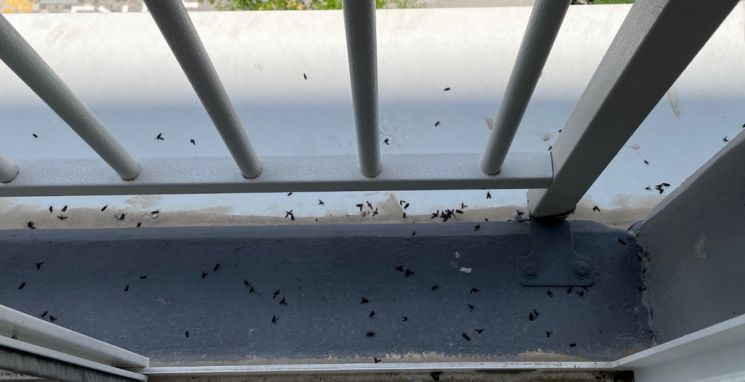 'Lovebugs' appearing in Eunpyeong and Seodaemun districts of Seoul, and Goyang city in Gyeonggi Province./Photo by Reader, Yonhap News
[Asia Economy Reporter Yoon Seul-gi] Recently, swarms of insects known as 'Lovebugs' (Sarangbeolle) have appeared in large numbers in some areas of Seoul and northwest metropolitan areas such as Goyang City in Gyeonggi Province, causing significant damage to residents and merchants. Experts predict that they will disappear within 1 to 2 weeks.
Lee Dong-gyu, Distinguished Professor of Health and Environmental Sciences at Kosin University, appeared on CBS Radio's 'Kim Hyun-jung's News Show' on the 4th and said, "(The appearance of Lovebugs) usually occurs a lot in early summer," adding, "We expect it to end within 1 to 2 weeks."
Regarding Lovebugs, Professor Lee explained, "In Korean, they are called Udarm Teolpari (Udarm Hairy Flies). They have a lot of hair on their bodies. They are only about 1 cm in size. These insects fly around while mating (male and female), which is why they are called Lovebugs," and added, "Even after mating, they stay attached for several days to prevent mating with other species or insects."
He continued, "Their behavior is quite slow. They usually appear from April to June, mostly until June, and after that, they may appear once more in the fall. This species has existed in Korea since ancient times, mainly living in mountains. They lay eggs under fallen leaves and dead plants in the mountains and feed on the decayed substances in those leaves, so they rarely came down to residential areas until now."
Regarding the large-scale appearance of Lovebugs in cities this year, Professor Lee said, "If there is a prolonged drought in spring like this year, the pupae do not emerge as adults but wait until it rains. When it rains after a long drought, the pupae suddenly emerge all at once, causing a mass outbreak."
Professor Lee mentioned that while Lovebugs play a beneficial role as decomposers in the ecosystem, problems can arise when they swarm in cities. He said, "Both larvae and adults tend to gather in groups. When they lay eggs, they do not disperse but live together in thousands or tens of thousands in the same place, then become pupae and emerge as adults, continuing to swarm together," adding, "Lovebugs are attracted to car exhaust smells and can swarm on highways, causing traffic problems."
◆ How to reduce damage caused by Lovebugs?
Professor Lee advised, "Their bodies are strongly acidic, so they leave stains on cars and reduce the function of radiators in front of cars. In areas where they appear frequently, it is recommended to apply wax to your car."
He also said, "Lovebugs do not like wet or moist places, so spraying lake water on apartment walls where they often stick can prevent them from settling. They are active during the day, so when Lovebugs are abundant, it is better to be active at night. Also, Lovebugs prefer bright colors, so it is better to wear dark-colored clothes if possible."
Additionally, Professor Lee said, "Mixing three spoons of mouthwash with orange or lemon juice in a cup of water and spraying it has a repellent effect. Spraying this near window screens will prevent them from sticking."
© The Asia Business Daily(www.asiae.co.kr). All rights reserved.
![Clutching a Stolen Dior Bag, Saying "I Hate Being Poor but Real"... The Grotesque Con of a "Human Knockoff" [Slate]](https://cwcontent.asiae.co.kr/asiaresize/183/2026021902243444107_1771435474.jpg)















