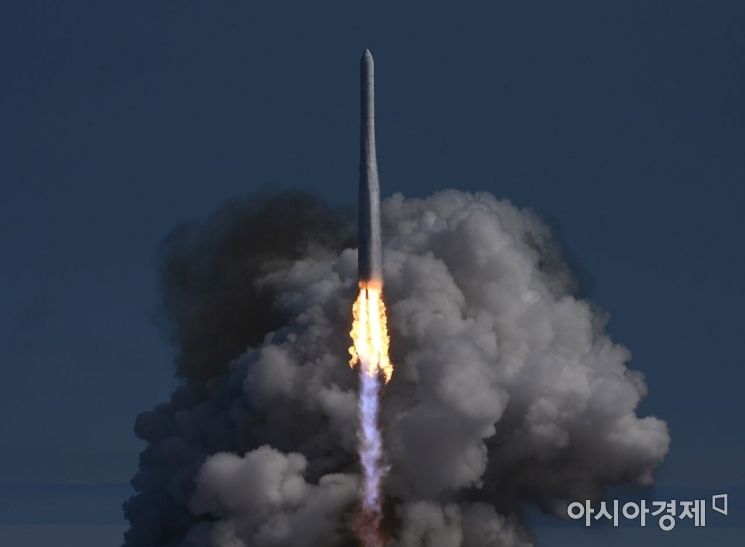
 The Korean launch vehicle Nuriho (KSLV-II), designed and manufactured entirely with domestic technology, is soaring into space with flames erupting from the launch pad at Naro Space Center in Goheung-gun, Jeollanam-do on the 21st. Unlike the first launch, which carried only a dummy satellite with no actual functionality, the second launch of Nuriho this time included a performance verification satellite and four CubeSats. / Goheung = Photo by Joint Press Corps
[Asia Economy Yang Nak-gyu, Military Specialist Reporter] Korean Air is embarking on the development of a high-performance engine for small launch vehicles to lead the "New Space" (private-led space industry). Having been selected as a target for the Ministry of Science and ICT's "Small Launch Vehicle Development Capability Support Project," the company aims to develop a two-stage small space launch vehicle using domestic technology. The lower stage of the two-stage launch vehicle will be equipped with a 75-ton class engine used in the Nuri rocket.
The engine Korean Air has started developing is a 3-ton class engine to be installed in the upper stage of the launch vehicle. Private companies selected for the project, including Korean Air, will lead the entire process from initial design to development, competing in research and development. The project budget is approximately 20 billion KRW, with a target completion date set for 2027. Korean Air played a leading role in the development and assembly of Naroho, Korea's first space launch vehicle, in 2012, as well as in the development of 75-ton and 7-ton class engines. The company has also continuously carried out comprehensive aircraft system integration and private aircraft structural development projects.
Currently, to strengthen the global competitiveness of the domestic space industry, the Ministry of Science and ICT is actively promoting the "Space Pioneer" project with a total budget of 211.5 billion KRW through 2030. Korean Air is participating in this project by developing common bulkhead propellant tanks used in space launch vehicles, fuel supply devices connecting the stages of launch vehicles, and mobile launch pads. The company is also involved in the Future Space Education Center consortium at Pusan National University to foster space specialists. Through this, Korean Air is developing avionics systems for launch vehicle payloads and designing airborne launch vehicle missions. Participation in the Small Launch Vehicle Development Capability Support Project is expected to further enhance Korean Air's core technological capabilities related to space launch vehicles.
There is also analysis suggesting that the security crisis triggered by Russia could actually be a boon for the space industry. Following Russia's invasion of Ukraine and subsequent international sanctions, Russia has significantly reduced cooperation in the space industry. In March, the planned launch of British internet satellite company OneWeb's satellites using Russian Soyuz rockets from the Baikonur Cosmodrome in Kazakhstan was canceled. This was in retaliation after Russia demanded that the UK government, which joined economic sanctions against Russia, sell all its shares in OneWeb, a demand that was refused. In April, Russia announced its withdrawal from the International Space Station (ISS). Russia plays a significant role in ISS management, maintaining the station's altitude with its domestically developed spacecraft engines. Russia's obstinacy has inevitably created a gap in the space industry sector. However, this is expected to ultimately serve as an opportunity for countries worldwide to expand their own space industry infrastructure.
© The Asia Business Daily(www.asiae.co.kr). All rights reserved.
![Clutching a Stolen Dior Bag, Saying "I Hate Being Poor but Real"... The Grotesque Con of a "Human Knockoff" [Slate]](https://cwcontent.asiae.co.kr/asiaresize/183/2026021902243444107_1771435474.jpg)















