[Asia Economy Reporter Seo So-jung] An analysis has emerged that if the risk of global supply disruptions materializes due to the prolonged Ukraine crisis and China's zero-COVID policy, the inflationary trend in South Korea, which has a high dependence on external factors, could intensify.
On the 4th, the Bank of Korea stated in its report titled "Characteristics of Recent Global Supply Chain Disruptions and Their Impact on Domestic Industries" that "Although global supply chain disruptions somewhat eased since the end of last year, supply chain pressures have increased again this year due to the Ukraine crisis and China's lockdown measures, restricting production activities and acting as a factor that raises inflationary pressures."
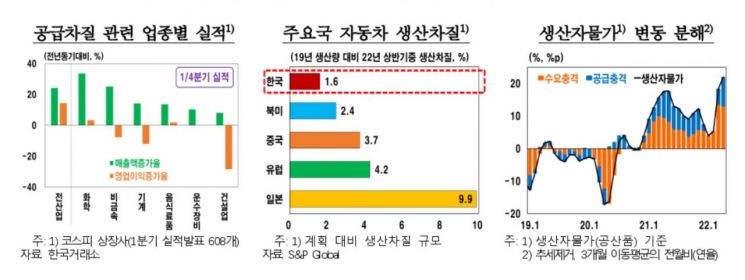
According to the report, recent global supply chain disruptions are characterized mainly by increased cost pressures, production disruptions concentrated in specific sectors such as automobiles, and differentiated impacts by country depending on trade structures.
Kim Seon-jin, head of the Survey Team at the Bank of Korea's Research Department, explained, "Due to the surge in energy and raw material prices caused by increased geopolitical risks, cost burdens across industries have intensified," adding, "Production disruptions have occurred mainly in industries with complex supply chains or low substitutability of intermediate goods, such as automobiles."
In fact, among items classified as manufactured goods in the producer price statistics, the proportion of items with price increases exceeding 5% has surpassed 50% this year, and about 40% of items have risen by more than 10%.
Furthermore, the degree of impact varies by country depending on trade structures with war and lockdown regions and differences in intermediate goods self-sufficiency rates. Europe, with high dependence on Russia and China for energy and raw materials, has been notably affected by supply disruptions, whereas the United States, a net energy exporter, has been relatively less impacted.
Domestically, recent global supply chain disruptions have partially constrained production and acted as a factor increasing input costs across industries.
Production has been restricted in some industries such as automobiles, construction, and machinery equipment due to parts and material supply disruptions, and from a cost perspective, the widespread rise in raw material and intermediate goods prices has increased cost burdens and worsened profitability in most industries.
Estimates using models also show that producer prices are under upward pressure as robust demand continues alongside supply disruptions.
However, South Korea's relatively favorable quarantine situation, along with efforts such as parts internalization and inventory management, have meant that the impact on production has been less severe compared to other countries.
Kim said, "Given the prolonged Ukraine crisis, continued Chinese zero-COVID policy, and potential instability in global food supply, there is high uncertainty about the future development of supply disruptions," adding, "It is necessary to closely examine the global supply chain situation and domestic industry vulnerabilities to prepare in advance for shocks and actively respond to the restructuring of global supply chains."
© The Asia Business Daily(www.asiae.co.kr). All rights reserved.
![Clutching a Stolen Dior Bag, Saying "I Hate Being Poor but Real"... The Grotesque Con of a "Human Knockoff" [Slate]](https://cwcontent.asiae.co.kr/asiaresize/183/2026021902243444107_1771435474.jpg)















