[Asia Economy Reporter Lee Jung-yoon] It has been identified that one out of five listed companies has experienced a change in their largest shareholder within the past three years. It is explained that companies with three or more changes in their largest shareholder pose higher risks, so caution is necessary when investing.
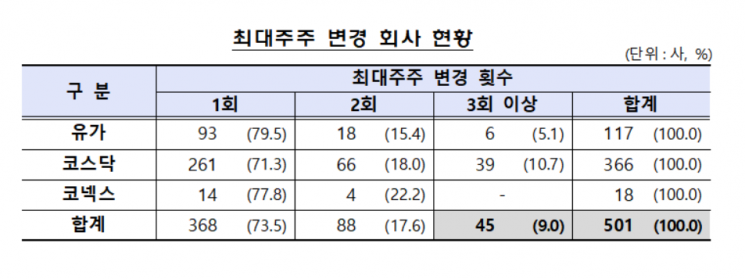
According to the Financial Supervisory Service on the 4th, a total of 501 listed companies had changes in their largest shareholder from 2019 to 2021, accounting for about 21% of all listed companies as of the end of last year.
By market, there were 366 companies in the KOSDAQ market, 117 in the KOSPI market, and 18 in the KONEX market. Changes in the largest shareholder occurred through stock transfer agreements (31.6%), third-party allotment rights offerings (26.3%), and on-market trading (14.0%). After the change, the average shareholding ratio of the new largest shareholder was 27.5%, slightly higher than the previous largest shareholder’s average of 22.7%.
Furthermore, 45 listed companies had their largest shareholder change three or more times within the past three years. As of the end of last year, a high proportion of these companies were financially distressed, with net losses reported by 29 companies (64.4%) and capital erosion in 13 companies (28.9%). Additionally, many cases of designation as management warning companies (22 companies, 48.9%), delisting (7 companies, 15.6%), and embezzlement or breach of trust (13 companies, 28.9%) were reported. These companies conducted an average of 4.8 rights offerings or convertible bond (CB) issuances per company over three years. On-market sales of held shares or forced sales of pledged shares also occurred in 22 companies (48.9%).
A Financial Supervisory Service official stated, "Companies with frequent changes in their largest shareholder have higher investment risks due to financial instability, designation as management warning companies, delisting, and embezzlement or breach of trust. Frequent capital raising processes can dilute stock value, leading to stock price declines and investor losses. If the largest shareholder changes due to on-market sales or forced sales of pledged shares, there is a high likelihood that such changes will continue repeatedly, so investors need to exercise special caution."
He added, "We plan to classify companies with frequent largest shareholder changes as high-risk groups and strengthen the review and monitoring of disclosure documents such as securities registration statements and major event reports."
© The Asia Business Daily(www.asiae.co.kr). All rights reserved.
![Clutching a Stolen Dior Bag, Saying "I Hate Being Poor but Real"... The Grotesque Con of a "Human Knockoff" [Slate]](https://cwcontent.asiae.co.kr/asiaresize/183/2026021902243444107_1771435474.jpg)















