WTI Futures Price Recent Decline Causes
OPEC+ Agrees on August Production Increase
President Biden's Saudi Visit in Focus
Russia's Sanctions Response Could Spike Oil Prices
JPMorgan: International Oil Prices May Rise 3-4 Times
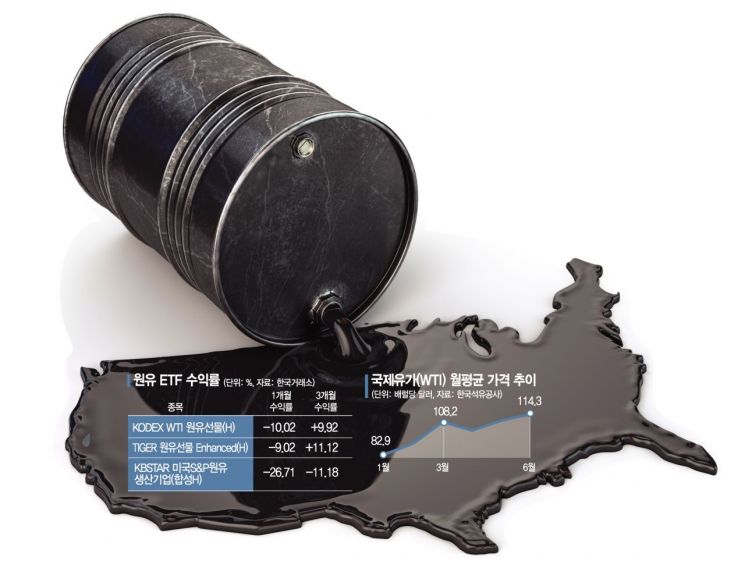
[Asia Economy Reporter Hwang Yoon-joo] Crude oil-related exchange-traded funds (ETFs) that recorded top-tier returns in the first half of this year have recently turned negative over the past month. Crude oil ETFs track futures prices rather than spot prices. As the price of West Texas Intermediate (WTI) crude oil futures in the U.S. declined, their returns also dropped.
According to the Korea Exchange on the 4th, the recent one-month returns of crude oil-related ETFs ranged from -9% to -26%. Specifically, TIGER Crude Oil Enhanced (H) recorded -9.02%, KODEX WTI Crude Oil Futures (H) -10.02%, and KBSTAR U.S. S&P Oil Production Companies (Synthetic H) -26.71%.
This contrasts with the high returns crude oil ETFs showed in the first half of the year. The price of crude oil (WTI) surged 41.6% from $76.08 to $108.82 between January 3 and July 1 this year. Dubai crude oil, which Korea mainly imports, also jumped 27.4% from $83.4 to $106.3. Due to the sharp rise in oil prices, crude oil-related ETFs recorded six-month returns in the 50% range.
The reason crude oil ETFs recorded negative returns despite this situation is that they track futures prices rather than spot prices. Futures prices have stalled over the past month. Jae-seok Ha, head of Asset Allocation/Global ETF team at NH Investment & Securities, explained, "Crude oil ETFs are based on WTI futures prices, which have fallen about 9% over the past month."
Looking at the monthly average WTI prices, they peaked last month. Prices were $82.9 in January, $91.6 in February, $108.2 in March, $101.6 in April, $109.2 in May, and $114.3 in June.
In response, OPEC+ decided on June 30 (local time) to increase production by 648,000 barrels per day starting in August. Although this is below the initially expected supply increase, concerns about economic recession and demand reduction, such as the recent negative GDP growth in the U.S., are seen as factors preventing price rises.
U.S. President Joe Biden's scheduled visit to Saudi Arabia this month is also drawing attention. Although he stated he would not directly request increased production from Saudi Arabia, calming energy prices (crude oil) is essential to control inflation, and Saudi Arabia's cooperation is crucial.
However, some speculate that crude oil prices could surge sharply depending on international geopolitical developments. Recently, international oil prices have been more influenced by diplomatic and security issues than by supply and demand.
There is also a forecast that if Russia counters economic sanctions, crude oil prices could rise three to four times the current level. According to Bloomberg, Natasha Kaneva, head of JP Morgan's International Commodities Analysis division, said, "Russia can cut up to 5 million barrels of crude oil per day," and "in this case, international oil prices could soar to $380 per barrel." If Russia cuts 3 million barrels per day, prices are expected to rise to $190.
Domestic experts maintain a conservative view. Team leader Jae-seok Ha said, "Although there are evaluations that crude oil prices have reached a peak, it is premature to predict the direction of oil prices."
© The Asia Business Daily(www.asiae.co.kr). All rights reserved.
![Clutching a Stolen Dior Bag, Saying "I Hate Being Poor but Real"... The Grotesque Con of a "Human Knockoff" [Slate]](https://cwcontent.asiae.co.kr/asiaresize/183/2026021902243444107_1771435474.jpg)















