[Asia Economy Reporter Changhwan Lee] Domestic insurance companies have a higher proportion of loans to vulnerable borrowers such as multiple debtors and low credit rating borrowers compared to other financial institutions, leading to calls for proactive risk management.
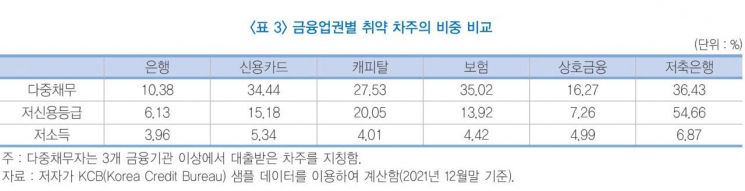
According to the April 4 report titled "Current Status and Evaluation of the Soundness and Loss Absorption Capacity of Insurance Companies' Loan Claims" by the Korea Institute of Finance, the proportion of household loans to multiple debtors, commonly referred to as vulnerable borrowers in the insurance sector, reached 35% as of the end of last year. This figure is approximately 3.4 times, 2.1 times, and 1.3 times higher than banks' 10.4%, mutual finance's 16.3%, and capital companies' 27.5%, respectively.
The proportion of low credit rating borrowers (grades 7 to 10), another category of vulnerable borrowers, was also high at 13.9%, compared to 6.1% for banks and 7.3% for mutual finance. The proportion of low-income borrowers (1st quintile) was 4.42%, higher than banks' 3.96% and capital companies' 4.01%.
The risk of loans to vulnerable borrowers by insurance companies is expected to increase in the second half of the year. This is because the loan principal maturity extension and principal and interest repayment deferral measures for self-employed individuals and small business owners affected by COVID-19 are scheduled to end by the end of September.
According to the Bank of Korea, the outstanding loan balance for self-employed individuals was KRW 960.7 trillion at the end of March, a 40.3% increase compared to the end of 2019, just before the outbreak of COVID-19. Among these, loans to low-income, low-credit self-employed borrowers (vulnerable borrowers) who borrowed from three or more banks increased by 30.6% to KRW 88.8 trillion.
Therefore, it is analyzed that once the COVID-19 financial support ends in September, the issue of loan defaults among vulnerable borrowers in the insurance industry is likely to surface. The report estimates that if full recovery of extended loans to vulnerable borrowers occurs after the end of financial support, the non-performing loan ratio of insurance companies could rise to 0.34%, about 2.6 times the current 0.13%.
Domestic insurance companies are also assessed to be exposed to risks from real estate project financing (PF) loans. The scale of real estate PF loans, considered relatively high-risk and high-return compared to traditional corporate loans, reached KRW 42 trillion as of the end of last year, an increase of 1.8 times compared to the end of 2018.
The average annual growth rate over the past three years was 23.5%, which is 3.9 times the overall average annual loan growth rate of 6% for insurance companies and 2.1 times the 11% average annual growth rate for corporate loans. The outstanding real estate PF loan balances for banks, specialized credit finance companies, and savings banks were KRW 29 trillion, KRW 19.5 trillion, and KRW 9.5 trillion, respectively, smaller in scale than insurance companies.
In particular, while other secondary financial sectors such as savings banks, securities companies, and specialized credit finance companies have set limits on real estate PF loans, insurance companies face no such regulations, raising concerns that real estate PF loans pose credit risk factors.
In fact, on the 30th of last month, Lee Bok-hyun, Governor of the Financial Supervisory Service, at a meeting with insurance company CEOs, stated, "The risk of PF loan defaults has increased due to construction stoppages caused by recent raw material price hikes," and urged, "Strengthen risk management for high-risk assets."
Lee Seok-ho, Senior Research Fellow at the Korea Institute of Finance, said, "Insurance companies have a relatively higher proportion of vulnerable borrowers compared to banks, and real estate PF loans are rapidly increasing," adding, "They should proactively prepare for the realization of potential risks through additional provisioning for loan losses, strengthening stress testing capabilities, and enhancing loss absorption capacity."
© The Asia Business Daily(www.asiae.co.kr). All rights reserved.
![Clutching a Stolen Dior Bag, Saying "I Hate Being Poor but Real"... The Grotesque Con of a "Human Knockoff" [Slate]](https://cwcontent.asiae.co.kr/asiaresize/183/2026021902243444107_1771435474.jpg)















