[DTx Era⑦] Interview with Andy Molnar, DTA CEO
"Advisory Committee to Be Formed for Commercialization and Insurance Coverage"
"Data Is Crucial for Actual Market Entry"
"Localization Is Essential for Global Market Expansion"
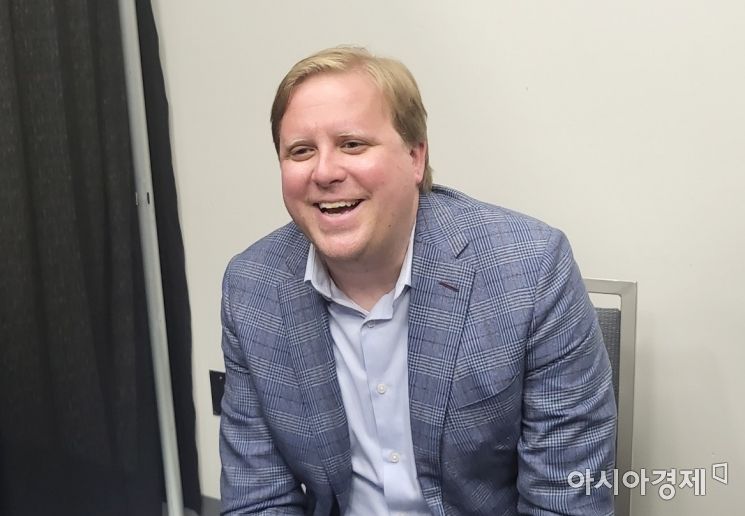
[San Diego (USA) = Reporter Lee Chun-hee] What is the environment of the global digital therapeutics (DTx) market like? Andy Molnar, CEO of the Digital Therapeutics Alliance (DTA), recently met with Asia Economy in San Diego, USA, and emphasized that "data is important for DTx to actually enter the market." He argued that various efforts are needed for commercialization and insurance reimbursement through this. He said that DTx "can encompass cancer, chronic disease treatment and management," and through this, we should create a society where ‘whole-person care’ is possible.
- What is the main focus of DTA?
▲ DTA has three pillars: community building, market pathway, and commercial acceleration. First, we aim to create a community that encompasses patient groups, decision-makers within the government, and DTx developers. The second is how to achieve insurance reimbursement. Germany (Digital Health Applications (DiGA)), France, and the United States have related systems or are creating them. The last, commercial acceleration, involves working together on various tasks for DTx commercialization. Early developers like Pear Therapeutics and Akili Interactive had to do this on their own. We will form an advisory committee that includes insurance companies and others to help with DTx commercialization. This is our main goal this year, and we will start related plans from September.
- What should be considered for DTx market entry?
▲ The important thing is data. Data similar to clinical data must be produced even in actual use. There is particular concern that medical devices may not be used properly. Five years ago, people said, ‘Who would use this?’ but it has changed since COVID-19. There is data showing adherence rates as high as 90%, higher than for drugs.
- Currently, different countries are creating different guidelines for DTx. Is there a plan to create unified global guidelines?
▲ We do. Of course, there are concerns that the perspective on DTx in Germany may differ from that in Korea. However, creating international guidelines is one of our biggest goals.

- DTx development is focused on mental disorders and degenerative brain diseases. Do you think DTx can also cover cancer and chronic diseases?
▲ It can do everything. Companies like Voluntis in France have already released cancer-related DTx, and products for diabetes have been launched by Voluntis and Welldoc. However, it is difficult to say exactly what effects DTx can have related to cancer treatment. But many believe it will help enhance the effects of drugs and so on.
- What is your view on the status of the DTx industry in Asia, including Korea?
▲ I see it as a budding stage. There is a lot of demand, but it does not seem to be moving quickly. I want to emphasize that localization is essential for entering the global market. We live in different cultures. Attention Deficit Hyperactivity Disorder (ADHD) does not need to be treated the same way in Japan and New York, and we cannot be sure that autism DTx developed in the U.S. will have the same efficacy in China. Therefore, it will take a long time to accept DTx from a global perspective, but conceptually, expansion is possible.
- What is the ultimate goal of DTA?
▲ An ecosystem where whole-person care is possible. If diagnosed with cancer, you should be able to receive a list of what will happen next and what measures are needed. If you have diabetes, you track blood sugar with a continuous glucose monitor (CGM), and doctors monitor it to ensure everything is going according to plan. This is already happening, and DTx is one piece to ensure this. Promoting DTx is our goal and mission. Of course, complex issues remain, such as how to deliver DTx to patients, what to do if they do not have or lose a smartphone, and interoperability. But this is ultimately a ‘guiding star.’ It may not be realized within 40 to 50 years, but we must reach it.
▶ Digital Therapeutics Alliance (DTA)
DTA was established in 2017 to spread understanding of DTx and activate the industry. Molnar has been CEO of DTA since June last year. Previously, he was in charge of commercialization at DTx developers such as Pear Therapeutics and Cognoa. In Korea, 11 organizations participate in DTA. Companies such as Welt, Herings, Imocog, Aimed, Bressings, Doctor Diary, S-Alpha Therapeutics, Atomos, and GoQuba Technology, as well as general hospitals like Yonsei Medical Center and Chung-Ang University Hospital, are members.
San Diego (USA) = Reporter Lee Chun-hee spring@
© The Asia Business Daily(www.asiae.co.kr). All rights reserved.



















