 According to recent reports from the Associated Press, a law delaying the start times of public schools in California is expected to take effect as early as this August for the fall semester. The photo is not related to any specific expressions in this article. [Image source=Pixabay]
[Asia Economy Reporter Hwang Sumi] The start times for some public schools in the United States will soon be delayed. The aim is to provide adolescents with more sleep time to improve their academic performance and health. However, some voices oppose the change, citing difficulties such as parents' work schedule adjustments.
According to recent reports from the Associated Press, a law delaying the start times of public schools in California is expected to take effect as early as the fall semester beginning in August. Middle schools must start classes after 8 a.m., and high schools are limited to starting no earlier than 8:30 a.m.
This is based on a law enacted in 2019. According to the LA Times, then-Governor Gavin Newsom signed the bill mandating public schools to delay their start times. However, early morning elective classes known as zero periods and some rural schools are exempt from this provision. The implementation timing was set to the later of either the start of the 2022?2023 school year or the expiration of the schools' three-year collective bargaining agreements with staff.
The law was designed to guarantee more sleep time for sleep-deprived adolescents to enhance academic achievement. According to data from the National Center for Education Statistics for the 2017?2018 school year, the average start time for high schools nationwide was 8 a.m., but 42% of schools began classes earlier. About 10% of schools started before 7:30 a.m.
In this context, delaying school start times through legislation is expected to allow students to get more sleep, which can positively affect not only academic achievement but also physical and mental health. The American Academy of Pediatrics (AAP) has supported delaying school start times, citing research linking later start times and increased sleep with improved health and academic performance. The Centers for Disease Control and Prevention (CDC) recommends 8 to 10 hours of sleep per night for adolescents aged 13 to 18.
On the other hand, there are opposing voices against delaying school start times. Critics argue that changing start times could affect school bus routes, leading to increased costs. Concerns were also raised that parents might not be able to drop off their children before work, and that extracurricular activities might extend late into the evening.
In particular, it has been argued that such changes could disadvantage children from working-class or single-parent families. According to the Associated Press, the nonprofit organization CalMatters stated, "Some families with flexible schedules can easily adapt to the change, but working parents who have to earn a living cannot afford the luxury of starting work later."
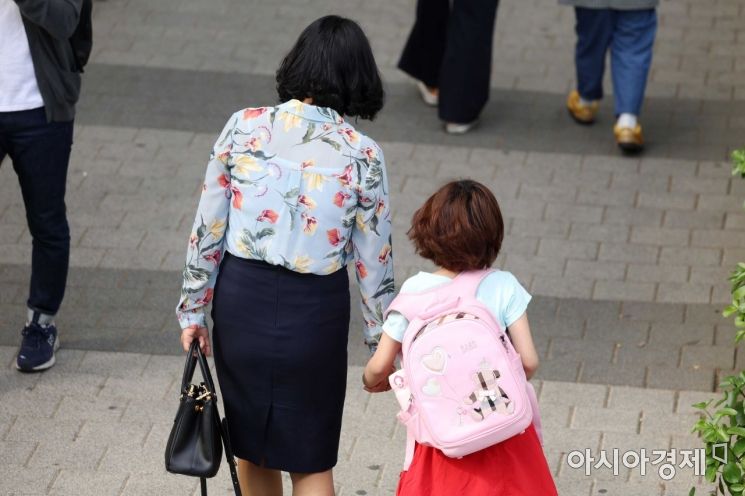 On May 13th, students are arriving at an elementary school in Seoul city./Photo by Mun Ho-nam munonam@
Meanwhile, the issue of sleep deprivation among students is also present in South Korea. According to the 2022 Youth Statistics released by the Ministry of Gender Equality and Family, the average weekday sleep duration for adolescents last year was 7.2 hours. For high school students, it was only 5.8 hours. Additionally, 52.4% of children and adolescents responded that their current sleep time is insufficient. The National Sleep Foundation in the U.S. recommends appropriate sleep durations as follows: 9 to 11 hours for elementary students aged 6 to 13, 8 to 10 hours for middle school students aged 14 to 17, and 7 to 9 hours for high school students aged 18 to 25.
In this regard, during the 8th nationwide simultaneous local elections held last month, there was a debate among candidates over the '9 a.m. school start system.' The 9 a.m. start system delays school start times to ensure students' sleep time and was first implemented nationwide after Lee Jae-jung was elected superintendent of education in Gyeonggi Province in 2014.
At that time, Sung Gi-seon, former president of the Korea Institute for Curriculum and Evaluation and a candidate for Gyeonggi Province superintendent of education, expressed a positive response to the policy, saying, "Through many studies, it has been proven that the 9 a.m. start is more efficient than zero periods in terms of students' health rights, sleep rights, normalization of public education, guaranteeing students' breakfast rights, and pursuit of happiness."
On the other hand, Im Tae-hee, former president of Korea National University of Education and a candidate in the same election, advocated for abolishing the 9 a.m. start system. He explained that he wanted to return autonomy over school start times to the schools. He also pointed out that there was no democratic public opinion gathering process when the 2014 policy was implemented. After winning the election, he plans to promote a policy to allow schools in Gyeonggi Province to decide autonomously on the 9 a.m. start system from the second semester, starting with his inauguration in July.
© The Asia Business Daily(www.asiae.co.kr). All rights reserved.
![Clutching a Stolen Dior Bag, Saying "I Hate Being Poor but Real"... The Grotesque Con of a "Human Knockoff" [Slate]](https://cwcontent.asiae.co.kr/asiaresize/183/2026021902243444107_1771435474.jpg)

















