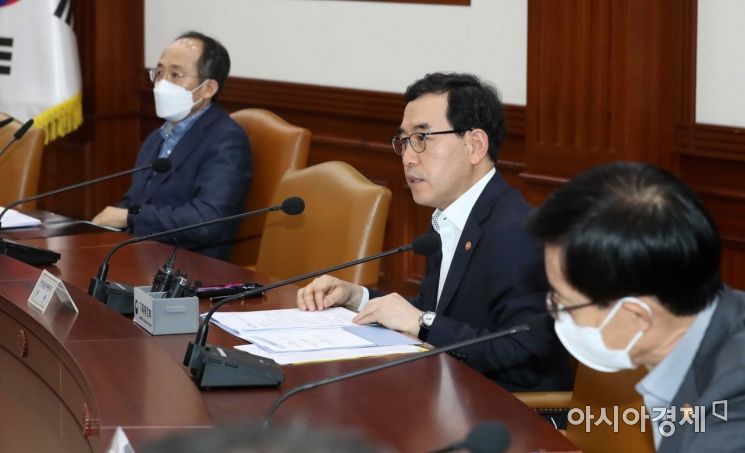
 Minister Lee Chang-yang of the Ministry of Trade, Industry and Energy is speaking at the 3rd Emergency Economic Ministers' Meeting held at the Government Seoul Office in Jongno-gu, Seoul, on the afternoon of the 3rd. Photo by Kang Jin-hyung aymsdream@
[Asia Economy Sejong=Reporter Dongwoo Lee] The government announced that it will expand the scale of trade finance supply to more than 301 trillion won, an increase of 40 trillion won from the initial target set at the beginning of the year. To support companies in diversifying their import sources, import insurance will be supplied at a scale of 1.3 trillion won.
On the 3rd, Minister of Trade, Industry and Energy Chang-yang Lee stated in his opening remarks at the Emergency Economic Ministers' Meeting held at the Government Seoul Office, "Although exports in the first half of the year achieved a record high of 350.3 billion dollars, the import amount of energy such as crude oil and gas increased sharply by 88% compared to the previous year, resulting in a trade deficit in the first half of this year."
In fact, the trade balance in the first half of this year recorded a deficit of 10.3 billion dollars (approximately 13 trillion won) due to the increase in energy import costs, marking the largest deficit on a first-half basis.
Minister Lee explained, "Under a serious recognition of the situation, the government plans to establish a pan-government export response system and make every effort to improve the trade balance. First, the government will expand the annual supply scale of trade finance to more than 301 trillion won, an increase of 40 trillion won from the initial target."
To support companies in diversifying their import sources, import insurance will be supplied at a scale of 1.3 trillion won. Additionally, by expanding the scope of application for import exchange rate fluctuation insurance and providing exchange rate fluctuation management consulting by six regional zones, the government plans to minimize companies' uncertainties and difficulties caused by high exchange rates.
Logistics support will also be strengthened. Minister Lee emphasized, "Until international maritime freight rates stabilize, we will continuously deploy more than four temporary vessels per month, and increase the dedicated shipping space for small and medium-sized enterprises by 50 TEU per week (1 TEU equals one 20-foot container) compared to the current supply." He added, "We will also actively consider expanding financial support to assist small and medium-sized enterprises and mid-sized companies with logistics costs."
The government plans to expand support for overseas marketing and participation in exhibitions to increase export opportunities for Korean companies. In line with the post-COVID-19 re-opening trend,
starting in the second half of the year, support will be provided for over 2,500 export companies to participate in overseas exhibitions. The government will also strengthen customized marketing for key markets through export consultation meetings held both online and offline, and by dispatching more than 80 trade delegations.
Minister Lee said, "To devise measures to resolve the trade deficit, a 'Public-Private Joint Export Situation Review Meeting' will be held on the 13th, where major industry associations, the Korea International Trade Association, export support organizations, and industry-specific export situations will be diagnosed and discussed to find ways to eliminate the trade deficit and strengthen industrial competitiveness."
He added, "We will establish comprehensive countermeasures against the trade deficit, including semiconductor industry support measures to be announced in July, strategies to foster related advanced industries, and energy demand efficiency plans to be formulated soon."
© The Asia Business Daily(www.asiae.co.kr). All rights reserved.
![Clutching a Stolen Dior Bag, Saying "I Hate Being Poor but Real"... The Grotesque Con of a "Human Knockoff" [Slate]](https://cwcontent.asiae.co.kr/asiaresize/183/2026021902243444107_1771435474.jpg)















