3rd Anniversary Survey on the Enforcement of the Workplace Harassment Prevention Act... March 23.5% → June 29.6%
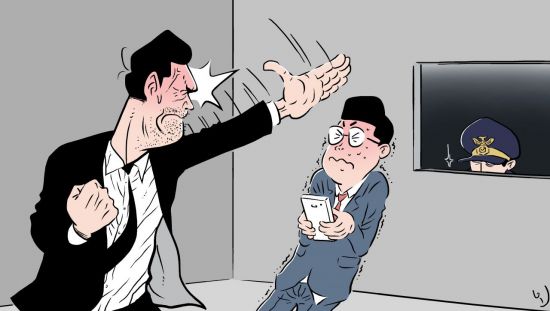 Photo by Asia Economy DB
[Asia Economy Reporter Moon Hyewon] With the lifting of social distancing measures, workplace bullying has been found to have increased.
Civil society group Workplace Bullying 119 and the Public Coexistence Solidarity Fund commissioned Embrain Public, a public opinion research firm, to conduct an online survey from the 10th to the 16th of last month targeting 1,000 workers nationwide aged 19 and older, based on the economically active population employment ratio. The survey (sampling error 95%, confidence level ±3.1%p) results were released on the 3rd. This survey was conducted to mark the third anniversary of the enforcement of the Workplace Bullying Prevention Act.
According to the survey results, in the March survey when social distancing was still in place, the rate of experiencing workplace bullying such as assault, verbal abuse, insults, defamation, ostracism, discrimination, and unfair orders within one year was 23.5%. However, in last month’s survey after social distancing was eased, this figure rose by 6.1 percentage points to 29.6%.
In particular, the bullying experience rate among service workers increased by 12.1 percentage points from 22.1% in the March survey to 34.2%.
However, compared to September 2019, right after the Workplace Bullying Prevention Act was enacted, when the overall workplace bullying experience rate was 44.5%, it has decreased by 14.9 percentage points.
The bullying experience rate varied somewhat by gender and job security. The workplace bullying experience rates for male regular workers and female regular workers were 22.4% and 28.4%, respectively, while for male non-regular workers and female non-regular workers, the rates were 35.2% and 38.8%, respectively.
Among the 296 respondents who said they had experienced workplace bullying, 11.5% (multiple responses allowed) said they had even considered extreme measures. 25.3% said they protested individually or with colleagues. However, the majority, 67.6%, endured or pretended not to know, and 23.6% quit their jobs.
Only 29 people reported workplace bullying. Most responded that they did not report because they felt "the situation would not improve even if they responded" or "they feared disadvantages in personnel matters."
Among those who reported bullying, 24.1% said they actually faced retaliatory treatment such as personnel retaliation. 51.7% said the company did not properly fulfill its obligations to investigate bullying and protect victims.
The most common perpetrators of workplace bullying were "supervisors who are not executives" at 36.8%. "Employers such as representatives, executives, and management" accounted for 24.7%, and "colleagues of similar rank" were 22.6%.
In workplaces with fewer than five employees, the perpetrators were "employers" in 33.3% of cases and "relatives of employers" in 10.3%, higher than the average among workers. However, workplaces with fewer than five employees are not subject to the Labor Standards Act and thus fall outside the scope of the Workplace Bullying Prevention Act.
Workplace Bullying 119 stated, "More than 10 million workers, including at least 3.5 million workers in workplaces with fewer than five employees and about 7 million non-wage workers such as special employment workers and freelancers, are not covered by the Workplace Bullying Prevention Act," and argued, "It is necessary to revise the Enforcement Decree of the Labor Standards Act so that they can protect human dignity in the workplace."
© The Asia Business Daily(www.asiae.co.kr). All rights reserved.
![Clutching a Stolen Dior Bag, Saying "I Hate Being Poor but Real"... The Grotesque Con of a "Human Knockoff" [Slate]](https://cwcontent.asiae.co.kr/asiaresize/183/2026021902243444107_1771435474.jpg)














