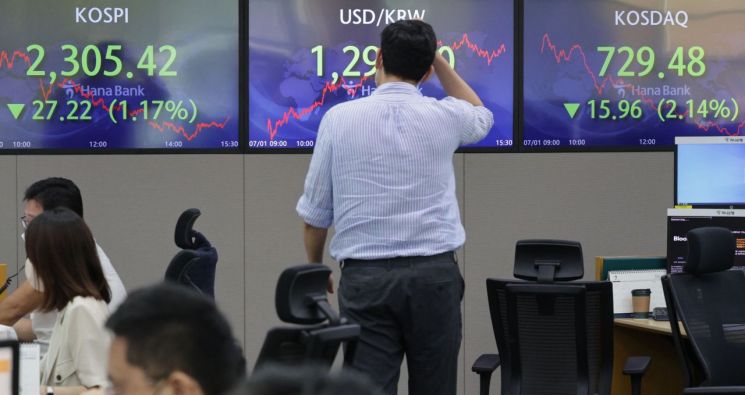
[Asia Economy Reporter Lee Jung-yoon] As concerns over an economic recession caused the KOSPI to plunge sharply, the trading volume of individual investors hit its lowest level in 2 years and 4 months.
According to the Korea Exchange on the 3rd, the average daily trading volume (average of buying and selling amounts) of individuals in the KOSPI market last month was 4.3009 trillion won. This is the lowest monthly average since February 2020, when the daily average trading volume was 3.702 trillion won. Compared to 11.0418 trillion won in June last year, it decreased to about one-third in just one year.
In January last year, when the KOSPI surpassed the 3,000-point mark for the first time in history, the average daily trading volume of individuals soared to 17.2994 trillion won. Until the first half of last year, the trading volume fluctuated between 9 trillion and 12 trillion won, but it started to decline in the second half as the stock market showed sluggish performance.
This year, until May, the monthly trading volume fluctuated between 5 trillion and 6 trillion won, but in June, as the KOSPI plunged to new lows amid the impact of soaring U.S. inflation and the "Giant Step" (a 0.75 percentage point hike in the base interest rate at once), it dropped to the 4 trillion won range, sharply dampening individual investors' sentiment.
The KOSPI fell sharply by 21.66% in the first half of this year, from 2,977.65 at the end of last year to 2,332.64 on the 30th of last month. This is the largest decline in 32 years since 1990 (-22.31%) for the first half of the year. Also, the KOSPI's performance in the first half of this year ranks second to last among the major 20 countries (G20) stock market indices.
Investor sentiment in the KOSDAQ market also froze rapidly. Last month, the average daily trading volume of individuals in the KOSDAQ market was 6.0533 trillion won, the lowest since February 2020 (5.5885 trillion won).
The signs of weakened investor sentiment are also detected in investor deposits, which act as standby funds for the stock market, and in the balance of credit loans used to buy stocks on margin.
According to the Korea Financial Investment Association, investor deposits stood at about 57.3649 trillion won at the end of last month, down by about 10 trillion won from 67.5307 trillion won at the end of last year. The balance of credit loans decreased by more than 5 trillion won in half a year, from 23.0886 trillion won at the end of last year to 17.8683 trillion won at the end of last month.
Credit balance refers to the amount individuals have invested in stocks through margin trading but have not yet repaid. When a stock price decline is expected, deleveraging (repayment or reduction of borrowing) reduces the balance.
Also, if the maintenance ratio of collateral for margin trading falls below the standard due to a stock price drop, forced liquidation through a margin call reduces the balance. As the stock market plunged last month, the balance decreased by nearly 4 trillion won in one month, from 21.5646 trillion won at the end of May.
© The Asia Business Daily(www.asiae.co.kr). All rights reserved.
![Clutching a Stolen Dior Bag, Saying "I Hate Being Poor but Real"... The Grotesque Con of a "Human Knockoff" [Slate]](https://cwcontent.asiae.co.kr/asiaresize/183/2026021902243444107_1771435474.jpg)















