Basic Livelihood Security Standards Limited to Minimum Living Expenses
Working May Lead to Exclusion from Benefits
Calls for Adjusting Median Income and Abolishing Support Obligation System
[Asia Economy Reporter Park Jun-yi] "Monthly rent 350,000 won, mobile phone bill 50,000 won, landline 22,000 won, medical expenses 150,000 won... I have to live for a month with the remaining 400,000 won."
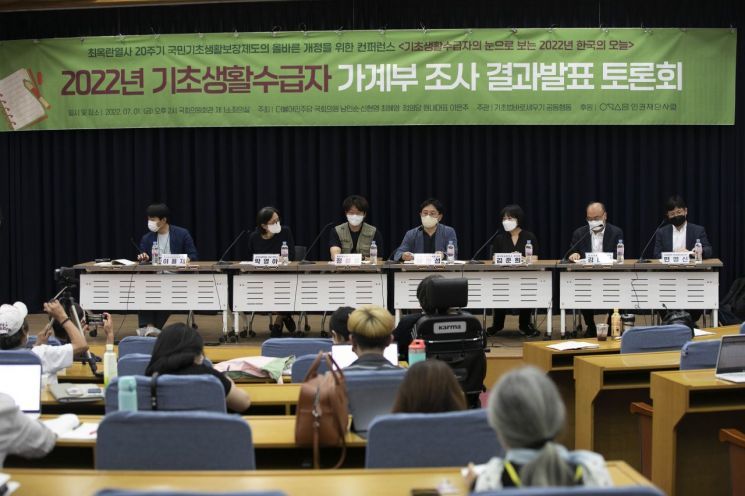
At the 'Conference for the Proper Revision of the National Basic Livelihood Security System on the 20th Anniversary of Choi Ok-ran' held at the National Assembly Members' Office Building on the 1st, the household accounts of basic livelihood security recipients were revealed. Their household accounts were densely filled with medical expenses, housing costs, and basic living expenses within an income of about 1 to 1.5 million won per month. The survey participants confessed that after deducting living expenses each month, their funds were tight or insufficient, so they could hardly enjoy cultural activities or special outings.
Kim Jun-hee, a researcher at the Korea Urban Research Institute who presented the survey results, pointed out, "Among the 25 households participating in the household account survey, 11 households spend beyond their income, and more than half of their income is spent on food and housing costs," adding, "Most recipient households receive benefits because they cannot work due to health reasons, but they cannot maintain a healthy diet, become isolated due to social disconnection, and lose hope for a better future. These issues need to be addressed." The event was hosted by Democratic Party members Nam In-soon, Shin Hyun-young, Choi Hye-young, Justice Party member Lee Eun-joo, and the Coalition for Correcting the Basic Law.
Where Does the Basic Livelihood Security System Stand?
Twenty years ago in 2001, the late Choi Ok-ran, a female person with disabilities and a basic livelihood security recipient, took her own life while pointing out the flaws in the Basic Livelihood Security System. In her resolution at the time, she expressed hope that "the National Basic Livelihood Security System would truly become a system that guarantees the minimum livelihood for poor people like me." However, after more than 20 years, the living standards of recipients remain unchanged. Although prices have risen, the median income standard for benefit payments is low, and the eligibility criteria are strict.
Activists gathered at the conference pointed out the blind spots of the Basic Livelihood Security System experienced in daily life. Cha Jae-seol, a basic livelihood security recipient, said, "I participate in the work-maintenance type self-support project, but the wages are too low," adding, "Even though I am working, living on less than 1.5 million won a month is tough. If I become a general recipient, I have to manage living expenses with 580,000 won excluding rent."
Excluded from Benefits if Working: The Burdensome Support Obligation System
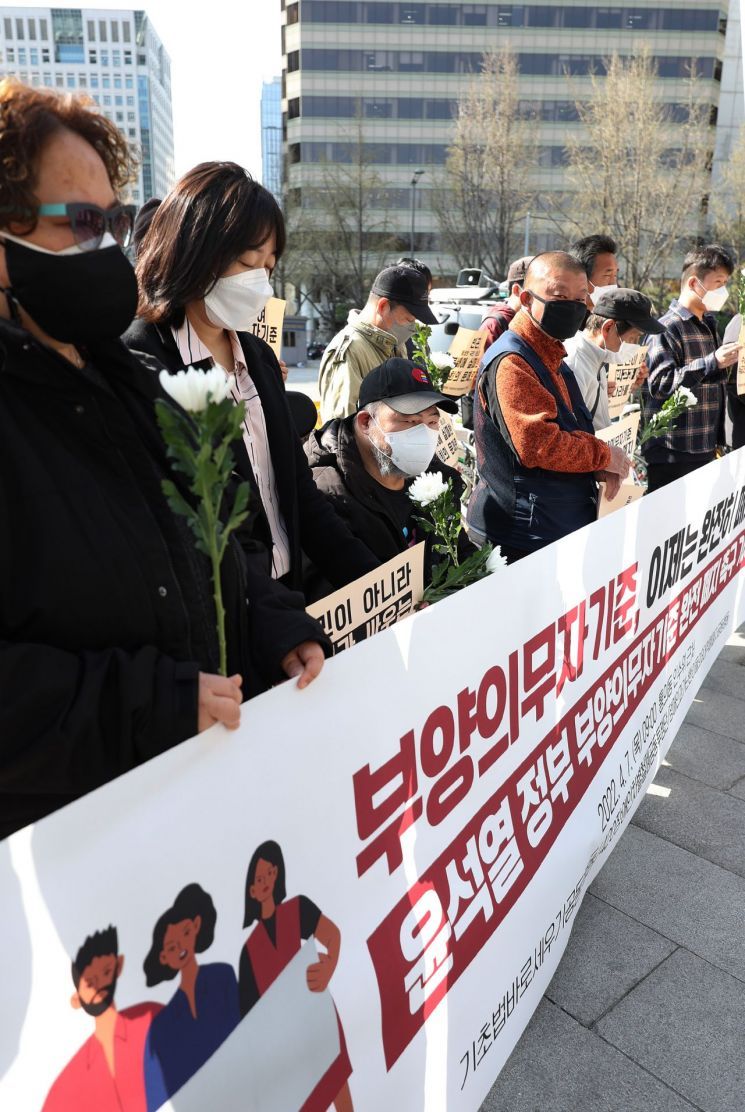
To qualify as a basic livelihood security recipient, one must simultaneously meet the 'income recognition standard' and the 'support obligation standard.' The income recognition standard means that the household's recognized income must be below a certain percentage of the median income: 30% or less for livelihood benefits, 40% or less for medical benefits, 46% or less for housing benefits, and 50% or less for education benefits. Additionally, under the support obligation standard, there must be no support obligor who is a direct lineal relative or spouse, or if there is, they must lack the ability to support or be unable to provide support.
The problem is that if the income exceeds these standards, the applicant is disqualified from receiving benefits. If it is difficult to live on the low support amount and one earns income through part-time work, it becomes difficult to receive income support. Because of this, recipients often do not work even if they can, maintaining their livelihood within the support amount. Cha said, "It would be good to solve the insufficient support problem by working a little, but that is difficult," adding, "If a day laborer is found to have worked, the support amount is cut accordingly. It makes you think it's better not to work than to lose benefits."
It was also pointed out that the support obligation condition makes it difficult to even apply for the support system. Although the Moon Jae-in administration abolished the support obligation standard, it has only been applied to housing and education benefits within the Basic Livelihood Security System so far. The government announced last year that it abolished the support obligation standard for livelihood benefits, but applicants still have to prove the income and property levels of their direct family members, so it remains only a 'relaxation.' The task left by the 2014 'Songpa Three Mothers Incident' has not been fully resolved even after eight years.
Seomgang (a pseudonym), who attends a homeless night school, said, "When I visited the community center to apply for conditional benefits, they asked if I knew the last time and contact information of my mother, and I said I had contacted her until September last year," adding, "I was told I could not apply for benefits because I had been in contact within the past year."
Kkeoksoe (a pseudonym) also pointed out the limitations, saying, "I applied for benefits during a period when I had to rest from work, but I was disqualified due to the support obligor's property and income standards," adding, "My mother's property or income has nothing to do with our household. We only occasionally check in by phone to see if she is alive or not."
The Yoon Government, Which Promises 'Walking with the Vulnerable,' Needs Parliamentary Attention
During the last presidential election, President Yoon Seok-yeol pledged to gradually raise the livelihood benefit eligibility standard to 35% of the median income. He also promised to provide an additional 100,000 won to households with elderly, disabled, or children among recipients and exclude this amount from the recognized income. Presidential candidate Ahn Cheol-soo also pledged to completely abolish the support obligation standard as one of his campaign promises.
However, it is uncertain whether such policies will be implemented under the current administration. In the case of livelihood benefits, completely abolishing the support obligation standard would likely require securing additional funding.
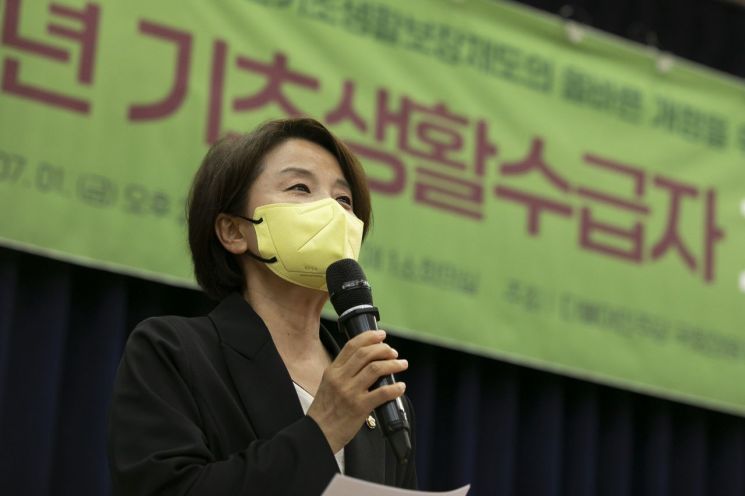
Parliamentary attention is also needed for system improvement. Democratic Party member Nam In-soon, who attended the discussion, said, "We must actively promote the abolition of the support obligation standard for the non-recipient poor in medical benefits," adding, "We will continue to work diligently to ensure this is deeply discussed and passed at the parliamentary level."
Justice Party member Lee Eun-joo also stated, "Realizing the median income standard is a very important issue," and added, "We need to create a reasonable poverty line, provide better benefits to recipients, and improve the system to reflect diverse life realities."
© The Asia Business Daily(www.asiae.co.kr). All rights reserved.
![Clutching a Stolen Dior Bag, Saying "I Hate Being Poor but Real"... The Grotesque Con of a "Human Knockoff" [Slate]](https://cwcontent.asiae.co.kr/asiaresize/183/2026021902243444107_1771435474.jpg)

















