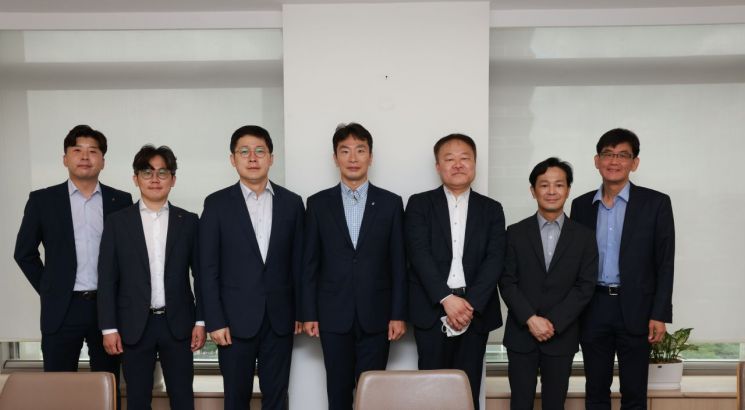
 From the left, Byeongjin Hwang, Researcher at NH Investment & Securities; Moonjun Jang, Researcher at KB Securities; Seokmo Yoon, Head of Research Center at Samsung Securities; Bokhyun Lee, Governor of the Financial Supervisory Service; Hakgyun Kim, Head of Research Center at Shin Young Securities; Seokgil Park, Economist at JP Morgan Chase; Seoktae Oh, Economist at Societe Generale. Photo by Financial Supervisory Service
[Asia Economy Reporter Lee Jung-yoon] Lee Bok-hyun, Governor of the Financial Supervisory Service (FSS), met with financial market experts to assess the current market situation and discuss response measures. Governor Lee emphasized expanding communication to detect potential risks and decided to reflect the discussions in supervisory tasks.
At the 'Market Experts Meeting' held at the Financial Supervisory Service on the 1st, Governor Lee stated, "Although the FSS is doing its best to prepare for crises, the market situation is rapidly changing, and it is impossible to know where and how new triggers will emerge." He added, "An unprecedented 'perfect storm' seems to be approaching, and it may have already begun."
During the meeting, Governor Lee sought opinions on ▲ supply chain instability and increased demand following the COVID-19 pandemic ▲ interest rate hikes by the U.S. Federal Reserve (Fed) and others ▲ potential economic slowdown and recession due to interest rate increases ▲ increased volatility such as sharp stock price fluctuations during events ▲ prolonged Ukraine war, among other issues.
In response, market experts evaluated that "recent inflation results from both demand and supply factors, making it difficult to control through monetary tightening alone," advising that "interest rate hikes could burden economic agents due to increased debt." They also explained, "The Ukraine war is accelerating deglobalization, and the resulting changes in the global value chain could act as a double-edged sword for the domestic market."
Additionally, they identified three risk factors for the domestic stock market in the second half of this year: international oil prices (inflation), exports, and corporate earnings uncertainty.
However, market experts projected that "considering Korea's sound external payment capacity, solid economic fundamentals, and corporate earnings, the stock market's downside support is strong." They added, "Taking into account the country's credit rating relative to interest rate competitiveness and the nature of inflowing funds, even if a Korea-U.S. interest rate inversion occurs, the possibility of a sharp outflow of foreign capital is limited." They further noted, "Economic slowdown and asset price adjustments due to monetary policy normalization are inevitable stabilization costs. In the long term, the economic benefits of stabilizing inflation expectations and enhancing monetary policy credibility will be greater. Although Korea is expected to face increased interest expenses during the monetary normalization process, it is assessed that this will not be large enough to undermine overall financial stability."
© The Asia Business Daily(www.asiae.co.kr). All rights reserved.
![Clutching a Stolen Dior Bag, Saying "I Hate Being Poor but Real"... The Grotesque Con of a "Human Knockoff" [Slate]](https://cwcontent.asiae.co.kr/asiaresize/183/2026021902243444107_1771435474.jpg)















