The Korean Society for Obesity Announces Results of 'Survey on Awareness and Status of Obesity Treatment'
78% of General Hospitals Say "Health Insurance Coverage for Obesity Medications Is Necessary"
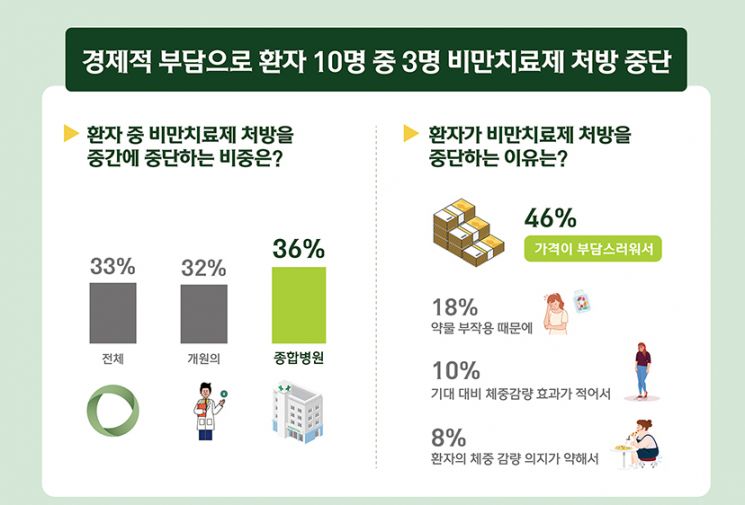 The Korean Society for the Study of Obesity's survey on "Perceptions and Current Status of Obesity Treatment."
[Asia Economy Reporter Kim Young-won] It was found that 3 out of 10 obese patients stop taking prescribed medications due to the financial burden. More than 60% of medical professionals responded that "insurance coverage for obesity treatment drugs is necessary."
On the 1st, the Korean Society for the Study of Obesity announced the results of a "Survey on Experts' Perceptions and Current Status of Obesity Treatment." The survey was conducted from May 27 to June 24, targeting 774 doctors nationwide.
According to the society's survey, although obesity is a disease that requires treatment, medical professionals face difficulties in allocating consultation time and prescribing medications due to the lack of related medical fees in actual clinical settings. Obese patients also sometimes discontinue treatment due to cost concerns.
The survey results showed that 8 out of 10 medical professionals answered that obesity is a "disease requiring specialized treatment." The rate of recognizing the necessity of obesity treatment was higher in general hospitals at 96%, compared to 77% in private clinics. Additionally, 84% responded that "obesity is a chronic disease requiring long-term and continuous treatment." The response rate was 98% for general hospitals and 80% for private clinics.
Despite the high awareness of the need for obesity treatment, more than 80% of medical professionals reported difficulties in treating obesity. The main reason for the difficulty was "longer consultation time compared to general diseases but no medical consultation fee," which accounted for 46%, the highest response rate. This was followed by "no established fees for counseling and education on nutrition and exercise," and "high cost of obesity drugs causing a significant financial burden for uninsured patients," each at 16%.
Drug therapy is mainly used for obesity treatment, but 30% of patients discontinued drug treatment due to cost burdens. 89% responded that drug treatment (obesity treatment drugs) is administered along with physician consultation during obesity treatment, and 42% of all respondents said drug treatment is the most effective for obesity treatment. It was found that 33% of patients discontinue obesity treatment drug prescriptions. Among the reasons for discontinuation, 46% responded that "patients feel a financial burden due to non-coverage by health insurance."
In this survey, more than 60% of respondents agreed on the need for insurance coverage for obesity treatment, counseling, and drugs across various items. Especially in general hospitals, 78% responded that insurance coverage for drug treatment is necessary. The main reason for the need for coverage was "high cost burden makes it difficult to start and maintain drug prescriptions," which accounted for 76%, the highest response rate. This was followed by "lack of insurance coverage for obesity drugs leads to insufficient active treatment, increasing the incidence of chronic diseases such as hypertension and diabetes," at 67%.
Lee Jae-hyuk, director of the Public Relations Committee of the Korean Society for the Study of Obesity, said, "Because obesity treatment requires a multifaceted and continuous approach including consultation, drug prescription, nutrition, exercise, and behavior, insurance coverage related to obesity treatment should be implemented so that patients can receive continuous and effective treatment."
© The Asia Business Daily(www.asiae.co.kr). All rights reserved.
![Clutching a Stolen Dior Bag, Saying "I Hate Being Poor but Real"... The Grotesque Con of a "Human Knockoff" [Slate]](https://cwcontent.asiae.co.kr/asiaresize/183/2026021902243444107_1771435474.jpg)















